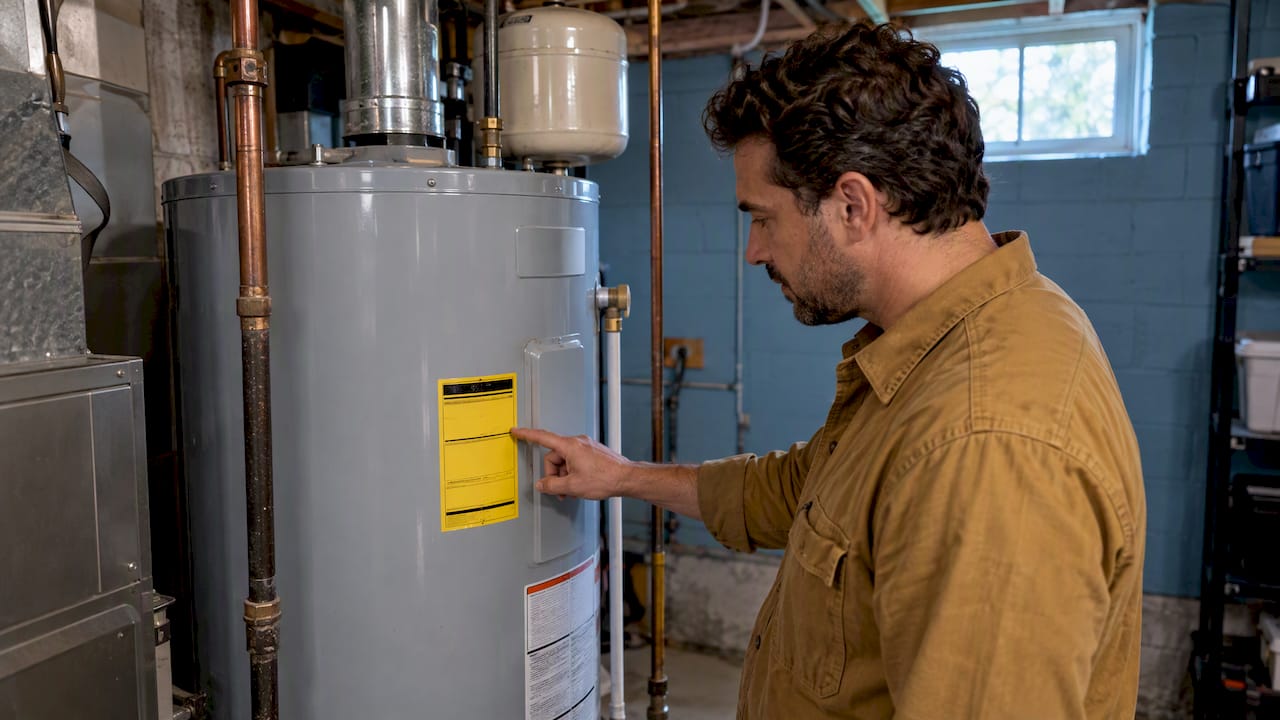
The right water heater size comes from your household’s busiest hour, not from a headcount alone. For a tank, match the first-hour rating (FHR) to the hot water you use at peak. For a tankless unit, match the flow rate (GPM) and temperature rise to the fixtures that run at the same time. Most homes land somewhere between 30 and 100 gallons of tank, and the steps below show you how to find your number.
We install and replace water heaters for homes and businesses in Burbank, so we see the cost of a wrong size every week: lukewarm showers on one side, wasted energy on the other. This guide gives you the method we use, with the math written out.
TL;DR
- Tank sizing starts with people in the home, but the number that matters is the first-hour rating, which should equal or slightly exceed your peak-hour demand.
- As a rough guide, A. O. Smith lists 30 to 40 gallons for up to two people, 40 to 50 for three, 50 to 75 for four and 75 to 100 for five.
- Tankless sizing uses two inputs: peak flow in GPM and temperature rise. The heating capacity needed in BTU/h is 500 x GPM x temperature rise.
- Too small means cold water mid-shower. Too big means higher energy costs. Gas line size, venting and electrical capacity can also limit what you can install.
Table of Contents
- Why size matters more than most people think
- Tank size by household: the quick answer
- The number that matters: first-hour rating
- How to calculate your peak-hour demand
- Sizing a tankless water heater
- Tank or tankless: what sizing tells you
- Fuel, space and code: size is not the only limit
- Sizing for businesses and larger buildings
- Our perspective: size to the way you live
- When to have a plumber size it for you
- Common sizing mistakes to avoid
- FAQ
- Sources
Why size matters more than most people think
A water heater that is too small runs out of hot water at the worst moments. One that is too large costs more to run, according to A. O. Smith’s sizing guide: an undersized unit can leave water running cold, and an oversized one raises energy costs.
Size also decides what else must change. A bigger gas unit may need a different vent. A tankless unit may need a larger gas line. An electric unit needs the right breaker and wire. That is why sizing belongs at the start of a replacement plan, not at the end. If you are still weighing the type, our overview of the main types of water heaters for your home is a good place to begin.
Tank size by household: the quick answer
If you want a fast starting point, use household size. These ranges come from A. O. Smith’s guide.
| Household | Typical tank capacity |
|---|---|
| Up to 2 people | 30 to 40 gallons |
| 3 people | 40 to 50 gallons |
| 4 people | 50 to 75 gallons |
| 5 people | 75 to 100 gallons |
Treat the table as a starting range, not a verdict. Two homes with four people can have very different needs. One has a soaking tub and teenagers who shower back to back. The other has two adults, two small kids and showers spread through the day. The next sections show how to tell which one you are.
Is a 30-gallon water heater enough for 3 people?
Usually not. The published range for three people is 40 to 50 gallons. A 30-gallon tank can work for one or two people with modest habits, and it can work for three only if showers are staggered and the unit recovers quickly. If your household is three and you already notice the water fading, the tank is too small for your pattern.
Is a 50-gallon water heater enough for 4 people?
Often yes, since 50 gallons sits at the low end of the 50 to 75 gallon range for four people. It works well when showers are spread out and you run the dishwasher and laundry at other times. If you have a large soaking tub, or everyone showers within the same hour, look at the upper part of the range or at a unit with a higher FHR.
Is a 40-gallon water heater enough for a family of 5?
Almost never. The published range for five people is 75 to 100 gallons, nearly double. A 40-gallon tank in a five-person home means running out of hot water on busy mornings. If space is tight, a high-recovery unit or a tankless system sized for peak flow can solve it without a giant tank, as the sections below explain.
The number that matters: first-hour rating
For tank-style heaters, the primary sizing metric is the first-hour rating: the total volume of hot water a unit can deliver in one hour, counting both the stored volume and how fast it heats more. ENERGY STAR defines it as an estimate of the maximum gallons a storage water heater can supply in an hour that begins with the tank fully heated. You will find it on the yellow EnergyGuide label.
This is why tank gallons alone mislead. A 50-gallon unit with a strong burner or elements can have a higher FHR than a 60-gallon unit that heats slowly. When you compare models, compare the FHR, not just the capacity on the front.
How to calculate your peak-hour demand
The method is simple. Picture your busiest hour of the day, usually weekday mornings. Add up the hot water used in that hour. Then choose a unit whose FHR equals that number or exceeds it slightly. A. O. Smith’s guidance uses about 20 gallons per shower and 7 gallons per dishwasher cycle for this estimate.
Step by step
- List every hot water use in your busiest hour: showers, baths, dishwasher, washing machine, kitchen and bathroom sinks.
- Assign gallons to each use. Start with 20 per shower and 7 per dishwasher cycle. Add your own figures for baths and laundry if they overlap.
- Add them up. That total is your peak-hour demand.
- Compare it with the FHR on candidate models. Pick one at or a little above your demand.
Worked example: a family of four
On a typical weekday morning, three people shower between 6:30 and 7:30 and the dishwasher runs after breakfast.
- 3 showers x 20 gallons = 60 gallons
- 1 dishwasher cycle = 7 gallons
- Peak-hour demand = 67 gallons
You want an FHR of about 67 to 75 gallons. A 50-gallon tank with a modest FHR may fall short here, while a 50-gallon unit with a high recovery rate or a 65 to 75 gallon unit would fit. This is why a family of four can need a 50-gallon tank in one house and a 75-gallon in another.
How many people can shower with a 60-gallon water heater?
There is no single answer, because the shower count depends on the FHR, not the 60 gallons. Using the 20-gallon-per-shower planning figure, you can do the math yourself. A 60-gallon unit with an FHR of around 70 gallons covers about three showers in one hour. A model with an FHR near 90 covers about four. Water usage is higher if your showerheads flow more than average or if people take long showers, so check the label on the exact model. Dishwasher or laundry use in the same hour reduces the number.
Sizing a tankless water heater
Tankless units heat water as it flows, so they have no stored volume. Tank units use FHR. Tankless units are sized by flow rate in GPM at a given temperature rise. You need two numbers.
Step 1: Peak flow rate
Add the flow of every fixture that might run at once. Typical residential figures from the Building America Solution Center are 0.8 to 2.5 GPM for showers and 1.0 to 6.0 GPM for filling a bathtub. Whole-house severe-peak demand in a home typically runs 6.0 to 8.0 GPM. Be honest about simultaneous use. If two showers and a kitchen faucet could run together, count all three.
Step 2: Temperature rise
Temperature rise is the temperature you want at the tap minus the temperature of the incoming cold water. Incoming water varies by location and season, and the coldest months matter most for sizing. If you lack local data, DOE recommends assuming 50°F. If you want 120°F water and your incoming water is 50°F, your rise is 70°F.
Step 3: Required heating capacity
The formula is BTU/h = 500 x GPM x temperature rise.

Worked example: two showers at 2.0 GPM each plus a faucet at 1.0 GPM gives 5.0 GPM. With a 70°F rise:
500 x 5.0 x 70 = 175,000 BTU/h
That is the heat the water needs. Gas units list an input rating, and because no heater is perfectly efficient, check the manufacturer’s data for each model’s maximum flow at your temperature rise. The Building America tool uses the same inputs to return the input heat value you should match or exceed.
If the numbers exceed what one unit delivers, two units in parallel is the usual answer.
Cold climates and winter
A unit that delivers 5 GPM at a 50°F rise might deliver far less at a 75°F rise. If your winter groundwater is cold, size for the coldest time of year, not for July. Lower flow in winter is the most common tankless complaint we hear, and it is almost always a sizing issue rather than a defective unit.
Tank or tankless: what sizing tells you
Sizing is also a way to choose between the two. Tanks cope with a short burst of high use because they hold hot water in reserve. Tankless units cope with long, steady use, but they are limited by flow. A household with a single bathroom and light use often does well with a mid-size tank. A large household with long overlapping use may prefer tankless or a larger tank with high recovery.
Tankless also changes the building. Retrofits are often held back by the cost of upsizing the typical 1/2-inch gas line and swapping the standard B vent for PVC or stainless-steel vent pipe. Before you decide, read how tankless water heaters work and save money and review the line-item tankless installation costs. Gas capacity is covered in our gas line plumbing guide.

Fuel, space and code: size is not the only limit
A correctly sized unit still has to fit the house. Check these before you buy.
- Venting. A larger gas input changes vent requirements. See our guide to the water heater venting code and the 2 to 10 roof rule.
- Gas supply. Bigger burners draw more gas, which can mean a larger line. Our overview of residential gas line installations explains the options, and the gas shut off valve requirements cover the code side.
- Electrical capacity. Electric tanks and tankless units need the right breaker and wire for their wattage. An electric unit that exceeds your panel’s spare capacity is not a fit, however well it matches your demand.
- Physical size. A bigger tank is taller or wider. Closets and alcoves set a hard limit.
As we say in the next section, these are the points where a licensed plumber earns the visit.
Sizing for businesses and larger buildings
Commercial sizing follows the same logic with more fixtures and stricter documentation. For tankless units in commercial or larger residential projects, you identify all coincident draws, and total GPM is the sum of simultaneous flows. Maricopa County plan review guidance gives showers at 1.5 to 2.5 GPM and faucets at 0.5 to 1.5 GPM as example ranges, and it says that when the calculation gives a fraction of a unit in parallel, you round up to the next whole number.
Large buildings can differ again. Central heat pump water heaters in multifamily buildings must account for the main hot water load and the circulation loop’s maintenance loads. Commercial heat pump systems often use large storage tanks and run 16 to 20 hours a day to recharge, so they follow different logic from gas-fired boilers. Restaurants, salons, gyms and offices each have their own peak pattern. Read our guide to water heaters for commercial buildings if you manage one.
Our perspective: size to the way you live
We get asked “how big a tank do I need” more than almost any other water heater question, and the honest answer starts with a different question: what does your worst hour look like?
The most common mistake we see is copying the size of the old heater. The old unit may have been chosen for a smaller household, or may have been wrong from day one. A replacement is the chance to fix that. The second mistake is going bigger “to be safe.” An oversized tank costs more to buy, more to keep hot and takes more floor space, and it rarely solves a problem that was really about recovery rate.
We walk through the same short checklist on every job: count the peak-hour fixtures, check the FHR or the GPM and temperature rise, look at the gas line or electrical panel, then confirm the venting and the space. Where a home or business has unusual demand, such as a big soaking tub, a rental with several units or a commercial kitchen, we size to that demand and tell you what it means for cost. Our water heater replacement checklist lists what to have ready before we visit.
— Serghei
When to have a plumber size it for you
The formulas above get you close. A professional visit is worth it when:
- You are switching between tank and tankless, or between gas and electric.
- Your gas line, vent or electrical panel may not support the unit you want.
- You manage a rental, office or commercial property with several fixtures in use at once.
- Your current heater runs out of hot water and you cannot tell whether the size or the unit is at fault.
If your heater is failing, our water heater replacement signs guide helps you tell a size problem from an age problem. Regular upkeep also keeps a correctly sized unit performing as rated, which is covered in our water heater maintenance tips.
PSV Plumbing is based in Burbank, licensed and insured, and handles water heater installation and maintenance for homes and commercial properties. We provide free quotes. Tell us how many people live in the home, what fixtures you run at once and what you have now, and we will recommend a size and explain why. See our water heater services or start from psvplumbinginc.com.
Common sizing mistakes to avoid
- Sizing by tank gallons alone. Compare FHR, not just capacity.
- Ignoring winter. Cold incoming water raises the temperature rise and cuts tankless output.
- Counting only average use. Size for the busiest hour, not the average day.
- Forgetting future changes. A new bathroom, a larger family or a remodel adds demand. If a remodel is coming, plan the heater with it. Our bathroom plumbing services cover the fixtures that drive that demand.
- Oversizing to be safe. It adds cost and standby energy use without fixing a recovery problem.
FAQ
What size water heater do I need for a family of four?
The published range is 50 to 75 gallons for a four-person household. Where you land depends on your peak hour. Three showers and a dishwasher cycle in the same hour come to roughly 67 gallons using the 20- and 7-gallon planning figures, so look for an FHR near that number.
How do I calculate water heater size for a tankless unit?
Add up the GPM of fixtures that run at the same time, then subtract your coldest incoming water temperature from your desired tap temperature to get the temperature rise. Multiply 500 x GPM x temperature rise to get the BTU/h needed. Then check that the unit can deliver that flow at your rise.
Is a bigger water heater always better?
No. A larger tank costs more to heat and takes more space, and oversizing raises energy costs. The better target is an FHR that meets your peak-hour demand, not the largest tank that fits.
Can I size a water heater myself?
You can get a solid estimate with the steps above. The part to confirm with a licensed plumber is whether your gas line, venting, electrical supply and space support that unit, since those can change what you can install.
Sources
- What Size Water Heater Is Right for You? (A. O. Smith)
- Water Heater Key Product Criteria (ENERGY STAR)
- How to Size a Water Heater for Any Building (CalcRig)
- DHW Instantaneous Sizing (Building America Solution Center)
- Assessment of a Hybrid Retrofit Gas Water Heater (U.S. DOE)
- Hot Water Supply Requirements, Plan Review (Maricopa County)
- Central Heat Pump Water Heaters for Multifamily Buildings (Building America Solution Center)
Leave a Reply