TL;DR:
- Residential gas piping uses four main materials: black steel, CSST, copper, and yellow MDPE or HDPE. Proper material choice, sizing, and certified installation are essential for safety, code compliance, and system efficiency.
Types of residential gas line installations refer to the different materials and configurations used to safely distribute gas within a home. The four primary piping materials are black steel, CSST, copper, and yellow MDPE/HDPE, each governed by standards such as the International Residential Code (IRC) and IGEM guidelines. Choosing the wrong material for your location or application creates pressure problems, code violations, and real safety hazards. This guide breaks down every major gas piping type so you can make a confident, code-compliant decision before work begins.
1. What are the types of residential gas line installations?
Residential gas piping systems use one of four core materials, and each serves a distinct purpose based on location, pressure requirements, and local code. Black steel pipe handles heavy-duty indoor runs. CSST routes gas through tight spaces. Copper works for above-ground interior work in permitted jurisdictions. Yellow MDPE or HDPE goes underground from the meter to the home. Understanding which material fits which job is the first decision every homeowner and contractor must make.

The right material choice also depends on whether the line is a service line, a branch line, or an appliance connector. Each of these is a distinct segment of your home’s gas network, and they carry different sizing and material requirements under the IRC 2024 and related plumbing compliance standards.
2. Black steel pipe: the standard for indoor main lines
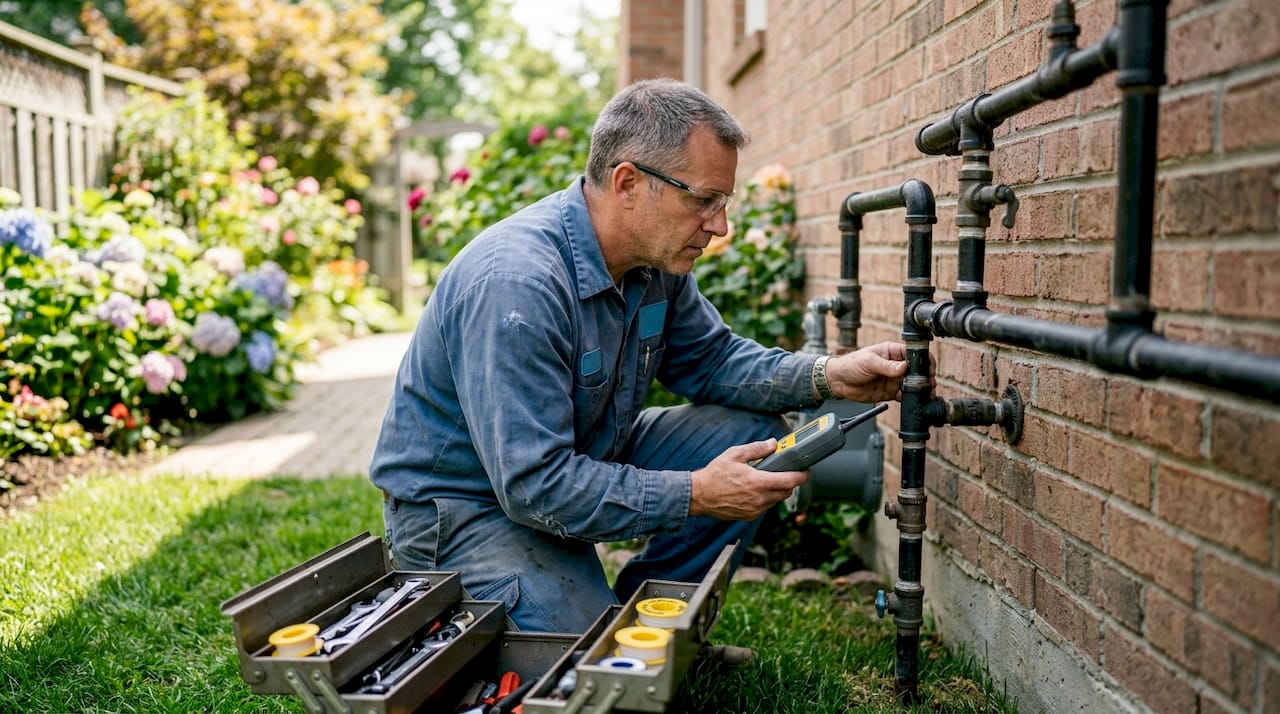
Black steel pipe is the most common material for indoor residential gas main lines. It is heavy gauge, heat resistant, and built to last decades without degrading under normal gas pressure. Contractors use it for large-diameter runs, high-demand appliance feeds, and any above-ground application where durability matters most.
Key characteristics:
- Threaded connections sealed with yellow gas-rated PTFE tape (not white plumbing tape)
- Available in standard diameters from ½ inch to 2 inches for residential use
- Suitable for both natural gas and propane systems
- Not appropriate for underground burial without protective coating
Pro Tip: Always use yellow PTFE tape on black steel threads. Joint quality is the most common failure point in gas installations, and the wrong tape type will not seal gas-rated fittings properly.
Black steel pipe requires threading tools and experienced hands. Improper thread cuts create micro-gaps that leak over time. For any main line work, professional installation is the only safe path.
3. What is CSST and when should you use it?
Corrugated Stainless Steel Tubing (CSST) is a flexible, factory-coated gas pipe designed to route through walls, floors, and tight residential spaces without multiple fittings. Its flexibility makes it faster to install than rigid black steel in complex floor plans. CSST is now one of the most widely used materials in new residential construction across the United States.
Key characteristics:
- Flexible enough to bend around framing without elbow fittings
- Requires fewer joints, which reduces potential leak points
- Must be electrically bonded per IGEM/UP/2 and most local jurisdiction codes
- Installation requires manufacturer-certified training, not general plumbing experience
Pro Tip: CSST bonding is not optional. Lightning-induced electrical surges can arc through unbonded CSST and burn through the tubing wall. Confirm your installer holds manufacturer certification before any CSST work begins.
Improper CSST bonding is one of the most cited code violations in residential gas inspections. The material itself is safe when installed correctly. The risk comes entirely from skipping the bonding and earthing steps that certified installers know to follow.
4. How and when is copper piping used in residential gas installations?
Copper pipe is permitted for interior, above-ground gas installations in many U.S. jurisdictions, particularly for natural gas. It is lighter than black steel and easier to work with in finished spaces. However, its use is more restricted than most homeowners realize.
Key characteristics:
- Half-hard (R220) and hard-drawn (R250) types are both used in gas applications
- Jointing methods include soldering and compression fittings
- Not suitable for direct burial underground due to corrosion risk from soil moisture
- Some jurisdictions prohibit copper for LP (propane) gas entirely; always verify local code
Copper pipes that must pass through a wall cavity or short underground section require sleeving and sealing to prevent moisture contact. Yellow MDPE is the correct material for any true underground run. Copper’s role in residential gas systems is specifically limited to interior, above-ground branch lines where local code allows it. If you are planning a pipe upgrade, confirming copper’s code status in your area is the first step.
5. What are polyethylene pipes and why are they used underground?
Yellow MDPE and HDPE pipes are the standard for underground gas service lines. These flexible plastic pipes resist corrosion from soil contact, moisture, and ground movement. Their yellow color coding identifies them as gas-rated under standards including BS EN 1555, and they are the only material approved for direct burial in most residential gas systems.
Key characteristics:
- Flexible and resistant to corrosion, unlike steel or copper
- Yellow color identifies gas-rated pipe at a glance
- Connected using electrofusion fittings, which heat-fuse the joint for a leak-free bond
- Transition fittings connect underground MDPE to above-ground rigid piping at the entry point
Minimum burial depths by location:
| Location | Minimum depth |
|---|---|
| Garden or landscaped area | 375 mm |
| Under a driveway | 450 mm |
| Under a road or paved surface | 600 mm |
Underground burial depth standards exist to protect pipe integrity from ground traffic, frost, and excavation damage. Heat-fused HDPE joints eliminate mechanical failure points entirely, making electrofusion the preferred connection method for underground runs. Any homeowner adding a gas appliance in a detached structure, like a garage or workshop, will need a properly buried MDPE service line to get there safely.
6. Galvanized steel pipe: a legacy material with limits
Galvanized steel pipe was common in older residential gas systems but is rarely specified for new installations today. The zinc coating that protects it from rust can flake off over time inside the pipe, creating debris that clogs appliance valves and regulators. Most current codes permit galvanized steel for gas only in specific above-ground applications.
Homeowners with older homes may still have galvanized gas lines in place. These systems are not automatically unsafe, but they warrant a professional inspection to confirm integrity. Replacing aging galvanized lines with black steel or CSST is a standard upgrade that improves both safety and flow performance.
7. Flexible appliance connectors and their limits
Flexible appliance connectors are the short, corrugated metal lines that connect a gas appliance to the rigid piping outlet in the wall or floor. They are not a substitute for properly sized rigid piping. Flexible connectors are limited to a maximum length of 6 feet and must connect a fixed pipe outlet to a movable appliance only.
Using a flexible connector to extend a gas line across a room is a code violation and a fire hazard. These connectors are designed for the final connection point only, such as behind a gas range or dryer. They also have a service life and should be replaced if kinked, corroded, or more than 10 years old. For guidance on identifying connector issues, the gas leak safety guide from Psvplumbinginc covers what to look for before calling a technician.
8. Gas pipe sizing: the calculation that ties it all together
Proper gas pipe sizing requires a full system load calculation, not a rough estimate. Undersized pipe causes pressure drops, delayed ignition, and inefficient combustion. Oversized pipe wastes material and can cause pressure regulation problems at the appliance level.
IRC 2024 Section G2413 requires sizing based on three factors: total BTU demand of all connected appliances, total developed pipe length from meter to appliance, and an allowable pressure drop of typically 0.5 inches water column. Contractors often apply a 50% adder to account for fitting resistance, but code-compliant sizing requires engineering tables, not rules of thumb. Adding a gas range, tankless water heater, or outdoor grill to an existing system without recalculating the full load is one of the most common mistakes homeowners make. Every new appliance changes the demand on the entire network.
Pro Tip: Before adding any gas appliance, ask your contractor to run a full BTU load calculation for the whole system. A single new appliance can push an undersized line past its safe capacity.
For appliance-specific guidance on how gas demand affects your home systems, the appliance repair blog at Express Xpert covers common performance issues that trace back to gas supply problems.
Key takeaways
Residential gas piping safety depends on matching the right material to the right location, sizing the system to total appliance demand, and meeting code requirements at every joint and connection point.
| Point | Details |
|---|---|
| Material selection is location-specific | Use black steel or CSST indoors, yellow MDPE underground, and copper only where local code permits. |
| CSST requires certified installation | Bonding and earthing are mandatory; skip them and you create a lightning surge hazard. |
| Pipe sizing must use BTU calculations | Total appliance load, pipe length, and pressure drop all factor into correct sizing under IRC 2024. |
| Flexible connectors have strict limits | Maximum 6 feet, fixed pipe to movable appliance only; never use them to extend a gas line. |
| Joint quality determines system safety | Heat-fused HDPE and properly taped steel threads eliminate the most common leak points. |
What I’ve learned after years of watching homeowners get gas lines wrong
Most homeowners treat gas piping as a single material decision. Pick a pipe, run it, done. That mindset causes the majority of the problems I see in the field.
The real issue is that a residential gas system is a network. Every appliance you connect draws from the same supply. When you add a tankless water heater to a system sized for a furnace and a gas range, you have not just added an appliance. You have changed the pressure dynamics for every other appliance on that line. I have seen furnaces short-cycle and ranges fail to ignite, and the root cause was always an undersized line that nobody recalculated after the last addition.
The second mistake is treating CSST like it is the same as black steel, just easier to route. It is not. CSST requires manufacturer-certified training, specific bonding procedures, and a different inspection mindset. A general plumber who has never been trained on CSST bonding is not qualified to install it, regardless of how many years of experience they have.
My honest advice: before any gas line work, get a professional gas line inspection to understand what your current system can actually handle. Then size the new work from there. The material choice matters, but the system-wide calculation matters more.
— Serghei
Gas line installation services from Psvplumbinginc
Psvplumbinginc handles residential gas line installations from the meter to the appliance, including new runs, system upgrades, and full BTU load calculations to confirm your system meets current code. Every project follows IRC 2024 requirements and local jurisdiction standards, with licensed and insured technicians on every job.

Whether you need a new gas line for a kitchen remodel, an outdoor grill connection, or a full system inspection before adding appliances, Psvplumbinginc delivers reliable work with transparent pricing. Start with the pipe repair workflow guide to understand what a professional installation process looks like from start to finish. Contact Psvplumbinginc for a free quote and let us make sure your gas system is sized, installed, and inspected correctly.
FAQ
What are the main types of residential gas piping materials?
The four primary materials are black steel pipe, CSST, copper, and yellow MDPE/HDPE. Each serves a specific location and application, with MDPE used exclusively for underground runs.
Can copper pipe be used for gas lines in a home?
Copper pipe is permitted for interior, above-ground gas installations in many jurisdictions, but it cannot be buried directly underground due to corrosion risk from soil moisture.
How deep must a residential gas line be buried?
Burial depth varies by location. Garden areas require a minimum of 375 mm, driveways require 450 mm, and roads or paved surfaces require at least 600 mm.
What is CSST and does it require special installation?
CSST is a flexible stainless steel gas tubing used to route gas through walls and tight spaces. It requires electrical bonding and earthing per code, and installation must be performed by a manufacturer-certified technician.
How is gas pipe sizing determined for a home?
Gas pipe sizing follows IRC 2024 Section G2413 and requires calculating total BTU demand for all connected appliances, total pipe length, and an allowable pressure drop of typically 0.5 inches water column.
Leave a Reply