TL;DR:
- Regular maintenance can extend a water heater’s lifespan up to 15 years.
- Monthly inspections, annual flushing, and safety checks prevent costly failures.
- Proper setup and safety measures ensure efficient operation and reduce safety hazards.
A neglected water heater can fail without warning, leaving you with cold showers, water damage, and repair bills that easily climb into the thousands. Most tank-style water heaters have an 8 to 12-year lifespan with proper care, yet the majority of homeowners never touch them after installation. The good news is that a few simple habits each year can cut your energy bills, prevent breakdowns, and squeeze years of extra life from your unit. This article walks you through every key maintenance task, from monthly visual checks to annual safety tests, so you can protect your home and your budget.
Table of Contents
- Start with safety: Clear the area and conduct monthly inspections
- Flush out sediment: How and why to perform tank flushes
- Adjust thermostat settings for safety and savings
- Crucial annual checks: T&P valve, insulation, and pro inspections
- Timeline and summary table: Maintenance tasks at-a-glance
- The overlooked benefits of consistent water heater maintenance
- Need help? Professional water heater and plumbing services
- Frequently asked questions
Key Takeaways
| Point | Details |
|---|---|
| Flush tank regularly | Annual flushing removes sediment and lengthens heater life. |
| Inspect and clear area | Monthly checks catch leaks or corrosion early and keep your system safe. |
| Optimal temperature set | Keep thermostat at 120°F for safety, savings, and scale reduction. |
| Insulate to save energy | Wrap your tank and pipes to cut heat loss and lower bills. |
| Know when to hire a pro | Call an expert for T&P valve, anode rod replacement, or stubborn problems. |
Start with safety: Clear the area and conduct monthly inspections
Now that you know why maintenance matters, let’s begin with essential safety checks and visual inspections. The foundation of any good maintenance routine is keeping the area around your water heater clean and clear. For gas models especially, storing boxes, cleaning products, or any flammable materials nearby creates a real hazard. Make it a habit to keep that space open.
Gas water heaters also rely on vents and flues to safely expel combustion gases. A blocked or corroded flue can allow carbon monoxide to build up inside your home. Schedule an annual vent and flue check as part of your maintenance checklist for homeowners to stay ahead of this risk.
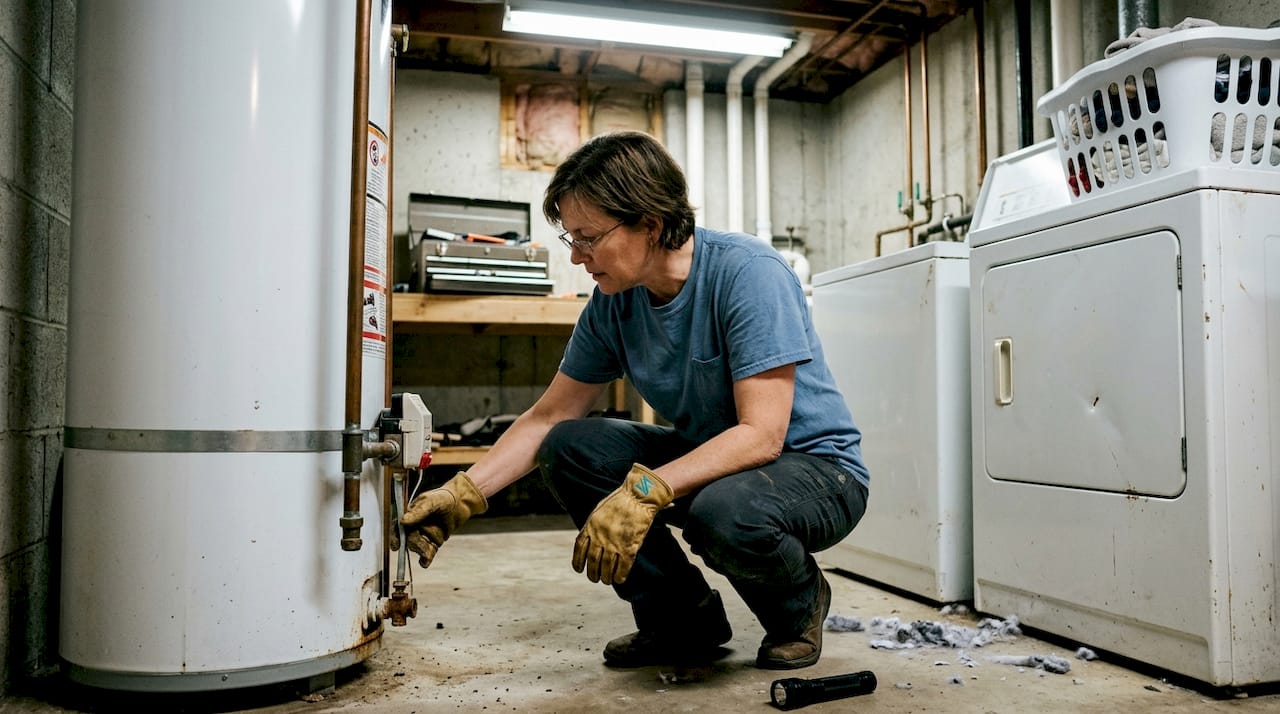
Each month, take two minutes to look your unit over. A quick visual inspection often catches small problems before they become expensive ones. According to the EPA WaterSense guidelines, you should check monthly for:
- Leaks or moisture around the tank base
- Rust or discoloration on the tank surface
- Corrosion around valves, pipes, and connections
- Loose fittings or dripping pressure relief valves
Remember: Spotting a small drip or rust patch early could save you from a full tank failure. Our plumbing inspections for damage prevention resource explains exactly what warning signs to watch for and when to act fast.
With a well-maintained heater, you can realistically extend its lifespan from the average 8 to 12 years up to 15 years. That kind of return comes from consistent, simple attention, not expensive repairs.
Flush out sediment: How and why to perform tank flushes
Once everything is clear and inspected, it’s time to remove the most common silent killer of water heaters: sediment. Over time, minerals from your water supply settle at the bottom of the tank. You’ll often hear this as popping or rumbling sounds when the heater is running. That noise is heat pushing through hardened sediment layers, and it’s wasting energy every time it happens.
The EPA recommends flushing your tank annually to remove sediment buildup, which reduces efficiency and shortens lifespan. If you live in a hard water area, flush every six months for best results.
Here’s how to flush your water heater step by step:
- Turn off the power supply or set the gas valve to pilot mode.
- Shut off the cold water inlet at the top of the tank.
- Connect a garden hose to the drain valve at the bottom of the tank.
- Run the other end of the hose to a safe drain or outside area.
- Open the drain valve and let the tank empty completely.
- Turn the cold water back on briefly to flush remaining sediment.
- Close the drain valve, refill the tank, and restore power.
Learning about the types of water heaters you own matters here because tankless models don’t require flushing in the same way, though they do need descaling.
Pro Tip: If this is your first time flushing or you’re unsure about the drain valve condition, bring in a professional. Old valves sometimes fail to reseal properly after draining, which can cause a slow leak. Investing in professional maintenance tasks for that first flush is always worth it.
Adjust thermostat settings for safety and savings
With your tank flushed, optimizing the heater’s temperature comes next for both cost and safety. Many water heaters ship from the factory set to 140°F, which is higher than most households need. This wastes energy and increases the risk of scalding.

The EPA’s recommended setting is 120°F, which balances safety, energy efficiency, and scale prevention. Research from the University of Florida EDIS confirms that 120°F minimizes both scald risk and scale buildup, while higher settings sharply increase both hazards. You save roughly 6% on water heating costs for every 10°F you reduce the temperature.
To adjust: locate the dial on your heater (usually behind an access panel on electric models, or near the gas valve on gas models), set it to 120°F, and check the actual output at your tap after a few hours.
Setting the temperature too high causes:
- Burns and scalding, especially for children and elderly residents
- Accelerated scale buildup inside the tank, shortening its life
- Higher energy bills with no added benefit
Setting it too low carries its own risks:
- Bacterial growth (Legionella bacteria thrive below 120°F)
- Lukewarm or insufficient hot water during peak use
For an additional boost in efficiency, consider pairing a correct thermostat setting with plumbing upgrades for efficiency, such as low-flow fixtures that reduce how hard your heater has to work.
Crucial annual checks: T&P valve, insulation, and pro inspections
After fine-tuning the temperature, focus on annual priorities that will protect your home and wallet. These tasks don’t take long, but skipping them can lead to serious and costly consequences.
Testing the temperature and pressure (T&P) relief valve is non-negotiable. This valve is a critical safety device. If pressure or temperature inside the tank climbs too high, the T&P valve opens and releases water to prevent an explosion. Per the EPA WaterSense guidelines, test it annually by lifting the lever briefly. Water should discharge into the drain pipe. If nothing comes out, or if it drips constantly afterward, replace it immediately.
Insulating your tank and pipes is a simple upgrade that pays back quickly. The EPA reports that insulating the first 6 to 10 feet of hot and cold water pipes, along with the tank itself, reduces standby heat loss by 7 to 25%, which translates directly into lower energy bills.
Here’s a quick breakdown of what you can do yourself versus what’s best left to a licensed plumber:
| Task | DIY-friendly | Call a pro |
|---|---|---|
| Visual inspection | Yes | Not required |
| Tank flushing | Yes (experienced) | First time or old valve |
| Thermostat adjustment | Yes | If panel is sealed |
| T&P valve replacement | No | Always |
| Anode rod inspection/replacement | No | Always |
| Vent/flue inspection (gas) | No | Always |
| Annual safety inspection | Optional | Strongly recommended |
Pro Tip: The anode rod is a sacrificial metal rod inside your tank that prevents corrosion. Most homeowners don’t know it exists until the tank rusts from the inside out. A licensed pro should inspect and replace it every three to five years.
Timeline and summary table: Maintenance tasks at-a-glance
With all main tasks covered in detail, here’s a summary you can save for quick reference. Staying consistent with these tasks is what separates a water heater that lasts 8 years from one that serves you reliably for 15.
According to water heater research from EDIS, regular maintenance can cut energy bills by 10 to 30% and extend the standard 8 to 12 year lifespan to 12 to 15 years. That’s real money saved over time.
| Frequency | Task | Key benefit |
|---|---|---|
| Monthly | Visual inspection for leaks, rust, corrosion | Catch problems early |
| Annually | Flush tank to remove sediment | Improve efficiency, extend life |
| Annually | Test T&P relief valve | Prevent dangerous pressure buildup |
| Annually | Check vent/flue (gas models) | Prevent carbon monoxide risk |
| Every 1-2 years | Check insulation on tank and pipes | Reduce standby heat loss |
| Every 3-5 years | Anode rod inspection/replacement | Prevent internal corrosion |
| As needed | Adjust thermostat to 120°F | Save energy, prevent scalding |
Your quick priority list:
- Clear and inspect the area monthly
- Flush sediment every 12 months (or every 6 months in hard water areas)
- Test the T&P valve once a year
- Keep the thermostat at 120°F
- Use our complete plumbing maintenance checklist to track every task
Even spending 30 minutes a year on these steps adds years of reliable performance and hundreds of dollars in savings.
The overlooked benefits of consistent water heater maintenance
We’ve worked with hundreds of homeowners over the years, and the pattern is always the same: people call us after their water heater fails, not before. The tank that had been humming along in the basement for 14 years finally gave out, and suddenly there’s water on the floor and no hot water for the family.
Here’s the honest truth most homeowners don’t hear until it’s too late. Maintenance isn’t just about preventing breakdowns. It’s about knowing your system is safe. A tested T&P valve and a clean tank mean you’re not living with a slow-building hazard behind that utility room door.
The reactive approach, waiting for something to go wrong, almost always costs more. Emergency service calls, water damage remediation, and rushed replacements add up fast. A proactive mindset, taking 30 minutes each year to run through the full plumbing maintenance checklist, delivers confidence and real savings.
We also encourage homeowners to look at efficiency-boosting plumbing upgrades as a natural next step once their maintenance routine is solid. Small investments in the right direction add up to a home that runs reliably and costs less to operate year after year.
Need help? Professional water heater and plumbing services
If you’re ready to maximize your water heater’s lifespan or need a professional’s touch, here’s where to turn next. At PSV Plumbing Inc, we handle annual flushes, anode rod replacements, T&P valve testing, insulation upgrades, and full safety inspections for both residential and commercial systems.

Not sure which type of water heater you have or whether it’s time for an upgrade? Our guide to water heater types is a great starting point. For businesses managing larger systems, we also offer commercial water heater servicing tailored to your building’s demands. Reach out to our local plumbing experts for a free quote and let’s keep your system running safely and efficiently for years to come.
Frequently asked questions
How often should I flush my water heater?
Flush your water heater once a year to remove sediment and protect efficiency. If you have hard water, flush every six months to prevent faster buildup.
What temperature should my water heater be set at?
Set your water heater thermostat to 120°F. This temperature balances safety, energy savings, and performance without the risks that come with higher or lower settings.
Is water heater maintenance safe to do myself?
Flushing and visual inspections are generally safe for experienced homeowners, but tasks like anode rod replacement, T&P valve issues, and first-time flushes are best handled by a licensed plumber.
What’s the expected lifespan of a water heater with regular maintenance?
With consistent care, your water heater can last 12 to 15 years, compared to the 8 to 12 years typical of neglected units.
How can I tell if my water heater needs professional attention?
Call a pro if you notice leaks, persistent rumbling noises, failure to heat water, or a T&P valve that won’t function properly after testing.
Leave a Reply