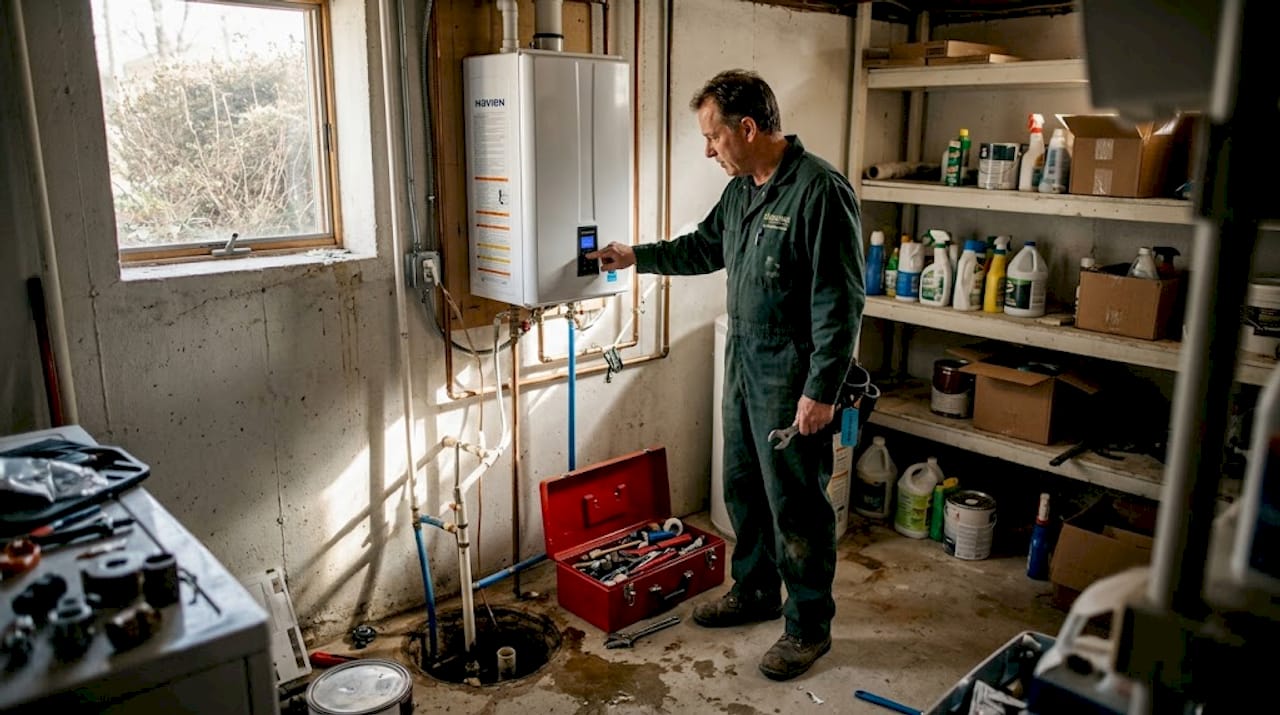
TL;DR:
- Tankless water heaters provide on-demand hot water, eliminating standby energy loss. They are 24% to 34% more efficient than traditional tank systems, especially in low-usage homes. Proper sizing, maintenance, and professional installation are essential for optimal performance and cost savings.
Most homeowners assume hot water always comes from a large storage tank sitting in a utility closet. That assumption costs real money every month. Tankless water heaters heat water directly without a storage tank, delivering hot water only when you need it. This shift from stored to on-demand heating is what drives the energy savings and lower utility bills that make tankless systems so appealing. Whether you manage a single-family home or a multi-unit property, this guide walks you through how these systems work, how much you can save, and what to consider before upgrading.
Table of Contents
- How tankless water heaters work
- Energy efficiency and cost savings
- Sizing, installation, and homeowner considerations
- Choosing the right model: gas vs. electric vs. condensing
- Why tankless water heaters are not a one-size-fits-all solution
- Next steps: professional advice and installation support
- Frequently asked questions
Key Takeaways
| Point | Details |
|---|---|
| Instant hot water | Tankless heaters deliver hot water on demand without storing it. |
| Energy savings | Homes switching to tankless see 24%-34% greater efficiency and lower bills. |
| Proper sizing matters | Sizing for peak demand is crucial to avoid flow issues and maximize performance. |
| Maintenance required | Annual descaling prevents efficiency loss due to mineral buildup. |
| Expert installation essential | Professional advice and skilled setup ensure the benefits of tankless water heating. |
How tankless water heaters work
Now that we’ve set the stage, let’s clarify exactly how tankless water heaters operate. A tankless unit, also called an on-demand water heater, produces hot water only when a tap or appliance requests it. There is no stored reservoir of water waiting to be reheated. When you turn on the hot water faucet, cold water travels through a pipe into the unit, where a heat exchanger rapidly warms it before it reaches your fixture.
This on-demand process relies on a few key components working together. The heat exchanger is the core of the system, transferring energy from a gas burner or electric element directly to the flowing water. Sensors detect when water begins moving through the unit and signal the burner or element to activate. Controls let you set your target temperature and monitor performance. These components work seamlessly so the heating cycle begins and ends automatically, every time.

Tankless water heaters deliver 2 to 5 gallons of hot water per minute depending on the model. That flow rate has real practical meaning. A standard shower uses about 2 gallons per minute, so a single unit can typically handle one or two fixtures running at the same time.
Here is a quick look at how the types of water heaters compare in terms of core operation:
| Feature | Tankless (on-demand) | Tank storage |
|---|---|---|
| Water stored | No | Yes (30–80 gal) |
| Energy use | Only when running | Continuous (standby) |
| Hot water supply | Continuous | Limited by tank size |
| Unit size | Compact, wall-mounted | Large floor unit |
| Lifespan | 20+ years | 10–15 years |
Pros of on-demand heating:
- No standby energy loss
- Endless hot water supply
- Longer equipment lifespan
- Space-saving installation
Cons of on-demand heating:
- Higher upfront cost
- Limited flow when multiple fixtures run simultaneously
- May require gas line or electrical upgrades
“Tankless water heaters can provide a continuous flow of hot water, but users sometimes notice a short lag before hot water arrives at distant fixtures while the unit ramps up.” This is worth factoring in when planning fixture placement, especially in larger homes. The complete homeowner’s guide covers this in more detail for those weighing their options.
Energy efficiency and cost savings
You know how tankless works. Now let’s see why these systems are so efficient and cost-effective compared to traditional setups. The biggest energy drain in a conventional tank system is something called standby loss. This is the heat that escapes from a stored tank of water while it sits idle, forcing the heater to cycle on repeatedly just to maintain temperature. You pay for that energy even when nobody uses hot water.
Tankless systems eliminate standby loss entirely. Because the unit only activates when you need hot water, you stop paying for heat that no one actually uses.
Tankless heaters are 24% to 34% more efficient for households using less than 41 gallons per day, and 8% to 14% more efficient for higher-use households. The efficiency rating used to measure this is the Uniform Energy Factor (UEF). The higher the UEF, the less energy the unit wastes. Top-performing tankless models reach a UEF of up to 0.96, meaning nearly all the energy input converts directly to usable hot water.
| Comparison point | Tankless | Tank storage |
|---|---|---|
| UEF rating | Up to 0.96 | 0.67–0.70 typical |
| Standby loss | None | Present daily |
| Est. annual savings | Up to 40% | Baseline |
| Space required | Minimal | Significant |
Savings vary depending on how your household uses hot water. Here is where you see the biggest returns:
- Low-use homes (under 41 gal/day): savings can reach up to 40%
- High-use homes (over 86 gal/day): savings are more modest but still meaningful
- Properties with multiple units: point-of-use tankless heaters at each location reduce pipe heat loss
- Homes in warm climates: incoming water temperature is higher, so the heater works less
If you are evaluating plumbing upgrades for efficiency, a tankless heater is one of the highest-impact changes you can make. You should also explore heat pump alternatives if your climate supports them, as those can push efficiency even further.
Pro Tip: Many utility companies and state programs offer rebates for high-efficiency water heaters. Federal tax credits may also apply for qualifying models. Check with your local utility and a licensed plumber before purchasing to make sure you capture every available incentive.
A routine bathroom plumbing inspection can also identify whether your existing plumbing layout supports an efficient tankless installation before you commit.
Sizing, installation, and homeowner considerations
With efficiency gains in mind, making the right sizing and installation choices is key to getting the most from your tankless heater. Sizing is not guesswork. An undersized unit will struggle to keep up with peak demand, leaving you with lukewarm water mid-shower.
Here is how to size your system properly:
- List your peak-hour fixtures. Identify which hot water fixtures (showers, dishwasher, washing machine) might run at the same time.
- Add up the flow rates. A shower uses roughly 2 GPM, a dishwasher about 1.5 GPM, and a faucet around 0.75 GPM. Add these together for your peak demand.
- Calculate the required temperature rise. Subtract your local incoming cold water temperature from your desired output temperature (typically 120°F). Colder climates mean a greater rise and a more powerful unit.
- Match demand to a model’s rated GPM at that temperature rise. A unit rated for 4 GPM at a 70°F rise may only deliver 2.5 GPM at a 90°F rise.
Proper sizing is crucial because simultaneous high-demand use can limit flow rates significantly. Running the dishwasher while two showers are going is a realistic scenario in many homes, and a single undersized unit simply cannot handle it well.
Bullet points on when to consider multiple units:
- Homes with more than three bathrooms in active daily use
- Properties with dedicated laundry rooms and frequent simultaneous loads
- Commercial or rental units where demand is unpredictable
- Homes with long pipe runs where a point-of-use unit at the far end saves both water and energy
The installation guide walks through what proper installation involves, including gas line checks, venting requirements, and electrical panel capacity. These are not DIY steps. Working with local plumbing experts means sizing, code compliance, and commissioning are all handled correctly from the start.

Pro Tip: If you live in a hard water area, schedule annual descaling for your tankless unit. Mineral deposits accumulate inside the heat exchanger and can quietly reduce performance well before a breakdown occurs.
Choosing the right model: gas vs. electric vs. condensing
Once you’ve narrowed your sizing and installation needs, choosing the right model is your next step. The three main categories are gas, electric, and condensing, and each has a distinct profile that suits different property types.
Gas models deliver higher flow rates, often 5 GPM or more, making them well suited to larger homes or properties with high simultaneous demand. However, they may require upgrades to your gas line and dedicated venting. Electric models are simpler to install and have no venting requirements, but they typically cost more to operate and work best in smaller homes or mild climates. Condensing models are the most efficient gas units available, capturing heat from the exhaust gases that would otherwise escape through the flue and using it to preheat incoming water.
| Model type | Flow rate | Install complexity | Efficiency | Best for |
|---|---|---|---|---|
| Gas (non-condensing) | High (5+ GPM) | Moderate | Good | Large homes, high demand |
| Electric | Moderate (2–3 GPM) | Low | Moderate | Small homes, mild climates |
| Condensing gas | High (5+ GPM) | High | Excellent | High demand, max savings |
When each type makes the most sense:
- Gas: Large households, cold climates, properties already on natural gas
- Electric: Small apartments, point-of-use applications, homes without gas service
- Condensing: Properties where long-term savings matter more than upfront cost
Pro Tip: Condensing models carry a higher purchase price and require a skilled installer who understands their specific venting and condensate drainage requirements. The efficiency payoff is real, but only when the installation is done right.
Refer to the water heater maintenance workflow and the maintenance checklist to keep whichever model you choose performing at its best year after year.
Why tankless water heaters are not a one-size-fits-all solution
Despite the advantages outlined above, there’s nuance to the tankless story that most guides miss. We’ve installed and serviced enough of these systems to tell you honestly: tankless is not the right answer for every property or every homeowner.
The marketing around tankless heaters emphasizes endless hot water and dramatic savings. Both are true under the right conditions. But if your property has hard water and no maintenance plan in place, mineral scaling reduces efficiency by 20 to 30 percent annually. That erases a large portion of the efficiency advantage you paid for.
“A tankless water heater without a maintenance schedule in a hard water area can end up costing more to operate than the tank system it replaced.”
Consider carefully before upgrading if any of these apply to your situation:
- Your property has four or more active bathrooms with frequent simultaneous use and a single unit installation is planned
- Your budget covers the unit but not the maintenance workflow needed to keep it running efficiently
- Your water supply is high in minerals and you don’t have a water softener in place
- You are managing a rental property where tenant habits make water use unpredictable and volume is high
Our recommendation is always to match the system to the property, not the property to the trend. When tankless is the right fit, it delivers. When it isn’t, a well-maintained tank system may serve you better at a lower total cost of ownership.
Next steps: professional advice and installation support
Having explored the ins and outs of tankless water heaters, here’s where you can find expert support for a successful upgrade. Choosing the right model and sizing it correctly are decisions that pay off for years. Getting them wrong costs real money to fix.

At PSV Plumbing Inc, we work with homeowners and property managers to evaluate their current setup, calculate peak demand, and recommend the right system for their needs. Whether you want to review all your options through our water heater guide, understand the installation process through our plumbing installation guide, or simply get a free quote from our local plumbing experts, we are ready to help you move forward with confidence. Let’s work together to get this right.
Frequently asked questions
Can a tankless water heater supply enough hot water for multiple showers or appliances at once?
Most single tankless units have flow rate limits, so simultaneous high-demand use across several fixtures can reduce output. For large homes, installing multiple units is often the most reliable solution.
How much can homeowners save by switching to a tankless water heater?
Savings depend on your household’s daily usage, but tankless heaters are up to 40% more efficient than tank systems, with the greatest gains in lower-use homes where standby loss is proportionally more wasteful.
What maintenance does a tankless water heater require?
Annual descaling is the most important task, particularly in hard water areas, because mineral scaling reduces efficiency by 20 to 30 percent per year if left unaddressed.
Is professional installation necessary for tankless water heaters?
Yes. Gas and condensing models especially require licensed work on gas lines, venting, and system calibration. Professional installation prevents sizing errors and code violations that can be costly to correct later.
Leave a Reply