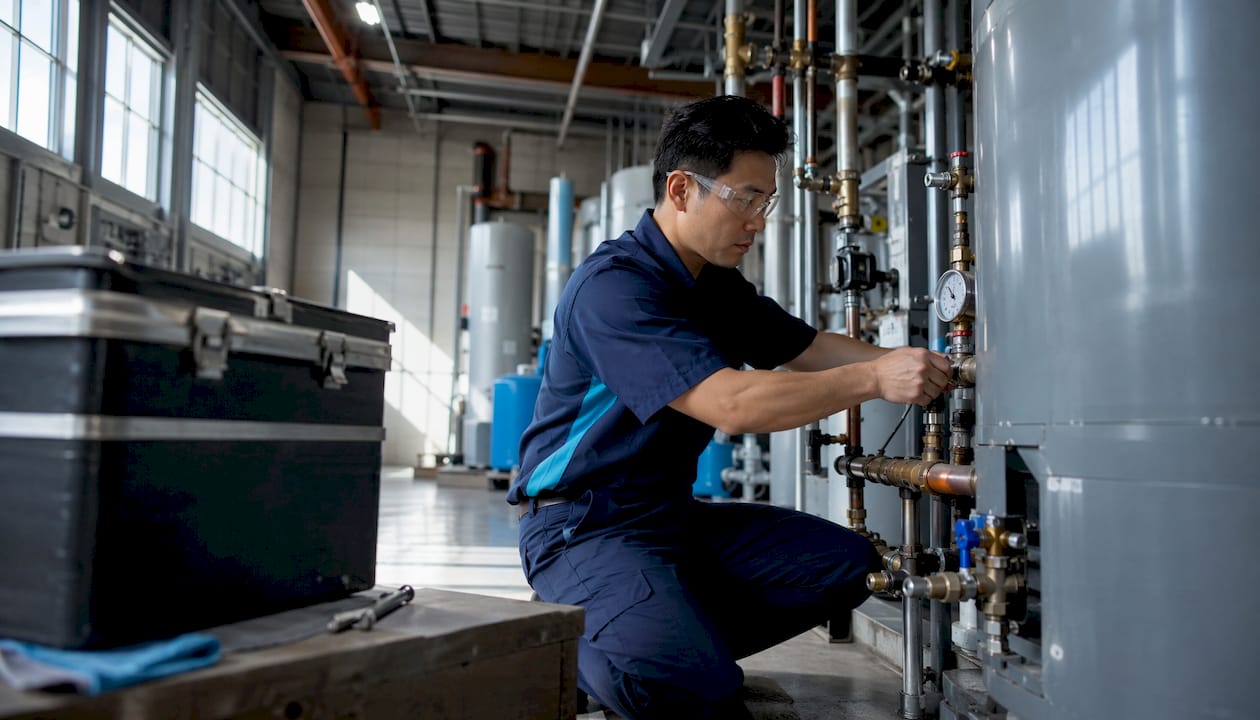
TL;DR:
- Selecting the optimal water-heating technology depends on demand, fuel infrastructure, and acceptable downtime.
- Condensing gas units excel for continuous loads using natural gas, while electric heat pump water heaters offer high efficiency for office and multi-family buildings.
For most commercial buildings, the right water-heating technology comes down to three factors: peak-hour demand, available fuel infrastructure, and how much downtime you can tolerate. Condensing gas units from manufacturers like Lochinvar or A. O. Smith are the go-to choice for restaurants and hotels where natural gas is available and hot-water loads are continuous. Commercial heat pump water heaters (HPWHs) lead for office buildings and multi-family properties on electric service, where ENERGY STAR-certified units can deliver about 15% higher efficiency than conventional models, and field studies have reported around 52% energy savings compared to standard electric-resistance units in specific applications. For healthcare and critical facilities, modular cascading systems, whether tankless or condensing storage, provide the redundancy that single-unit designs cannot. Before you finalize any specification, a licensed commercial plumber should walk the site and confirm fuel capacity, venting paths, and ASME compliance. Psvplumbinginc offers exactly that service.
Quick-reference by use case:
- Restaurant: Condensing gas tankless (cascaded) or high-efficiency condensing storage; Rinnai, Navien, or Lochinvar
- Hotel/lodging: High-capacity condensing gas storage or modular condensing systems; A. O. Smith, Bradford White, Rheem
- Office/retail: Commercial heat pump water heater (where electrical service allows) or condensing gas
- Healthcare/critical facility: Modular redundant condensing storage or cascaded tankless with BMS integration
- Laundromat/industrial: High-capacity storage tank (ASME-rated) or condensing gas with large storage buffer
- Multi-family: Commercial HPWH or condensing gas, sized to peak simultaneous fixture demand
Table of Contents
- What are the best water heaters for commercial buildings?
- How do you size a commercial water-heating system?
- How do fuel type and efficiency metrics affect your operating costs?
- What installation and code requirements apply to commercial water heaters?
- What do commercial water heaters cost, and what is the payback?
- Which commercial water heater brands should you consider?
- What maintenance do commercial water heaters require?
- Psvplumbinginc’s 10-point site-assessment checklist
- How do you make the final purchase and installation decision?
- Key Takeaways
- The specification mistake that costs the most
- Psvplumbinginc handles your commercial water-heater project from spec to startup
- Useful sources and rebate resources
What are the best water heaters for commercial buildings?
Commercial water heaters split into six practical categories. Understanding where each fits prevents costly over-specification or, worse, a unit that runs out of hot water during the lunch rush.

Storage tank (ASME-rated commercial)
These are large-capacity tanks, typically 75–500+ gallons, built to ASME pressure-vessel standards. They store pre-heated water and deliver it on demand without a recovery lag. The tradeoff is standby heat loss: the tank maintains temperature around the clock whether you need hot water or not. Best for facilities with predictable, steady demand, like laundromats, industrial wash stations, and large hotels with overnight occupancy.
Tankless / on-demand (cascading)
Tankless units heat water only when a fixture opens, eliminating standby loss entirely. For commercial volumes, a single unit rarely suffices. Instead, multiple units are cascaded for high-volume needs, with each unit firing in sequence as demand rises. Rinnai and Navien both offer commercial cascade controllers that manage load sharing and rotation to even out wear. The footprint is compact, which matters in tight mechanical rooms, but gas supply and venting must be sized for the full cascade load.

Condensing gas
Condensing units extract heat from flue gases that standard atmospheric burners waste, pushing thermal efficiency to 95% or above. They require a condensate drain (the flue gas condenses into mildly acidic water) and typically need PVC or CPVC venting rather than traditional B-vent. The efficiency gain over a standard 80% unit is meaningful and reflected on a monthly gas bill. Lochinvar, A. O. Smith, and Bradford White all offer commercial condensing lines.

Commercial heat pump water heater (electric HPWH)
HPWHs move heat from ambient air into the water rather than generating it directly, achieving COPs of 3.0–4.3. A. O. Smith’s CAHP-120 commercial model, for example, lists a COP of ~4.3 with hybrid and electric-only modes for different operating profiles. The catch: they need adequate ambient air volume (typically 1,000+ cubic feet of unconditioned space) and they cool the room they sit in, which can be an asset in a warm mechanical room or a liability in a cold climate.
Solar / solar-assist
Solar thermal collectors preheat water before it enters a conventional backup heater, cutting fuel use substantially in high-sun climates. The system complexity, roof penetrations, and collector maintenance make this a longer-payback option best suited to new construction or major renovations where the infrastructure investment is justified.
Hybrid / combined systems
Some facilities pair a condensing gas boiler with an indirect storage tank, or combine a heat pump with a gas backup. These hybrid configurations can optimize for both peak-hour capacity and off-peak efficiency but require careful controls integration.
Pros and cons at a glance:
| Type | Efficiency | Upfront cost | Footprint | Maintenance | Best for |
|---|---|---|---|---|---|
| ASME storage tank | Moderate (UEF 0.62–0.80) | Low–medium | Large | Anode, flush | Laundromats, hotels, industrial |
| Tankless (cascaded) | High (UEF 0.87–0.96) | Medium–high | Compact | Descaling, burner | Restaurants, offices, retrofit |
| Condensing gas | Very high (95%+ thermal) | Medium–high | Medium | Condensate, burner | Restaurants, hotels, healthcare |
| Commercial HPWH | Highest (COP 3.0–4.3) | High | Medium–large | Coil, refrigerant | Offices, multi-family, warm climates |
| Solar/solar-assist | Very high (with backup) | Very high | Large (roof) | Collector, pump | New construction, high-sun regions |
| Hybrid/combined | High | High | Variable | Complex | Large hotels, critical facilities |
How do you size a commercial water-heating system?
Sizing is where most specification errors happen. Undersizing causes cold-water complaints; oversizing wastes capital and energy. The industry-standard approach is a site-specific load analysis that balances peak-hour demand against available energy infrastructure.
The core math
Peak-hour demand (gallons) = Number of fixtures × Gallons per fixture use × Simultaneous use factor
Temperature rise (°F) = Target supply temperature − Incoming cold-water temperature
A typical commercial kitchen targets 140°F at the water heater (with a tempering valve to 120°F at sinks). If incoming water is 55°F, your temperature rise is 85°F. A tankless unit’s GPM rating drops as temperature rise increases, so always check the manufacturer’s GPM-at-temperature-rise table, not just the headline GPM number.
Worked example: 60-seat restaurant
- Fixtures in peak hour: 3 pre-rinse spray valves (1.6 GPM each), 2 pot-fill faucets (2.0 GPM each), 1 commercial dishwasher (1.0 GPM), 2 hand sinks (0.5 GPM each) = 12.8 GPM total if all run simultaneously
- Simultaneous use factor: In a real kitchen, not every fixture runs at once. Apply a 0.75 factor: 12.8 × 0.75 ≈ 9.6 GPM at 140°F
- Storage buffer: If the dishwasher runs a 15-minute cycle and needs 15 gallons of hot water, a 40-gallon storage buffer with a 9.6 GPM tankless cascade covers both continuous flow and surge demand
- Result: Two 199,000 BTU condensing tankless units in cascade (each rated ~4.5 GPM at 85°F rise) plus a 40-gallon buffer tank
Site data to collect before sizing
- Total fixture count by type and flow rate (GPM)
- Busiest operating hour (when do the most fixtures run simultaneously?)
- Incoming cold-water temperature (varies by region and season; use the coldest month)
- Available gas meter capacity (BTU/hr) and gas pipe size to the mechanical room
- Electrical service capacity (amps, voltage, phase) for heat pump or electric backup options
- Equipment room dimensions and ceiling height (affects HPWH air volume requirements)
Cascading and redundancy rules
For critical operations, design with at least N+1 redundancy: if your load requires two units, install three. Modular or redundant architectures preserve partial hot-water capacity if one unit fails and allow staged maintenance without a full shutdown. Cascaded tankless units also let you stage firing order, rotating lead units to equalize run hours.
How do fuel type and efficiency metrics affect your operating costs?
Fuel choice shapes both the equipment you can specify and the operating cost you will carry for the next 15–20 years. Getting this comparison right is worth the time.
Key efficiency metrics
- UEF (Uniform Energy Factor): The current DOE standard for storage and tankless units. Higher is better. Commercial condensing tankless units typically achieve UEF 0.87–0.96; standard atmospheric storage tanks run 0.62–0.80.
- COP (Coefficient of Performance): Used for heat pumps. A COP of 3.5 means 3.5 units of heat energy delivered per unit of electrical energy consumed. Commercial HPWHs typically achieve COP 3.0–4.3.
- Thermal efficiency: Used for condensing gas units. A 95% thermal efficiency unit wastes only 5% of gas input as flue heat. Standard atmospheric units run 78–82%.
ENERGY STAR-certified commercial units are typically about 15% more efficient than conventional models, and the program covers gas-fired storage, gas-fired instantaneous, and electric heat pump commercial water heaters.
Operating cost comparison (illustrative)
For a facility consuming 500 gallons of hot water per day at an 80°F temperature rise:
- Standard electric resistance (UEF 0.92): High kWh consumption; at $0.12/kWh, annual energy cost is substantial
- Commercial HPWH (COP 3.5): Cuts electrical consumption by roughly 65% versus resistance; field testing showed ~52% energy savings in a multi-family installation, with a payback of 3.2–4.4 years under specific commercial rate structures
- Condensing gas (95% thermal efficiency): At $1.20/therm, gas typically beats electric resistance significantly; competitive with HPWH depending on local utility rates
The right answer depends on your local gas and electric rates. In states with low electricity costs or strong demand-response programs, HPWHs often win on lifecycle cost. Where gas is cheap and abundant, condensing gas units are hard to beat on installed cost and simplicity.
Rebates and incentives
Utility rebates for energy-efficient water heaters can materially change payback calculations. Many utilities offer $200–$1,000+ per commercial HPWH unit; some states layer additional incentives on top. The federal 179D commercial energy-efficiency deduction may also apply to qualifying installations. Availability varies by utility and jurisdiction, so check your local utility’s commercial rebate portal and confirm eligibility before finalizing equipment selection.
Pro Tip: Request the manufacturer’s AHRI-certified efficiency data sheet and cross-reference it against your utility’s rebate eligibility list before purchasing. Some rebate programs require specific AHRI certification numbers, not just ENERGY STAR labeling.
What installation and code requirements apply to commercial water heaters?
Commercial installations carry code obligations that residential work does not. Missing one can trigger a failed inspection, a stop-work order, or a voided warranty.
Certifications and code items to confirm
- ASME stamp: Any pressurized storage tank in a commercial building typically requires an ASME Section VIII stamp. This is not optional in most jurisdictions. Confirm with your local authority having jurisdiction (AHJ) before specifying.
- Venting: Condensing units require Category IV (positive-pressure, sealed) venting, usually PVC or CPVC. Standard atmospheric units use B-vent. Mixing venting categories is a code violation and a safety hazard.
- NOx rules: California and some other states enforce low-NOx burner requirements for commercial gas appliances. Confirm local air-quality rules before specifying any gas-fired unit.
- Temperature/pressure relief (T&P) valves: Required on all storage tanks; must be piped to a safe discharge point per local code.
- Backflow prevention: Required on the cold-water supply to commercial water heaters in most jurisdictions.
For permit requirements specific to your project, the water heater replacement permit guide covers the key U.S. requirements.
Site constraints
- Clearances: Commercial units need manufacturer-specified clearances for service access. In tight mechanical rooms, this is often the binding constraint on unit selection.
- Makeup air: Gas-fired condensing units in enclosed rooms need adequate combustion air. Calculate the room volume and confirm it meets the unit’s combustion-air requirements, or plan a dedicated makeup-air duct.
- Condensate drainage: Condensing units produce mildly acidic condensate (pH 3–5). Most codes require neutralization before discharge to a sanitary drain. Plan for a condensate neutralizer and a gravity or pumped drain path.
- Noise: Heat pump units generate compressor noise. In noise-sensitive environments (adjacent to patient rooms or offices), confirm the unit’s sound rating and plan acoustic separation if needed.
BMS integration and smart controls
Modern commercial units increasingly support BACnet-ready controls and Wi-Fi monitoring for remote diagnostics, leak detection with auto shut-off, and usage trending. Connecting your water heater to the building management system (BMS) shifts maintenance from reactive to proactive and can prevent catastrophic leaks in multi-story buildings. Confirm BACnet or Modbus compatibility with your BMS integrator before finalizing equipment.
For new construction projects, water heater placement planning should address venting routes, condensate drainage, and BMS conduit runs before walls are closed.
Pro Tip: Always confirm the condensate drain path and neutralizer requirement with the AHJ before installation. It is one of the most commonly overlooked items on commercial condensing installs and can delay final inspection by weeks.
What do commercial water heaters cost, and what is the payback?
Installed cost for commercial water-heating systems varies widely by technology, capacity, and site complexity. The figures below reflect typical U.S. market ranges for equipment plus standard commercial installation labor; complex retrofits, venting modifications, or electrical service upgrades will push costs higher.
Typical installed cost bands
- ASME storage tank (standard efficiency, 100–200 gallon): $3,000–$8,000 installed
- Condensing gas storage (100–200 gallon): $6,000–$14,000 installed
- Commercial tankless (single unit, 199,000 BTU): $3,500–$7,000 installed; a two-unit cascade adds proportionally
- Commercial HPWH (80–120 gallon): $5,000–$12,000 installed, before rebates
- Modular condensing system (multiple units, large building): $15,000–$50,000+ depending on capacity and complexity
Service life and warranty
Commercial-grade units built to ASME standards, with ASME-grade tanks and powered anodes, typically carry 10–15 year service-life expectations with proper maintenance. Warranty structures vary: most commercial manufacturers offer 6–10 year tank warranties and 2–5 year parts warranties on commercial units. Heat exchangers on condensing units often carry separate 10–15 year coverage. Always confirm whether the warranty is commercial-grade or residential-grade. Installing a residential unit in a commercial setting typically reduces or eliminates warranty coverage, as commercial use limits warranty protections on residential equipment.
Simple payback example
A standard 80% efficiency gas storage unit installed for $5,000 versus a condensing gas unit at $10,000 for the same capacity: if the condensing unit saves $800/year in gas costs (a reasonable estimate for a mid-size restaurant), the incremental $5,000 pays back in about 6.25 years. Factor in a $500 utility rebate and payback drops to 5.6 years, well within the unit’s 15-year service life.
Factors that change lifecycle economics
- Local utility rates (gas vs. electric price spread)
- Water quality (hard water accelerates scale buildup and shortens heat-exchanger life)
- Maintenance policy (annual descaling and anode checks extend service life materially)
- Duty cycle (a unit running 16 hours/day ages faster than one running 8 hours/day)
Which commercial water heater brands should you consider?
The six manufacturers most commonly specified for U.S. commercial work each have distinct strengths. None is universally superior; the right choice depends on your application, fuel type, and service network in your area.
| Manufacturer | Best for | Fuel type | Capacity / GPM | Efficiency metric | Footprint / complexity | Typical installed cost band | Warranty / service life | Maintenance notes |
|---|---|---|---|---|---|---|---|---|
| A. O. Smith | Large integrated HPWH; condensing gas | Electric (HPWH), natural gas | 75–500 gallons; — | COP ~4.3 (HPWH); 95% thermal (condensing) | Medium–large; moderate complexity | $6,000+ up to about $20,000 | 6–10 yr tank; 10 yr HX | iCOMM Wi-Fi; powered anode option |
| Bradford White | Hotels, multi-family, industrial storage | Natural gas, electric, propane | 75–500 gal | UEF 0.62–0.80 | Large (storage); moderate | $4,000+ up to about $15,000 | 6–10 yr commercial | ASME-rated tanks; anode checks |
| Lochinvar | Restaurants, healthcare, high-efficiency gas | Natural gas, propane | 100–400 MBH; — | 95%+ thermal efficiency | Medium; moderate–high | $7,000+ up to about $18,000 | 10 yr HX; 5 yr parts | Condensate management; burner tune |
| Rheem | Broad commercial range; retrofit-friendly | Natural gas, electric, propane | 50–500 gal; tankless to 11 GPM | UEF up to 0.96 | Medium; low–moderate complexity | $4,500+ up to about $14,000 | 6–10 yr commercial | Standard commercial schedule |
| Rinnai | Restaurants, offices; cascade tankless | Natural gas, propane | Up to 11 GPM per unit; cascadable | UEF up to 0.96 | Compact; low–moderate | $4,000–$10,000 per unit | 5–10 yr commercial | Descaling; cascade controller |
| Navien | Retrofit cascade; high-efficiency tankless | Natural gas, propane | Up to about 4.5 GPM; cascade-ready | UEF up to 0.96 | Compact; low (pin-to-pin retrofit) | $4,000–$9,000 per unit | 5–15 yr (model-dependent) | Descaling; firmware updates |
Brand notes:
- A. O. Smith is a strong choice when you need an integrated commercial HPWH or a condensing gas unit with advanced BMS connectivity. The Cyclone FLEX and CAHP lines are widely specified for healthcare and multi-family projects.
- Bradford White is a reliable workhorse for hotels and industrial applications where large ASME-rated storage capacity is the primary requirement. Their commercial lines are built for heavy duty cycles.
- Lochinvar is frequently specified by mechanical engineers for restaurant and healthcare projects where 95%+ condensing efficiency and tight controls integration are non-negotiable.
- Rheem offers one of the broadest commercial ranges and is known for retrofit-friendly designs that minimize re-piping during emergency replacements.
- Rinnai commercial tankless units are a common choice for restaurants and offices where space is limited and cascade control is needed. Their commercial cascade controller manages up to 24 units.
- Navien commercial tankless units are designed with pin-to-pin retrofit compatibility, making them a practical option when an emergency replacement needs to happen fast with minimal re-piping.
For a side-by-side look at top commercial water heater providers, Psvplumbinginc has compiled a focused comparison of leading model families.
What maintenance do commercial water heaters require?
A commercial water heater that is not maintained on schedule will fail early. The maintenance requirements differ by technology, and knowing what to expect helps you budget for service contracts and spare parts.
Maintenance checklist by type
Storage tank (ASME):
- Annual anode rod inspection (or powered anode check); replace sacrificial anodes every 3–5 years depending on water hardness
- Annual tank flush to remove sediment
- T&P valve test annually
- Inspect for corrosion at fittings and connections
Condensing gas (storage or tankless):
- Annual burner inspection and tune-up
- Condensate trap and neutralizer inspection every 6 months; replace neutralizer media annually
- Heat exchanger descaling every 1–3 years depending on water hardness
- Check and clean combustion air intake and exhaust terminations
Commercial HPWH:
- Air filter cleaning every 3–6 months
- Evaporator coil inspection annually
- Refrigerant system check every 2–3 years
- Standard anode and tank flush schedule
Tankless (cascaded):
- Annual descaling of each unit’s heat exchanger (more frequent in hard-water areas)
- Cascade controller firmware updates
- Inlet filter screens cleaned every 6 months
- Burner inspection annually
Common failure modes
Scale buildup on heat exchangers is the leading cause of premature failure in commercial units, particularly in hard-water markets. Sacrificial anode depletion in storage tanks is the second most common issue and is entirely preventable with annual checks. Control board faults and pump failures are more common on HPWHs and condensing units with complex electronics. Smart diagnostics, where available, flag these issues before they cause a full shutdown.
Pro Tip: Set up remote monitoring alerts on any BMS-connected unit so your facility team gets an email or text the moment a fault code appears. Catching a control board fault early costs a service call; missing it can mean a full unit replacement and days without hot water.
For a detailed commercial maintenance workflow, Psvplumbinginc has published a step-by-step guide covering service intervals, contractor qualifications, and spare-parts strategies.
Warranty questions to ask before you buy
- Does the warranty cover commercial use, or is it a residential warranty applied to a commercial install?
- Is the heat exchanger covered separately, and for how long?
- Does the warranty require factory-authorized service to remain valid?
- Are parts and labor both covered, or parts only?
- What is the manufacturer’s average response time for commercial warranty claims in your region?
Psvplumbinginc’s 10-point site-assessment checklist
Before you specify or purchase any commercial hot water system, walk the site with this checklist. It captures the data your installer needs to size the system correctly and avoid surprises during installation.
10-point site-assessment checklist
- Electrical service: Confirm available amperage, voltage (208V/240V/480V), and phase (single or three-phase) at the mechanical room panel. HPWHs and electric backup units have specific service requirements.
- Gas meter and pipe size: Record the gas meter capacity (BTU/hr) and the pipe diameter from the meter to the mechanical room. Undersized gas supply is the most common reason a condensing cascade fails to reach full output.
- Incoming cold-water temperature: Measure or obtain historical data for the coldest month. This directly sets your temperature-rise requirement and affects GPM ratings.
- Peak-hour fixture count: Walk every floor and count fixtures by type. Record flow rates (GPM) and identify the busiest operating hour.
- Available equipment space: Measure the mechanical room dimensions, ceiling height, and door clearances. Note any obstructions that affect unit placement or service access.
- Venting paths: Identify existing flue routes and confirm whether Category IV (PVC/CPVC) venting is feasible for condensing units. Note roof penetration locations and distances.
- Condensate routing: Locate the nearest sanitary drain and confirm gravity drainage is possible, or plan for a condensate pump. Note whether a neutralizer is required by local code.
- Water quality: Request a water quality report from the local utility or conduct a hardness test. Hard water (above 120 mg/L) significantly affects descaling frequency and heat-exchanger life.
- Redundancy requirements: Determine whether the facility can tolerate any hot-water outage. Hospitals, hotels, and restaurants typically cannot; offices and retail may tolerate a 4–8 hour outage.
- BMS integration: Confirm whether the building has an existing BMS and what protocol it uses (BACnet, Modbus, LonWorks). Specify BMS-compatible units from the start.
Questions to ask a prospective installer
- Do you hold a current commercial plumbing license in this state, and can you provide proof of insurance?
- Have you installed ASME-rated commercial water heaters before, and can you provide references from similar projects?
- How do you handle condensate neutralization and condensate drain sizing for condensing units?
- Do you offer leak-detection integration and BMS commissioning as part of the installation scope?
- What is your commissioning and startup testing procedure, and do you provide a written startup report?
- Will you assist with utility rebate applications and warranty registration?
Psvplumbinginc offers site assessments for commercial water-heater projects, covering all ten checklist points and providing a written load calculation and equipment recommendation. Contact us to schedule yours.
How do you make the final purchase and installation decision?
Three steps get you from site data to a signed installation contract without second-guessing the specification.
Three-step decision flow
-
Confirm site constraints first. Before evaluating any equipment, lock down your gas capacity, electrical service, venting feasibility, and available space. These constraints eliminate options faster than any spec sheet comparison. A condensing cascade that requires a new gas meter upgrade may not pencil out against a heat pump system that runs on existing electrical service.
-
Match technology to your peak-hour and fuel profile. Use the sizing math from Section 3 to establish your GPM and storage requirements. Then overlay fuel availability and efficiency goals. If natural gas is available and your load is continuous (restaurant, hotel), condensing gas wins on simplicity and installed cost. If you are on electric service with high gas prices, a commercial HPWH with a COP above 3.5 typically delivers the better lifecycle cost.
-
Require redundancy and BMS options in every bid. Any bid that does not address what happens when a unit fails is incomplete. For critical facilities, specify N+1 redundancy explicitly. For any multi-story building, require BMS connectivity and leak-detection auto shut-off as standard scope items, not add-ons.
Procurement next-step checklist
- Collect a minimum of three bids from licensed commercial plumbing contractors
- Require each bidder to provide a written load calculation, not just a unit recommendation
- Confirm that warranty coverage is commercial-grade (not residential warranty applied to a commercial install)
- Verify that commissioning and startup testing are included in the bid scope
- Ask each bidder to identify applicable utility rebates and confirm they will assist with the application
- Confirm ASME compliance and local permit requirements are addressed in the bid
Retrofit vs. full replacement
When a unit fails unexpectedly, retrofit-compatible models that match the existing footprint and connection points reduce re-piping costs and downtime. Navien and Rheem both emphasize footprint-matching designs for this scenario. When you have lead time for a planned replacement, a full system redesign, including modular redundancy and BMS integration, usually delivers better long-term economics than a like-for-like swap.
Psvplumbinginc can assist with bid review, load-calculation verification, and rebate documentation for commercial water-heater projects. Reach out for a site assessment and bid assistance.
Key Takeaways
Condensing gas and commercial heat pump water heaters deliver the best lifecycle economics for most U.S. commercial buildings, but only when sized to peak-hour demand and matched to available fuel and electrical infrastructure.
| Point | Details |
|---|---|
| Size to peak-hour demand | Calculate GPM at your busiest hour, not average daily use, to avoid undersizing. |
| Prefer modular redundancy | Cascaded or parallel units preserve partial capacity during a failure; critical facilities need N+1 minimum. |
| Condensing and HPWH lead on efficiency | ENERGY STAR-certified commercial water heaters are typically about 15% more efficient than conventional models. Commercial HPWHs have delivered up to 52% energy savings over electric resistance in field studies, and condensing gas reaches 95%+ thermal efficiency. |
| Confirm site constraints before specifying | Gas capacity, electrical service, venting paths, and condensate routing eliminate options before any spec comparison. |
| Psvplumbinginc site assessment | Psvplumbinginc offers commercial site assessments covering all 10 checklist points, load calculations, and rebate assistance. |
The specification mistake that costs the most
The most expensive error in commercial water-heater selection is not choosing the wrong brand. It is skipping the site assessment and letting the equipment drive the decision instead of the other way around.
We see it regularly: a facility manager gets a quote for a high-efficiency condensing cascade, the price looks right, and the order goes in. Then the installer shows up and discovers the gas meter is undersized, the mechanical room has no condensate drain path, and the venting run is 40 feet longer than the manufacturer allows. The project stalls, costs climb, and the owner ends up with a less efficient unit because it was the only one that fit the constraints that were never checked.
The second most common mistake is ignoring redundancy for cost reasons. A single large-capacity unit is always cheaper upfront than two smaller units. But for a hotel or restaurant, a single-unit failure means no hot water for guests or a closed kitchen until a replacement arrives. The incremental cost of a second unit or a cascade design is almost always recovered in the first avoided emergency.
The third pitfall is skipping commissioning. A unit that is installed but not properly started up, with gas pressure verified, controls calibrated, and BMS integration tested, will underperform and may fail its warranty inspection. Always require a written commissioning report from your installer.
The right commercial water-heater specification starts with a site walk, not a catalog. Get the site data first, then let the numbers point to the technology.
Psvplumbinginc handles your commercial water-heater project from spec to startup
Selecting the right commercial hot water system is only half the work. Getting it installed correctly, commissioned, and connected to your building management system is where most projects either succeed or run into costly delays. Psvplumbinginc provides the full scope: site assessment, load calculations, equipment specification, licensed commercial installation, commissioning, and ongoing commercial maintenance plans that keep your system running at peak efficiency.

We work with facility managers, property owners, and general contractors on projects of all sizes, from a single-unit restaurant replacement to a multi-unit modular system for a hotel or healthcare facility. We assist with utility rebate applications, warranty registration, and BMS integration so you get the full value of your equipment investment. Our team is licensed, insured, and experienced with ASME commercial installations, condensing systems, and heat pump water heaters across a range of building types.
Ready to get the right system specified and installed without the guesswork? Request a site assessment from Psvplumbinginc and we will walk your facility, run the load calculations, and deliver a written recommendation with rebate options included.
Useful sources and rebate resources
The following authoritative sources were used in preparing this guide and are worth bookmarking for your own specification and procurement work.
| Resource | What it covers | How to use it |
|---|---|---|
| ENERGY STAR Commercial Water Heaters | Certified product lists, efficiency specs, rebate eligibility | Confirm ENERGY STAR certification and check rebate eligibility for HPWHs and gas units |
| U.S. DOE Water Heater Sizing Guide | Sizing methodology, first-hour rating, GPM guidance | Use the DOE sizing formulas to validate your peak-hour demand calculation |
| Consumer Reports Water Heater Buying Guide | Reliability data, brand comparisons, owner satisfaction | Cross-reference brand reliability ratings before finalizing manufacturer selection |
| AHRI Directory (ahridirectory.org) | Certified efficiency ratings by model number | Verify UEF, COP, and thermal efficiency figures for specific models before purchase |
How to check for rebates:
- Visit your local electric or gas utility’s commercial rebate portal (search “[utility name] commercial water heater rebate”)
- Check the ENERGY STAR rebate finder at energystar.gov for state and utility programs
- Ask your equipment distributor whether the manufacturer offers a mail-in rebate on commercial units
- Confirm that the specific model number, not just the brand, qualifies for the rebate before purchasing
Leave a Reply