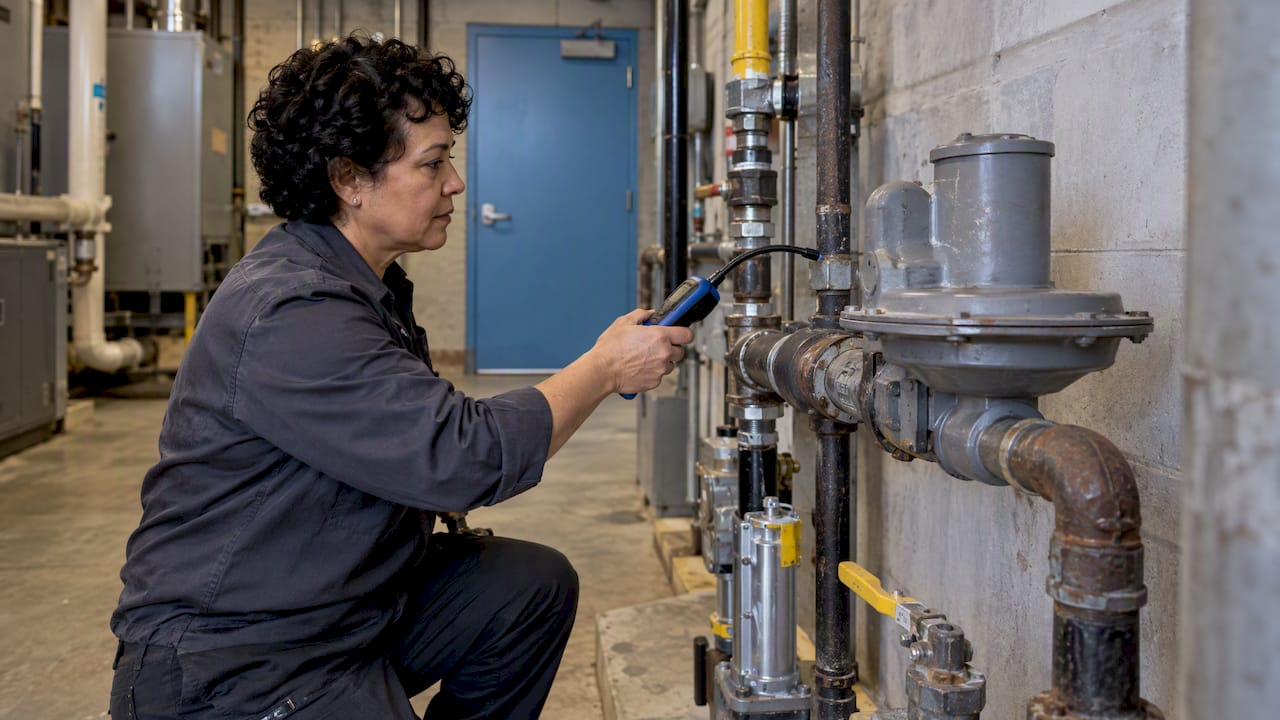
A good gas line inspection checklist covers six things: the appliance connections, the visible piping, the meter and regulator, the shut-off valves, a leak test with approved equipment, and written results. You can safely watch for warning signs yourself. The testing, and any repair, belongs to a licensed professional. Below is the full checklist, split into what an owner can observe and what a licensed plumber should do.
TL;DR
- Owners can look for warning signs: damaged appliance connections, hissing sounds, a gas odor, dead vegetation over buried lines and insect or fungus activity near risers and meters.
- If you suspect a leak, leave, avoid anything that could spark, and call 911 or your gas utility from a safe place.
- Leak testing and repairs need a licensed plumber with approved detectors or noncorrosive leak solution, never flames or guesswork.
- Federal leak survey rules apply to gas distribution operators. Inspection schedules for buildings come from local rules, such as New York City’s four-year cycle.
- Commercial properties follow a different code framework than one- and two-family homes, and approved plans can be stricter than code minimums.
Table of Contents
- What a gas line inspection should cover
- The owner’s visual checklist
- What to do if the checklist turns up a leak sign
- The professional checklist
- How often should gas lines be inspected?
- Residential vs. commercial gas piping
- Making inspections part of routine property care
- Our view on gas line inspections
- Book an inspection with PSV Plumbing
- FAQ
- Sources
What a gas line inspection should cover
A gas line inspection looks at every point where gas enters, travels through and leaves your building’s piping. For a home, that is usually the meter and regulator, the piping to each appliance, the shut-off valves and the appliance connections. For a commercial property, add larger piping runs, mechanical rooms, rooftop equipment and kitchen lines.
The Plumbing Foundation of New York describes the interior inspection checklist as including atmospheric corrosion, leaks, abnormal pressure, inadequate support, improper connections, meter or regulator location and bonding, venting, gas odor, point-of-entry seals, below-grade entry protection and access restrictions, in its covered task sheet for interior gas piping. The same document makes a useful point: a proper inspection combines visual examination with leak surveying, because several of those defects can be hazardous even when no leak is obvious.
That is why a quick look around the furnace is not an inspection. The checklist below separates what you can observe from what needs a licensed technician.
The owner’s visual checklist
These are observations, not repairs. Do not tighten fittings, disassemble connections or try to locate a suspected leak by experiment. The Indiana Utility Regulatory Commission says gas appliance work should be done by someone qualified, such as a licensed plumber or HVAC technician, and that you should not try to find or fix a suspected leak yourself, in its gas safety guidance.
Inside the building
- Appliance connections. Look at the flexible connectors behind the range, dryer, water heater and furnace. SoCalGas lists damaged appliance connections among the visible signs to watch for in its home energy and safety guide.
- Exposed piping. Look for rust, flaking, pitting or discoloration. Corrosion is one of the items on the professional checklist above.
- Support. Pipes should not sag, rattle or hang from makeshift supports. Inadequate support is a listed inspection item.
- Odor. Natural gas has a distinctive added smell. SoCalGas and Oklahoma State University’s natural gas manual both list odor as a warning sign.
- Sound. The same sources list hissing, whistling or roaring near piping. The OSU manual ties a hissing sound to a bad connection, fractured pipe or corrosion pit, in its natural gas manual revised November 2025.
- Pilot lights and flames. Flames that look unusual or go out repeatedly are a reason to call a technician. Do not relight anything you are unsure about.
- Shut-off valves. Confirm you know where the main shut-off and each appliance valve is, and that nothing blocks access. Our guide to gas shut-off valve requirements and what code says explains what to expect.
Outside the building
- Meter and regulator area. Look for damage, rust and anything stacked against the equipment. The OSU manual says heavy insect activity near risers, meters or regulators can indicate gas leakage.
- Valve boxes. The same manual says white or grayish-white fungus-like growth in valve boxes can indicate a leak.
- Vegetation. SoCalGas lists dead or dying vegetation in moist areas as a sign. A brown patch in a green, watered lawn deserves a call.
- Dirt or water blowing into the air. This is another visible sign from the SoCalGas guide.
- Exposed pipeline. After a storm, earthquake or flood, exposed pipe is a reason to call your utility.
- Before you dig. The IURC advises contacting 811 before any digging. Do that even for a fence post or a garden bed.
What to do if the checklist turns up a leak sign
Stop the inspection. The Mississippi Home Inspection Division advises that if you suspect a leak you should evacuate immediately, avoid operating lights or electrical devices that could spark, and call 911 or your utility from a safe location, in its article on your role in gas inspections.
In practice:
- Get everyone out, including pets.
- Do not flip switches, use a phone inside, start a car in an attached garage or light anything.
- Call from outside or from a neighbor’s home.
- Wait for the utility or fire department to clear the building.
- Have a licensed plumber inspect and repair before service is restored to the affected line.
We cover the sequence in more detail in Smell Gas at Home? Leave First, Call From Outside and explain the risks in Why Gas Leaks Are Dangerous. If a leak is confirmed, natural gas leak repair is the next page to read.
The professional checklist
This is the part that needs a license. It is also the part that finds problems an owner’s walk-through cannot.
| Check | What the technician does | Why it matters |
|---|---|---|
| Visual survey | Walks the full run, notes corrosion, support, connections and venting | Finds defects that are not leaking yet |
| Leak detection | Uses an approved combustible-gas detector or noncorrosive leak solution | Pinpoints leaks without ignition risk |
| Meter and regulator | Checks location, bonding and condition | Problems here affect the whole system |
| Entry points | Inspects point-of-entry seals and below-grade entry protection | Common spots for damage and gas migration |
| Pressure test | Tests the system at the required pressure and duration | Confirms the piping holds after work or alterations |
| Valves and appliances | Confirms shut-offs operate and connections are sound | Lets you isolate a problem quickly |
| Records | Documents findings, readings and corrections | Gives you proof for insurers, buyers or inspectors |
Leak detection methods
South Dakota’s official guidance on inspection, testing and purging says leak checks should use an approved combustible-gas detector or a noncorrosive leak-detection solution. It also says open flames, matches and candles must not be used. Find that in the state’s inspection, testing and purging form. This is also why a homemade soap test is not a substitute for a licensed inspection: a technician knows where to test, how to read the result and what to do next.
Reading detector results
A reading is not always an emergency, and not always nothing. The Mississippi Home Inspection Division notes that trace gas readings at meters can be typical because of minor regulator venting. It also says a sustained alarm above 5% LEL near a structure warrants action. A technician interprets the number in context, which is the reason to hire one instead of buying a detector and guessing.
Pressure testing
Pressure tests confirm the piping holds. South Dakota’s form specifies a test pressure of at least 1.5 times the proposed maximum working pressure and at least 3 psi. For systems under 10 cubic feet, or in a single-family dwelling, the test runs at least 10 minutes. Requirements differ by state and jurisdiction, so your plumber follows the rules where the property sits. For what a test can cost, see our breakdown of gas pressure test costs for U.S. homeowners.

What the paperwork should say
Ask for a written record. At minimum it should list:
- The date, the address and the technician’s name and license number.
- Which lines, appliances and areas were inspected.
- The detection method used and any readings.
- Defects found, with locations.
- Repairs made or recommended, and whether a retest followed.
Keep it with your home or building records. It helps at resale, at insurance renewal and when a new technician takes over the property.
How often should gas lines be inspected?
There is no single national schedule for a house’s piping, and that surprises owners. Two different sets of rules get mixed up.
Federal leak surveys apply to utilities. Under 49 CFR 192.723, operators of gas distribution systems survey for leaks at least annually in business districts, at intervals no longer than 15 months. Outside business districts the survey is at least every five calendar years, or every three years for specified cathodically unprotected lines. The rule applies to operators of distribution systems, not to ordinary customer-owned building piping.
Local rules can set building schedules. New York City requires covered buildings, other than one- and two-family homes and specified R-3 buildings, to have gas piping inspected at least every four years, following a community-district schedule. The work must be done by a Licensed Master Plumber or a qualified individual working for one, according to the NYC Department of Buildings. Many other places have no such cycle, so check with your city or county building department.
Outside any mandate, a sensible approach is to schedule an inspection:
- When you buy or sell a property.
- After a remodel, appliance swap or new gas line.
- After an earthquake, flood, fire or ground movement.
- When you notice any warning sign above.
- As part of a regular maintenance plan.
Our article on gas line inspection safety, compliance and benefits goes deeper on timing.
Residential vs. commercial gas piping
The checklist items are the same. The framework around them is not.
Connecticut’s official training materials for inspectors distinguish the two. The International Residential Code applies to one- and two-family dwellings. Commercial work commonly uses the International Plumbing Code, the International Mechanical Code and NFPA 54. The state material also notes that approved commercial plans and specifications may impose requirements more stringent than code minimums. See the state’s inspection procedures handout.
For property owners and managers, that means:
- Check the approved plans. For a commercial space, the plans on file may demand more than the code minimum.
- Expect more equipment. Kitchens, boilers, rooftop units and water heaters multiply the connections to inspect. Our commercial kitchen plumbing checklist covers one common case.
- Document more carefully. Landlords, lenders and insurers often ask for records. Property managers can use the plumbing guide for residential portfolios to set a routine across buildings.
- Plan access. Tenants, locked mechanical rooms and occupied kitchens all affect when an inspection can happen.
If you manage a business site, our commercial plumbing service page explains how we approach it.
Making inspections part of routine property care
Gas lines are one item in a wider maintenance habit. Pairing the gas checks with water heater, drain and fixture checks saves a return visit. Our residential plumbing checklist shows what to review through the year. For a broader view of the role of inspections in property care, the same idea applies to any property: look regularly, record what you find and fix small problems before they grow.
A few habits make the checklist easier to follow:
- Keep the area around the meter, appliances and valves clear.
- Note the date of every appliance install, because new connections are a reason to inspect.
- Keep inspection reports in one folder, paper or digital.
- Tell your plumber about anything you noticed, even if it seems minor, such as a faint smell that came and went.
Our view on gas line inspections
The most common mistake we see is treating a gas line inspection as optional until something smells wrong. By then the problem has had time to grow.
We think the best inspection is boring. A licensed plumber walks the system, tests it with approved equipment, hands you a written record and leaves you knowing where your shut-offs are. That is the result we aim for on every residential and commercial property we serve in and around Burbank.
We also want owners to understand where their role ends. Watch for the signs, keep access clear and call a professional. Leave the testing and repair to a licensed, insured team, because the cost of a wrong guess is too high.
Serghei
Book an inspection with PSV Plumbing
We are a licensed and insured plumbing company based in Burbank, serving homes and commercial properties. Our services include sewer and gas line inspections, water heater installation and maintenance, and plumbing system maintenance plans. We offer free quotes, and we explain what we find in plain language.

If you want a licensed plumber to run through this checklist at your property, contact PSV Plumbing for a free quote. Business owners can start at our commercial plumbing page. If your water heater is part of the visit, see our water heater services.
FAQ
Can I inspect my own gas lines?
You can look for warning signs, such as damaged connectors, odor, hissing, dead vegetation or insect activity near the meter. You should not try to find or fix a suspected leak yourself. State regulators advise using a licensed plumber or HVAC technician for gas appliance work and leak investigation.
Can I use soapy water to check for a leak?
Professionals use approved combustible-gas detectors or noncorrosive leak-detection solution, and never flames, matches or candles. A homemade test can miss leaks or give false comfort. If you smell gas, do not test. Leave and call 911 or your utility from outside.
How often does a house need a gas line inspection?
No single federal schedule covers customer-owned house piping. Federal leak surveys apply to gas utilities, and building inspection cycles come from local rules such as New York City’s four-year requirement for covered buildings. Check with your local building department, and inspect after remodels, disasters or any warning sign.
Do commercial properties need a different inspection?
The checklist is similar, but the code framework differs. Homes of one or two families fall under the International Residential Code, while commercial work commonly uses the International Plumbing Code, International Mechanical Code and NFPA 54. Approved commercial plans may be stricter than code minimums.
What should I get after an inspection?
Ask for a written report with the date, areas inspected, detection method, any readings, defects found and repairs or recommendations. Keep it with your property records for insurers, buyers and future technicians.
Sources
- SoCalGas, Home Energy and Safety Guide
- Oklahoma State University, Natural Gas Manual
- Plumbing Foundation of New York, Covered Task 86
- Mississippi Home Inspection Division, Your Role in Gas Inspections
- Indiana Utility Regulatory Commission, Signs of a Gas Leak
- South Dakota Department of Health, Inspection, Testing, and Purging
- 49 CFR 192.723, Distribution systems: Leakage surveys
- NYC Department of Buildings, Gas Piping Inspection
- Connecticut DAS, Inspection Procedures for Plumbing and Mechanical Systems
Leave a Reply