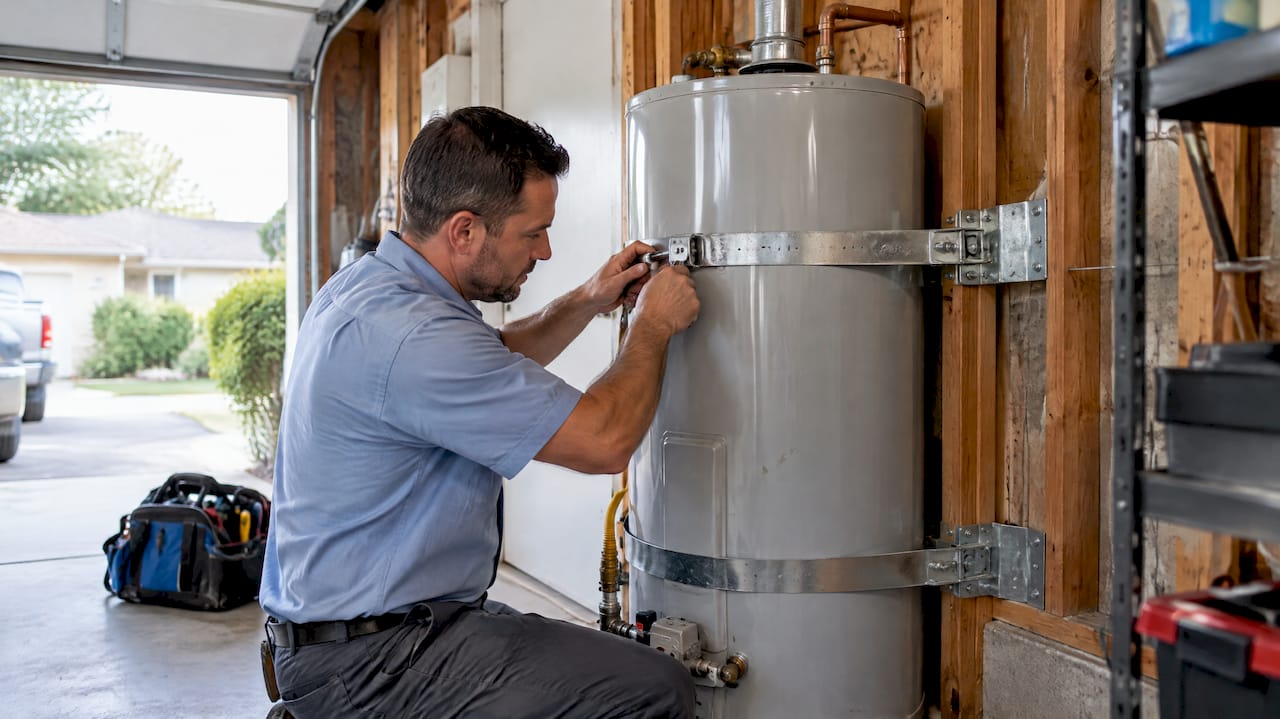
Strap your water heater with two heavy-gauge metal straps anchored into wall studs or blocking, one near the top third and one near the bottom third of the tank, and replace rigid water and gas lines with flexible connectors. Kits are inexpensive and many homeowners install them in an afternoon, but we recommend calling a licensed plumber when gas lines, hidden framing, or local permit rules are involved. IRC P2801 and FEMA both back this approach.
TL;DR:
- Strapping a water heater requires heavy-gauge metal bands positioned at one-third height from top and bottom, anchored into studs or solid blocking.
- Installation must be confirmed by local code, which often mandates straps in seismic zones, especially in California, Washington, or Oregon.
- Using thin plumber’s tape or multiple straps improperly is non-compliant and can cause inspection failure during seismic retrofit.
- Flexible gas and water connectors reduce damage risk when tanks shift during earthquakes and must be installed alongside proper strapping.
- Hiring a licensed plumber is advisable for complex jobs involving gas disconnection, framing issues, or permit requirements to ensure compliance and safety.
Table of Contents
- When is water heater strapping required by code?
- What to look for in a compliant strap kit
- Where exactly do the straps and anchors go?
- Step-by-step installation checklist and common mistakes
- Flexible connectors, drain pans, and what inspectors check
- How a licensed plumber handles a seismic strapping job
- Schedule a compliant water heater strapping with PSV Plumbing Inc
- FAQ
- Sources
When is water heater strapping required by code?
The International Residential Code addresses this directly. Under IRC Section P2801, water heaters must be anchored or strapped to resist horizontal displacement in seismic design categories C, D0, D1, and D2. These categories cover a large share of the country, not just the West Coast, so a property in the Midwest or Southeast may fall under this rule depending on local soil and seismic mapping.
California requires strapping statewide, regardless of seismic category, which makes it one of the strictest jurisdictions in the country. Washington and Oregon follow suit in the areas mapped into the higher seismic categories, and both states publish homeowner guidance on proper strap placement.
Because adoption and enforcement vary by city and county, we suggest confirming the exact rule for your address before buying materials.
- Check your seismic design category through your local building department or permit office.
- Ask whether a permit or inspection is required for a water heater swap in your city.
- Review any homeowners association rules that may add stricter requirements than the state code.
Replacing a water heater often triggers an inspection even in areas where strapping was previously optional, so it pays to confirm requirements before the old unit comes out.
What to look for in a compliant strap kit
A code-compliant kit uses heavy-gauge metal strapping, not the thin perforated plumber’s tape sold for general hanging jobs. Washington State’s Department of Health instructs wrapping heavy-gauge strapping one to one and a half times around the tank, then anchoring it with lag screws and oversized washers rather than relying on thin bands or adhesive strips.
A typical kit includes the following parts:
- Two lengths of heavy-gauge metal strap sized for your tank diameter.
- Lag screws and oversized washers for wood-framed walls.
- Spacers or tension hardware to keep the strap snug without denting the tank jacket.
Many inspectors treat a single band of plumber’s tape as an automatic fail, since it offers no real resistance to horizontal movement during ground shaking, according to Building America’s guidance. Compliant kits are sold at most hardware stores and major online retailers, and the parts themselves cost relatively little compared to the plumbing labor around them.
Where exactly do the straps and anchors go?
Placement matters as much as the hardware itself. Inspectors look for two separate restraint points, not one strap doubled over, and they check that the lower strap stays clear of the gas valve or electrical controls.
- Position the upper strap roughly one-third of the way down from the top of the tank.
- Position the lower strap roughly one-third of the way up from the bottom, keeping it at least 4 inches above any controls or valves.
- Anchor both straps into studs or solid blocking, never into drywall alone.
- Where studs do not line up with the strap locations, add a horizontal 2×4 block fastened to the studs to create a solid anchor point, a fix Washington DOH specifically recommends.
- Keep the tank within 1 to 2 inches of the wall; if the gap is larger, attach blocking to bridge the distance before strapping.
For wood framing, Building America recommends quarter-inch by three-inch lag screws with oversized washers at minimum. On concrete walls, swap in quarter-inch expansion bolts instead of lag screws, since concrete anchors behave differently under load.
Pro Tip: Tug on each strap by hand after tightening. If you can shift the tank even slightly away from the wall, the anchor point isn’t transferring load into the framing the way it should.
Step-by-step installation checklist and common mistakes
A straightforward installation follows a predictable order, and skipping steps is usually what leads to a failed inspection.
- Confirm your seismic design category and local permit requirements before buying materials.
- Shut off the water heater’s power or gas supply and the water inlet following standard safety practice.
- Mark stud locations behind the tank and add blocking if the straps won’t align with existing framing.
- Wrap each strap one to one and a half times around the tank and fasten into studs or blocking with the correct lag screws and washers.
- Tighten straps snugly against the tank jacket without crushing the insulation layer underneath.
- Confirm the gas valve, temperature and pressure relief valve, and electrical controls remain fully accessible.
- Replace any rigid water or gas connectors with listed flexible connectors so the lines can flex if the tank shifts during an earthquake.
Our plumbing team at PSV Plumbing Inc also flags a few mistakes that routinely show up during inspections:
- Straps anchored into drywall or trim instead of structural framing.
- A single strap doing the job of two, often placed too close to the tank’s middle.
- Rigid gas lines left in place after strapping, which defeats the purpose of bracing the tank at all.
If the job involves disconnecting gas piping, working around framing you can’t easily access, or pulling a permit, hiring a licensed plumber makes more sense than finishing it yourself.
Flexible connectors, drain pans, and what inspectors check
Strapping only solves half the problem. FEMA’s guidance on flexible connections explains that flexible connectors on both gas and water lines reduce the chance of a torn connection when a tank shifts during an earthquake. Straps keep the tank close to its original position, and flexible connectors absorb the smaller movements that straps alone can’t prevent.

Flexible connectors paired with proper anchoring form the complete mitigation approach FEMA recommends, rather than straps or connectors doing the job alone.
Drain pans and temperature and pressure relief valve routing matter too, especially where a leak could damage finished living space below or beside the unit. Some states also require elevated platforms for water heaters installed in garages.
At final inspection, expect your inspector to check for:
- Two straps at the correct heights, anchored into framing or blocking.
- Lag screws or anchors matching the wall material, not improvised hardware.
- Clear access to the gas valve and temperature and pressure relief valve.
- Flexible connectors on both water and gas lines.
- Photos of concealed backing or blocking if the wall has already been closed up.
How a licensed plumber handles a seismic strapping job
When a plumber is sent out for a seismic retrofit, the process starts with confirming the property’s seismic design category and the specific local code that applies, since requirements shift from one city to the next even within the same county, often coordinated using construction project management software for plumbers. From there, the framing behind the tank is documented, blocking is added where studs don’t align, and listed straps along with flexible water and gas connectors are installed.

The finished anchor points are photographed before any drywall goes back up, providing homeowners a record and inspectors what they need without opening the wall again. Jobs come with a written invoice, and permit coordination is provided where the city requires one.
If your water heater sits in an easily accessible closet with exposed studs and no gas line to disturb, strapping it yourself is a reasonable weekend project. Once gas piping, finished walls, or unusual framing enter the picture, that’s when a licensed plumber earns the call.
— Serghei
Schedule a compliant water heater strapping with PSV Plumbing Inc
A seismic retrofit done right the first time saves you a second inspection and a second invoice. The full job includes strap placement, flexible connector replacement, and an inspection-ready photo packet covering every anchor point before the wall closes up.

Free quotes are provided before any work begins. If you’d rather not track down blocking lumber and lag screw specs on a Saturday, schedule your water heater service with us and we’ll take it from there.
- Seismic strap installation with listed, code-compliant hardware.
- Flexible water and gas connector replacement.
- Documentation and permit coordination for your local inspector.
FAQ
What states require seismic straps for water heaters?
California requires water heater strapping statewide regardless of seismic category, while Washington and Oregon require it in areas that fall under the higher seismic design categories mapped by IRC Section P2801. Many other states enforce the same IRC categories locally, so checking with your building department is the most reliable way to confirm your area’s rule.
How much does it cost to install earthquake straps on a water heater?
Strap kits themselves are inexpensive and sold at most hardware stores and major online retailers, with the bulk of any job cost tied to labor rather than materials. For an exact quote based on your home’s framing and local permit requirements, PSV Plumbing Inc provides a free estimate before starting work.
Is there an earthquake strap for a water heater?
Yes, heavy-gauge metal strap kits designed specifically for water heaters are widely sold, typically including the straps, lag screws, and washers needed for a compliant installation. Washington State’s Department of Health recommends wrapping heavy-gauge strapping one to one and a half times around the tank rather than using thin perforated tape.
Do electric water heaters need earthquake straps?
Electric water heaters fall under the same IRC Section P2801 requirements as gas units in applicable seismic design categories, since the structural risk of a tank tipping over applies regardless of fuel type. The main difference is that electric units skip the flexible gas connector step, though a flexible water connector is still recommended.
Sources
- IRC 2024 — Chapter 28: Water heaters (P2801)
- Use Flexible Connections on Gas and Water Lines — FEMA
- Water Heaters (How to secure them) — Washington State Department of Health
- Water heater elevated and secured — Building America Solution Center (PNNL)
Leave a Reply