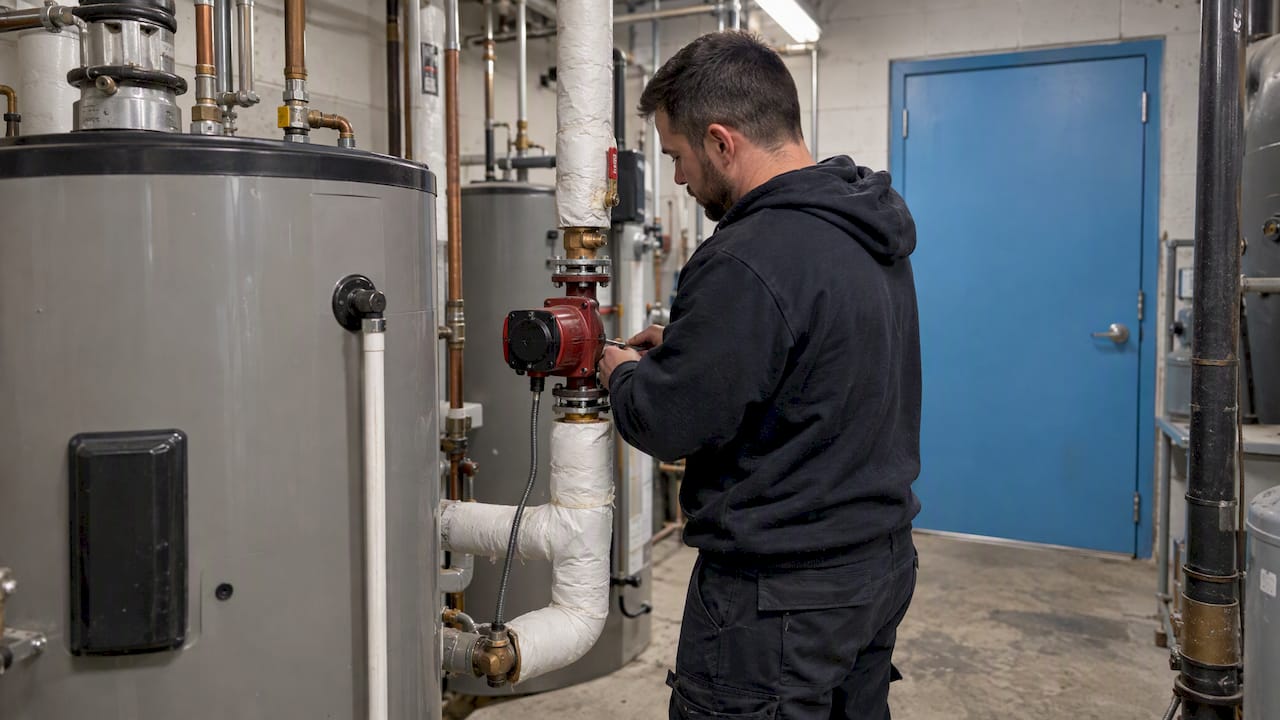
Most homeowners pay about $200 to $400 to have a hot water recirculation pump installed, and the job usually takes one to two hours, according to This Old House. That figure covers the simple case. A home with no return line, a finished wall or a crawlspace that is hard to reach can cost much more, and the pump also adds to your electricity and water-heating bills every year. Below we break down the install price, the running cost, and when the system pays for itself in comfort, water or money.
TL;DR
- A straightforward recirculation pump installation runs about $200 to $400. A dedicated return line, tight access or a water heater that needs changes pushes the total higher.
- The running cost depends on controls far more than on the pump. A pump that runs 24/7 can cost over $100 a year in electricity alone, while a demand-activated pump can cost a few dollars.
- Continuous systems also lose heat through the pipes, which makes your water heater work harder.
- The main payoff is hot water within seconds. Water savings of 3,600 to 12,000 gallons a year are reported in case studies, but dollar savings are usually modest.
- Choose a timer or demand control, insulate the hot water pipes, and have a licensed plumber check your layout before you buy equipment.
Table of Contents
- What a recirculation system does and why cost varies so much
- Installation cost: what to expect
- Operating cost: the part most people overlook
- Can savings offset the cost?
- Three setups compared
- Commercial and multifamily properties
- Our perspective
- Get a recirculation quote from PSV Plumbing
- How to prepare for your estimate
- FAQ
- Sources
What a recirculation system does and why cost varies so much
A recirculation system keeps hot water moving, or ready to move, through your hot water pipes so it is near the fixture when you open the tap. Without one, the cool water that has been sitting in the line goes down the drain while you wait. With one, hot water arrives in a couple of seconds.
Two setups account for most homes:
- Dedicated return line. A separate pipe carries water from the farthest fixture back to the water heater. This is the cleanest design, and it is easiest to build into new construction or a repipe.
- Crossover or comfort system. A pump under the farthest sink uses the cold water line as the return path. It avoids new pipe in the walls, so it is usually the cheaper retrofit.
The design matters because it sets how much work the plumber does. Researchers at the National Laboratory of the Rockies note that system performance and cost recovery depend on design and installation quality. They point to efficient piping that keeps water volume low, and to pump selection based on flow rate and head.
Installation cost: what to expect
The simple retrofit
The $200 to $400 range from This Old House describes a relatively simple installation of one to two hours. That fits a home where a plumber can put a pump at the water heater or under the fixture farthest from it, with an outlet nearby and open access to the pipes.
One installer-published example of equipment plus installation gives a wider spread, from $599 to over $2,000, averaging about $1,200. That is a useful reminder that a quote reflects the home, the equipment and the controls, not just the pump.
What pushes the price up
These are the factors we see decide whether a job lands at the low or the high end:
- A new return line. Running pipe through finished walls, ceilings or a slab means opening surfaces, then patching and painting them. Access to a crawlspace or attic helps a great deal.
- Distance and layout. A long pipe run, or several branches far from the heater, may need more than one pump or a different design.
- Controls. A timer, a temperature sensor or a push-button or motion-activated demand control costs more than a pump alone, and it is where the running cost gets decided.
- Water heater compatibility. Some heaters have a recirculation port and some do not. If you have a heat pump water heater, federal retrofit guidance says to assess the existing setup and make sure a new or replacement pump is compatible with it.
- Labor rates and permits. Hourly rates differ between metro areas, and some jurisdictions require a plumbing permit for added piping.
- Pipe condition. Adding a pump to old galvanized or corroded lines can speed up wear or expose leaks. In that case it can make sense to look at a repipe first. Our guide to when to act on a plumbing repipe explains how to judge it.
A realistic way to budget
Use the retrofit range as the floor for a crossover-style job, then add for each item above that applies to you. If your quote includes a new return line, ask the plumber to itemize the pipe, the pump, the control, the insulation and any wall repair. That makes it easy to compare two bids and see where the money goes.
Operating cost: the part most people overlook
The pump is cheap to buy. What it does to your bills over ten years can cost more than the installation, and the answer depends almost entirely on how it is controlled.
Electricity for the pump

The Natural Resources Defense Council reports that typical residential circulator pumps draw 20 to 30 watts when running continuously. It also notes that one commonly sold 87-watt pump uses about 762 kWh a year. Moving that pump to on-demand operation would save roughly 670 kWh a year of pump electricity. Multiply by your own rate per kWh to get dollars.
A 2015 calculation from a recirculation controls white paper puts numbers on the three operating modes, using its stated assumptions:
| Operating mode | Estimated annual electricity cost |
|---|---|
| Running 24/7 | $126.70 at national-average rates ($220.25 in San Francisco) |
| Timer, 8 hours a day | $42.23 |
| Demand-activated, about 30 minutes a day | $2.64 |
Those figures come from one paper’s assumptions, so treat them as a comparison between modes, not a quote for your house. The gap between the first row and the last is the point.
Heat lost from the pipes
The pump is not the biggest cost in a continuous system. Hot water sitting in the pipes gives off heat, and the water heater keeps reheating it. ENERGY STAR says demand-controlled recirculation can save water, energy and money, but systems that run continuously can use more energy because of pumping and heat lost through the pipes.
Virginia Tech researchers put a number on it. Their work found that continuous recirculation used 20% more energy even in a best-case scenario, and it could require more than twice the energy when always on. For a household with an electric water heater, they estimated up to $158 more per year than without recirculation.
NRDC’s modeling of a switch from continuous to on-demand operation shows the same direction. It estimates savings of about 21.3 million Btu a year of natural gas for water heating, or about 3,944 kWh a year for an electric water heater, on top of the pump electricity. Actual dollars depend on your local gas and electric rates.

Insulation is part of the cost
Insulating the hot water piping cuts those standing losses. The Smart Energy Design Assistance Center at the University of Illinois points out that insulation of recirculation piping is required under energy codes such as the IECC to keep efficiency up and standby losses down. Add pipe insulation to your quote even where your local code is looser. It is inexpensive next to the energy it protects.
Can savings offset the cost?
Only partly, and it depends on what you count.
Water. Every gallon you no longer run down the drain while waiting is a gallon you do not pay for. The National Laboratory of the Rockies reports that on-demand systems can save between 3,600 and 12,000 gallons a year in U.S. case studies, depending on configuration and household habits. If your water and sewer rates are high, or you are in a drought-prone area, that adds up.
Energy. With a continuous pump, energy savings are negative. With good demand or timer controls and insulated pipes, the added energy is small, but it rarely turns into big bill reductions.
Time and comfort. This is the real return for most households. Hot water within seconds at a far-off bathroom or kitchen is a daily benefit, especially in a large or multi-story house.
A fair summary: if you are buying a recirculation system to cut your bills, expect a slow payback at best. If you are buying it to stop waiting and to waste less water, and you choose a demand-activated or timed control, it is a reasonable upgrade.
Three setups compared
| Setup | Typical install effort | Running cost | Best for |
|---|---|---|---|
| Crossover pump with demand control | Low: pump at the heater or far fixture, about 1 to 2 hours in simple homes | Low | Existing homes without a return line |
| Dedicated return line with timer | Higher: new pipe, often wall or ceiling access | Moderate, depends on schedule and insulation | Large homes, remodels, repipes |
| Dedicated return line, always on, no controls | Higher | Highest | Rarely a good choice |
The last row is the one to avoid. Federal guidance for heat pump water heater retrofits says continuously running recirculation pumps without timers or on-demand logic are not considered best practice because of the energy they waste.
Commercial and multifamily properties
For property managers and building owners, the same logic applies at a larger scale, and the stakes are higher because loops are longer and run more hours. The Department of Energy’s requirements for Zero Energy Ready multifamily buildings say central hot water systems must use on-demand recirculation based on a demand indicator and loop-water temperature, and they encourage R-4 pipe insulation.
Water heating equipment rules are also changing. DOE standards call for condensing technology in new commercial gas-fired storage, instantaneous and hot-water supply boiler models starting in 2026. If you plan a boiler replacement, plan the recirculation loop with it. Our commercial plumbing page covers the work we handle for businesses and multi-unit properties.
Our perspective
We talk to homeowners every week who ask for a recirculation pump because they are tired of waiting at the tap. Our advice is nearly always the same: decide how you want it controlled before you decide which pump to buy.
Here is how we look at a job:
- Start with the water heater. Its type, its location and its ports shape every option. If it is near the end of its life, it is cheaper to plan the pump and the replacement together. Our water heater replacement signs guide helps you judge that.
- Walk the pipe route. Before we quote, we want to see where the farthest fixtures are and whether a return line is realistic or a crossover setup will do.
- Control it. We would rather install a timer or demand control than leave a pump running all day. The research above is clear that always-on systems cost the most to run.
- Insulate. Bare hot water pipes lose heat. Insulation is one of the cheapest parts of the job.
- Quote it in lines. You should see the pump, controls, insulation, labor and any repairs separately. Transparent pricing means you know what each piece costs.
If the numbers do not make sense for your home, we will say so. A simple fix, such as insulating pipes or moving a fixture, sometimes does more than a pump.
— Serghei
Get a recirculation quote from PSV Plumbing
We are a licensed and insured plumbing company based in Burbank, and we offer free quotes. If you are weighing a recirculation pump alongside a water heater replacement or new piping, our water heater services are the place to start. We look at your heater, your pipe layout and your hot water habits, then give you an itemized price.

If you are also planning a remodel, our repiping and remodel work is the best moment to add a dedicated return line, since the walls are already open.
How to prepare for your estimate
A few things speed up the quote and keep it accurate:
- Note your water heater make, model, age and location.
- Identify the fixture where you wait the longest, and how far it is from the heater.
- Check whether the pipes run through a basement, a crawlspace, an attic or inside finished walls.
- Think about when you use hot water most, which helps choose a timer or a demand control.
- Tell the plumber if you are considering a tankless unit. Our tankless installation cost checklist and overview of how tankless heaters work explain how that choice changes the design.
If lower bills are your main goal, read our guide to energy-saving plumbing solutions as well. A recirculation pump is only one of several upgrades, and not always the one that saves the most.
FAQ
How much does it cost to install a hot water recirculation pump?
For a simple retrofit, about $200 to $400 and one to two hours of work is a typical estimate. Costs rise when the job needs a new return line, wall or ceiling repair, a special control, or a water heater that needs modifications. Ask for an itemized quote.
How much does a recirculation pump cost to run?
It depends on the control more than the pump. One 2015 white paper estimates $126.70 a year at national-average rates for a pump running around the clock, $42.23 on an 8-hour timer and $2.64 with demand activation. Add the heat lost from the pipes, which is not included in those pump-only figures and can be larger for continuous systems.
Does a recirculation pump save money?
Usually only a little, and sometimes it costs you. Continuous systems can raise energy use, and Virginia Tech researchers estimated up to $158 more a year for an electric water heater household. Demand-controlled systems avoid most of that and can save thousands of gallons of water a year, so the case for them rests on comfort and water use.
Can I add a recirculation pump to any house?
Most homes can take one, but the method differs. Houses with a return line can use a standard pump. Others usually need a crossover-style setup that uses the cold line. A plumber should check your water heater, your pipe material and your layout first, and confirm compatibility if you have a heat pump water heater.
Do I need to insulate the pipes?
Yes, in practice. Insulation limits the heat the pipes lose, and energy codes such as the IECC call for it on recirculation piping. It is a small cost compared with the energy it saves over the life of the system.
Sources
- How To Install a Hot Water Recirculation Pump, This Old House
- Hot Water Recirculation Systems: Designing for Success, National Laboratory of the Rockies
- Best Practices for the Retrofit Installation of Heat Pump Water Heaters, U.S. Department of Energy
- Water recirculation pump installation example, Solarponics
- Research and Analysis of the Benefits of Appliance Standards for Hot Water Circulator Pumps, NRDC
- Hot Water Recirculation System White Paper: Energy and Water Cost Calculations
- Demand Hot Water Recirculating System, ENERGY STAR
- Researchers find that some ‘green’ hot water systems fail, Virginia Tech
- Domestic Hot Water, Smart Energy Design Assistance Center, University of Illinois
- Efficient Hot Water Distribution in Zero Energy Ready Multifamily Buildings, U.S. Department of Energy
- DOE Announces Efficiency Standards to Save Americans More Than $1 Billion Annually
Leave a Reply