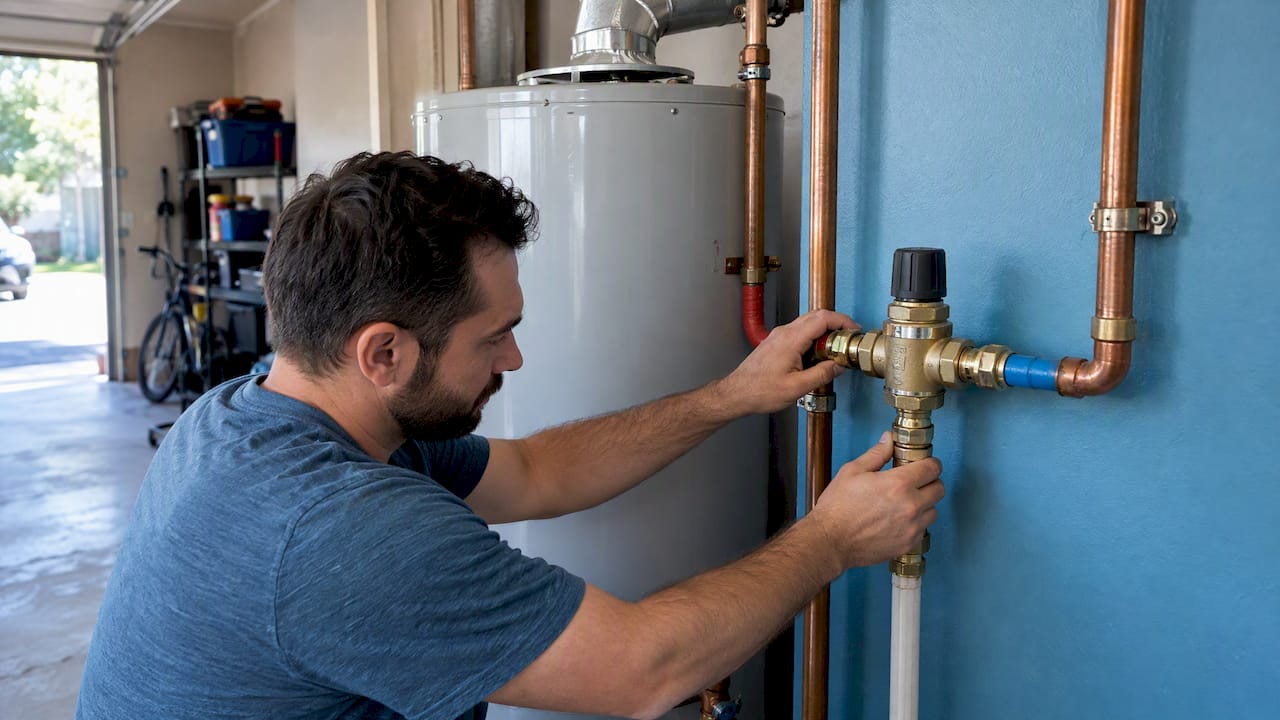
A thermostatic mixing valve (TMV) blends hot water with cold water so the water that reaches your faucets and showers stays at a steady, safe temperature. The main benefits are scald protection, more usable hot water from the same tank, a steadier temperature at the tap, and room to store water hot enough to limit bacterial growth. Below we explain how each benefit works, where a TMV does not help, what upkeep it needs, and how to decide if your home or building should have one.
TL;DR
- A TMV blends hot and cold water to a set outlet temperature, so a hotter tank no longer means hotter water at the tap.
- Because the tank can run hotter, you get more usable hot water. ENERGY STAR guidance says going from 125°F to 140°F adds about as much hot water as a tank 10 to 15 gallons larger.
- Not every mixing valve protects against scalding on its own. Valves for showers and bathing fixtures are listed to different standards than valves at the water heater.
- A TMV needs periodic inspection and cleaning. When one wears out, it tends to let more hot water through, so check your tap temperature.
- A licensed plumber should size, pair and install it. The right valve depends on your water heater, your fixtures and who uses the water.
Table of Contents
- What a mixing valve does at a water heater
- The benefits of a thermostatic mixing valve
- Where a mixing valve does not protect you
- When a TMV makes sense
- Installation and upkeep
- Our perspective
- Get a mixing valve assessed by a local plumber
- FAQ
- Sources
What a mixing valve does at a water heater
A water heater stores water at whatever temperature the thermostat says. Without a mixing valve, that is also the temperature of the water leaving the tank. With one, the hot outlet of the tank feeds the valve, a cold line feeds the same valve, and the valve sends out a blend at the temperature you set.
Manufacturers describe the job in similar terms: a TMV mixes hot and cold water to hold a constant safe temperature at shower, bath and faucet outlets, and it can control temperature either at the heat source or at the point of use. That is why people searching for a “mixing valve for a water heater” and people searching for “thermostatic mixing valve” are usually asking about the same device.
How the valve holds its temperature
Inside the valve is a temperature-sensitive element. It expands and contracts as the incoming hot and cold supplies change, and that movement shifts an internal slide valve that proportions the hot and cold water entering the valve. If someone flushes a toilet and the cold supply dips, the element reacts and cuts back the hot side so the shower does not spike.
The same design gives a useful failure response. If the cold supply is lost completely, the element expands fully and closes the slide valve against the hot seat, shutting off the hot supply rather than sending scalding water to the outlet. That behavior is described by one manufacturer for its own product line, so confirm the specific behavior of any valve you buy with the installer.

The benefits of a thermostatic mixing valve
1. Protection against scalding
This is the benefit most people care about. Hot water that is comfortable for adults can burn a child, an older adult or someone with reduced sensation within seconds. A TMV caps the temperature that leaves the valve, so the tank setting stops being the temperature you bathe in. One manufacturer describes water safely delivered at 120°F when a valve is used on a water heater.
For showers and bathing fixtures, a lower number is recommended. Watts advises valves listed to ASSE 1016 or ASSE 1070 for bathing and washing fixtures, with a maximum of 110°F at shower and bathing fixtures. If anyone in your home is very young, elderly, or has a medical condition that affects how they sense heat, ask your plumber and your doctor what outlet temperature suits them.
2. More usable hot water from the tank you already have
This is the benefit that matters to families who run out of hot water. A tank’s capacity is not only its gallons. It is also how hot the stored water is, because hot water gets diluted with cold at the tap anyway.
A TMV lets the tank run above 125°F, which raises its thermal storage. ENERGY STAR’s installation guidance says raising a tank from 125°F to 140°F provides about the same available hot water as adding 10 to 15 gallons of tank capacity. A U.S. Department of Energy field study of plug-in heat pump water heaters makes the same point: an integrated mixing valve separates tank temperature from delivery temperature, adding hot water capacity while limiting scald risk, and it can help reduce hot water runout events.
A practical example: a household with a 40-gallon tank and two teenagers who shower back to back. Turning the thermostat up without a mixing valve would be a scald hazard. Turning it up with a correctly installed valve gives the family more showers per recovery cycle while the water at the shower stays where it was.
You will see blogs promising a fixed percentage gain, such as 25% more hot water. The real figure depends on your tank temperature, your mixed outlet temperature, the incoming water temperature and how you use water. Treat any single number as a rough guide, and ask for a calculation for your own setup.

3. A steadier temperature at the tap
TMVs hold outlet temperature even when the hot or cold supply temperature varies. In a house, that means fewer surprises when the dishwasher starts or a second shower turns on. In a commercial building with long recirculation loops, it means more consistent water across many fixtures.
4. Room to manage bacteria risk
Storing water at a low temperature saves a little energy but leaves more room for bacteria to grow. ENERGY STAR notes that a TMV can reduce Legionella risk when tanks are heated to 140°F. The valve is what makes that setting safe to use, because it brings the delivered water back down before it reaches anyone. For buildings with vulnerable occupants, such as care facilities or multi-unit housing, ask a plumber about this alongside your local requirements.
5. Flexibility for load management and sizing
Two further benefits are less visible to homeowners but matter to property managers and builders. ENERGY STAR notes a TMV can let users heat extra water when electricity rates are low for load management. Watts adds that mixing valves can reduce the size or BTU capacity needed to meet peak system demand. On a new build or a large renovation, that can affect equipment choices.
Where a mixing valve does not protect you
The word “mixing valve” covers several devices, and they are not interchangeable. This is where many online answers go wrong.
ASSE guidance explains that distribution-system mixing valves (ASSE 1017) are installed at or near the hot water source. Used alone, they do not provide thermal shock protection or adequate scald protection at a fixture. In other words, a valve on the water heater helps with tank temperature and delivery, but a shower or bathing fixture may still need its own point-of-use protection.
| Device | Where it sits | What it does | What it does not do |
|---|---|---|---|
| Distribution mixing valve (ASSE 1017) | At or near the water heater | Blends hot and cold to a fairly uniform temperature for the whole system | Does not give thermal shock or adequate scald protection on its own |
| Point-of-use thermostatic valve (ASSE 1016 or 1070 for bathing and washing fixtures) | At the shower, tub or fixture | Controls the temperature of that outlet | Does not manage storage temperature for the whole system |
| Pressure-balance valve | At the shower or tub | Equalizes hot and cold pressures to limit temperature swings | Does not limit the maximum outlet temperature |
That last row answers a common question. A pressure-balancing device minimizes temperature variation caused by pressure changes but does not cap how hot the water can get. A thermostatic valve reacts to temperature itself, which is why it is the better pick when the goal is scald protection. Pressure-balance valves are common in existing showers, and many are fine for their purpose, but they solve a different problem.
When a TMV makes sense
In our experience, these situations are the strongest cases:
- You want more hot water without buying a bigger tank. If the tank is sound and the household simply outruns it, a valve plus a higher tank setting can be a cost-effective fix. Check the age and condition of the heater first.
- Children, older adults or people with reduced heat sensitivity live in the home. The cap on delivered temperature is the reason to install one.
- You are setting a tank to 140°F for bacteria control. The valve is what makes that setting usable.
- You are replacing a water heater or remodeling a bathroom. The plumbing is open, access is easy and the valve can be planned with the rest of the work. Our bathroom and fixtures service covers fixture-level planning.
- You manage a commercial property. Multiple fixtures, public use and long pipe runs raise both the scald and the temperature-consistency stakes. See our commercial plumbing page for the work we handle.
It may be less useful if your heater is near the end of its life. A valve cannot fix a failing tank, and our guide to water heater replacement signs helps you judge that first. If you are deciding what to set your tank to, read what to set and why before touching the thermostat.
Installation and upkeep
A TMV is not something to wire in and forget. Watts recommends that for hot-water supply systems you use an ASSE 1017-listed valve at the source, install a way to isolate the valve for service, and consider check valves where extreme pressure differences may occur. Those details are why we suggest a licensed plumber handle it: the valve, the isolation, the check valves and the fixture-level protection all have to fit together.
Inspection and cleaning
Regular inspection helps the valve last and keeps the system working properly. It can also reveal corrosive water conditions or unauthorized adjustments. How often you need to clean it depends on your local water conditions: hard water and sediment build up inside the valve, which can make it sluggish.
Rheem’s guidance says valves need cleaning to keep working and have a typical lifespan of about 5 to 6 years. Treat that as a planning figure, not a guarantee, since water quality and use vary.
How a worn valve fails
This part is worth knowing as an owner. Mixing valves typically fail gradually and let more hot water through over time, so the water can become hotter than is safe without any obvious break. Check the temperature at a tap now and then with a thermometer, and write the result and the date on the heater. If the number climbs, call a plumber instead of adjusting it yourself.
This fits with ordinary tank care. Our water heater maintenance tips cover flushing and inspection, and the valve can be checked on the same visit.
Our perspective
Most mixing valve questions we hear start the same way: “My water heater runs out too fast, so should I just turn it up?” We understand the thinking, but turning up the thermostat on its own trades a hot water problem for a scald risk. The valve is what lets you do the first without the second.
We also see people assume that one valve at the heater covers every fixture. It does not, as the standards above make clear. A good installation starts by asking who uses the water, which fixtures are involved, and what the heater can really deliver. Sometimes the answer is a valve at the tank. Sometimes it is point-of-use valves in the bathrooms. Sometimes it is a new heater, because the old one has more problems than a valve can solve.
The last thing we would say is to not skip the maintenance. A valve you never check is a safety device you cannot trust. Put a thermometer test on your calendar, and have a licensed professional look at the valve whenever the heater is serviced.
— Serghei
Get a mixing valve assessed by a local plumber
If you are in Burbank and want to know whether a TMV fits your water heater, we can look at the tank, the fixtures and the household or building it serves, and give you a free quote for the work. See our water heater services or reach us through our home page. We are licensed and insured, and we work on both residential and commercial properties.
If you are planning a larger project, the water heater project checklist lists what to settle before work begins, including where a mixing valve belongs.
FAQ
Does a thermostatic mixing valve really give you more hot water?
Yes, indirectly. It lets the tank store water hotter, then blends it down at delivery. ENERGY STAR says moving from 125°F to 140°F is comparable to adding 10 to 15 gallons of tank capacity. The real gain depends on your setup and usage.
Is a mixing valve the same as a pressure-balance valve?
No. A pressure-balance valve evens out hot and cold pressure to reduce temperature swings, but it does not limit how hot the water can get. A thermostatic valve responds to temperature and can hold a set maximum, which makes it the stronger choice for scald protection.
What temperature should a mixing valve be set to?
For general delivery from a water heater, manufacturers cite 120°F. Watts recommends a maximum of 110°F for showers and bathing fixtures. Your plumber can set the figure for your household, especially if children, older adults or medical needs are involved.
How do I know if my mixing valve is failing?
The usual sign is water that gets hotter than before, since these valves tend to fail gradually. Test the tap temperature with a thermometer from time to time. If it creeps up, have a plumber inspect, clean or replace the valve.
Can I install a mixing valve myself?
We would not recommend it. The right valve depends on the standard it is listed to, where it sits and what it protects, and an error can leave you with a false sense of safety. A licensed plumber can match the valve to your heater and fixtures and add the isolation and check valves the system needs.
Sources
- Thermostatic Mixing Valves, Cash Acme
- Thermostatic Mixing Valves, Watts
- How does a thermostatic mixing valve work?, Horne
- Heat Pump Water Heater Installation Best Practices, ENERGY STAR
- Plug-In Heat Pump Water Heater Field Study Findings, U.S. Department of Energy
- Guidelines for Temperature Control Devices, ASSE
- How a Mixing Valve Can Get More Out of Your Water Heater, Rheem
Leave a Reply