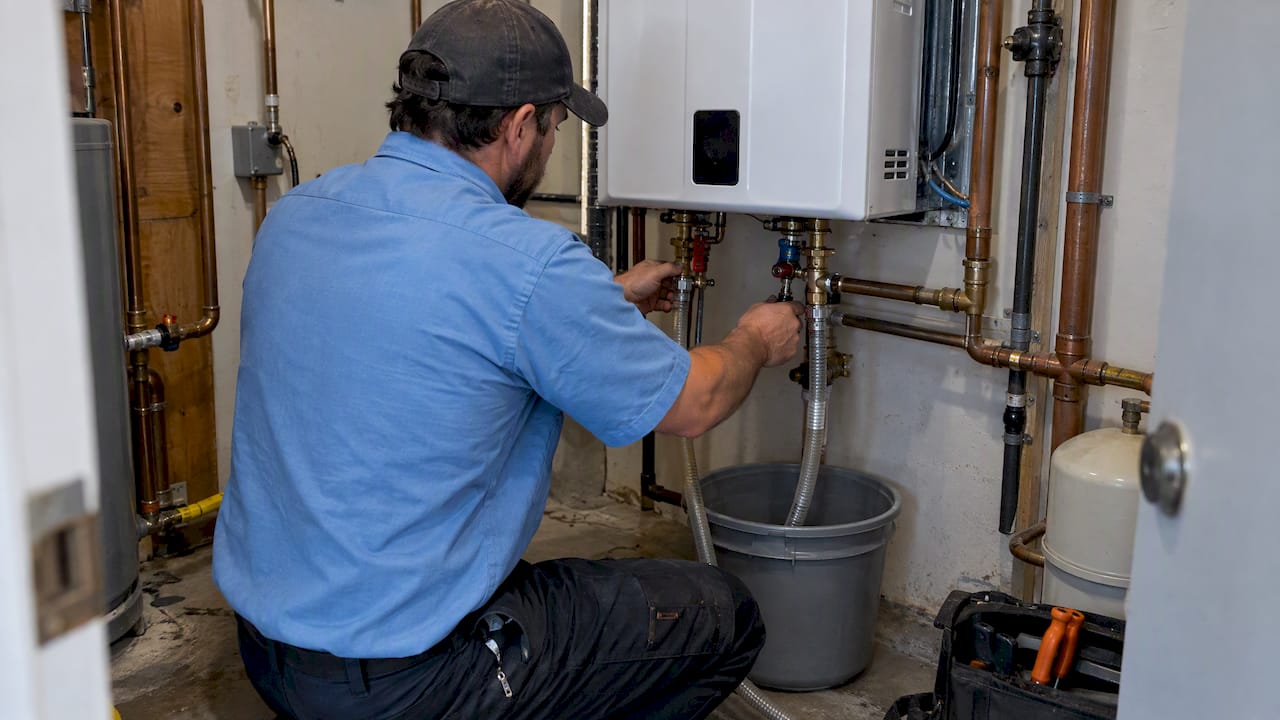
Tankless water heater maintenance comes down to four habits: clean the inlet filter on a regular basis, flush or descale the heat exchanger on a schedule matched to your water hardness, inspect venting and ignition components on gas units, and bring in a licensed plumber when a flush does not restore flow or when gas and safety issues appear. Keep records of each service date, since manufacturers often tie warranty coverage to proof of regular upkeep.
TL;DR:
- Regularly flushing the heat exchanger is necessary twice a year in areas with very hard water and less frequently in soft water zones.
- Inspecting burners, venting, and ignition components on gas units should be part of annual maintenance to prevent safety hazards and ensure efficient operation.
- DIY vinegar flushing is a manufacturer-supported method for cleaning scale buildup, but safety steps and proper procedures must be followed to avoid damage.
- A professional service typically includes a comprehensive diagnostic, inspection, and record keeping, which helps preserve warranty coverage.
- Property managers managing multiple units should consider setting up a formal maintenance schedule and documentation to prevent costly repairs and ensure safety.
Table of Contents
- Maintenance checklist for homeowners and property managers
- How often to service: factors that change the schedule
- Step-by-step DIY flush (vinegar method) and safe variations
- Troubleshooting common problems and diagnostic codes
- Water quality, scaling prevention, and system-level solutions
- Safety, codes, and winterization notes
- PSV Plumbing perspective: when to hire a licensed pro and what to expect
- What homeowners get wrong about tankless maintenance
- Professional water heater maintenance involves a full service visit covering inspection, an optimized flush, filter cleaning, combustion and venting checks on gas units, and a written report you can keep for warranty records. Licensed, insured technicians help protect both your safety and your manufacturer’s warranty terms, something a rushed DIY flush can accidentally void if a step gets missed.
- FAQ
- Sources
- Primary manuals and authoritative guidance
Maintenance checklist for homeowners and property managers
A tankless unit rewards attention in a few specific places. None of these tasks require advanced tools, but skipping them is the fastest way to lose flow, efficiency, or warranty coverage.
Start with the inlet water filter or strainer, usually located where the cold water line enters the unit. Shut off the water supply, remove the screen, rinse away sediment, and reinstall it. Most manufacturers recommend checking this every few months, more often in homes with older pipes or well water.

The heat exchanger needs periodic flushing to clear mineral scale, since scale buildup can restrict flow and reduce the unit’s working life according to Rinnai’s installation and operation manual. On gas models, check the burner assembly, flame sensor, and igniter for soot or corrosion, and confirm the venting has no blockage, rust, or loose joints. Electric units need a visual check of wiring connections and controls instead.
Condensing models have a condensate drain and trap that can clog with sediment, so clear them during the same visit. If your unit has pressure or temperature monitoring devices, confirm they read within the manufacturer’s normal range.
- Remove and rinse the inlet filter on the schedule your manual lists.
- Flush the heat exchanger before scale builds up enough to choke flow.
- Inspect burners, igniter, and venting on gas units for soot or blockage.
- Clear the condensate trap on condensing models.
- Log every service date, reading, and any diagnostic code you see.
Keeping a simple written log, even a notebook by the unit, makes it far easier to spot a pattern before a small problem turns into a cold shower. For a broader preventive routine across the rest of the house, see this residential plumbing checklist.
How often to service: factors that change the schedule
Water hardness drives the maintenance calendar more than any other factor. Soft water lets a heat exchanger go years between flushes, while hard water can demand attention twice a year.
**Flushing frequency varies depending on factors such as model, usage, and water hardness, ranging from multiple times annually to a few times over several years depending on the model, how often the unit runs, and the hardness of the water passing through it, according to the DOE’s Measure Guideline on tankless water heaters."}]} Hardness is measured in grains per gallon, and homes above roughly 8 to 14 grains per gallon often fall into the range where manufacturers recommend either more frequent flushing or a water softener, a threshold tied to the USGS reference on water hardness.
A rough rule of thumb: very hard water often calls for flushing twice a year, moderate hardness once a year, and soft water every two to three years. Multifamily buildings and commercial setups with constant demand wear through scale faster and need shorter intervals. Your unit’s manual is the final word on what keeps the warranty intact.

Step-by-step DIY flush (vinegar method) and safe variations
Flushing a tankless heat exchanger with white vinegar is a manufacturer-documented method, not a workaround. Technical Bulletin 188 lays out the exact hookup and timing for an optimized flush on supported models, and the same general sequence applies across most brands.
- Shut off the power (or gas) and the cold water supply to the unit before touching any valve.
- Close the hot and cold service valves and open the purge ports, connecting a small submersible pump and hose to each.
- Place the pump hose in a bucket holding about 4 gallons of food-grade white vinegar, with the return hose draining into the same bucket.
- Run the pump to circulate the vinegar through the heat exchanger for about 60 minutes at a moderate flow rate, per the manufacturer’s optimized flush procedure.
- Disconnect the pump, then run fresh water through the system for several minutes to rinse out any remaining vinegar.
- Remove, rinse, and reinstall the inlet filter, since residue tends to collect there during a flush.
- Close the purge ports, reopen the service valves, restore power or gas, and watch for any diagnostic codes on startup.
Pro Tip: Discard the used vinegar after the flush. Reusing it just recirculates the dissolved scale back into the exchanger.
Stop and call a licensed technician if flow does not improve after the flush, if an “LC” or similar scale-related code keeps reappearing, or if you notice anything off with venting, gas smell, or combustion air during the process. Never substitute a CLR-type descaler without checking your manual first, since some of these products can damage copper heat exchangers.
Troubleshooting common problems and diagnostic codes
Most tankless complaints trace back to one of a handful of causes, and matching the symptom to the likely culprit saves a wasted service call.
- Low flow or weak hot water delivery usually points to a clogged inlet filter or scale narrowing the heat exchanger passages.
- No hot water or ignition failures on gas units mean checking the gas supply and power first, then the burner and ignition components.
- Temperature swings or a brief burst of cold water mid-shower, often called a cold-water sandwich, relates to how the plumbing draws water rather than a unit defect, and a recirculation loop or small buffer tank can smooth it out.
- Gas odor or symptoms consistent with carbon monoxide exposure are not a DIY situation. Shut down the unit and call a licensed plumber or your gas utility immediately.
If a unit keeps throwing the same code after a proper flush and filter cleaning, it may be approaching the end of its service life rather than needing another round of maintenance. This guide to replacement signs and this installation cost breakdown are useful next steps if replacement looks more practical than repeated repair.
Water quality, scaling prevention, and system-level solutions
Tankless heat exchangers run hotter and hold far less water than a tank-style unit, so mineral scale builds up faster and has a bigger effect on performance. Left unchecked, scale narrows the internal passages, cuts flow, and forces the unit to work harder, which shortens its service life.
Hardness is the main trigger for manufacturer recommendations around softening. Readings at or above the thresholds covered in the USGS hardness reference often sit in the range where a softener pays for itself in fewer flushes and longer exchanger life. Building America research notes that tankless units are efficient “when carefully specified, sized, centrally located, properly installed, and regularly maintained,” a point made in the DOE’s comparison of residential water heating technologies.
- Salt-based softeners remove hardness minerals outright but add sodium and require salt refills.
- Salt-free conditioners alter mineral structure to reduce scale adhesion without adding sodium.
- In-line scale feeders release a small treatment dose into the line, a lower-maintenance option for moderate hardness.
Pipe length and diameter also affect how the system performs day to day. Longer, wider lines hold more standing water and add wait time for hot water to arrive, which some homeowners mistake for a unit malfunction.
Safety, codes, and winterization notes
Venting and combustion air matter as much as the heat exchanger itself. Check vent runs for corrosion, proper clearances, and any sign of exhaust leaking into living space, since poor venting is a carbon monoxide risk on gas units.
Freeze protection depends on your model’s temperature rating. Many tankless units include a freeze protection feature or heat tape, but only while connected to power, so a drain-down or auto-drain valve matters in homes prone to outages in cold weather. Electric units lose all function during a power outage, and a small backup power source can keep controls and freeze protection running if that is a recurring concern in your area.
Local code sometimes requires a pressure relief valve even in situations where it is not otherwise specified by national plumbing standards, so check with your municipality or a licensed plumber rather than assuming the manual covers every local requirement.
PSV Plumbing perspective: when to hire a licensed pro and what to expect
It is advisable to call a licensed plumber when scale keeps returning after a proper flush, when venting or combustion components need inspection, or when a commercial or multifamily system needs documentation for warranty purposes. A professional maintenance visit typically includes a full diagnostic check, an optimized flush, a combustion and venting inspection on gas units, filter replacement, and a written service report for records.
Before a visit, write down any diagnostic codes you have seen and when they appeared. Ask the technician what caused the issue and what interval they recommend going forward based on your home’s water hardness.
What homeowners get wrong about tankless maintenance
The biggest misconception is treating a tankless unit like a “set it and forget it” appliance because it has no tank to flush. Water hardness is the real schedule, not a fixed yearly reminder, and a home on hard water that waits three years between flushes is asking for a service call it could have avoided.
The vinegar flush gets undersold, too. It is a manufacturer-documented procedure, not a workaround, and most homeowners can do it safely with basic tools. Where DIY maintenance should stop is anywhere gas, venting, or persistent error codes are involved. That is not caution for its own sake. It is the line between routine upkeep and a safety issue.
Prioritize the inlet filter and a hardness-based flush schedule first. Everything else on the checklist matters, but those two habits prevent most of the service calls this article covers.
— Serghei
Professional water heater maintenance involves a full service visit covering inspection, an optimized flush, filter cleaning, combustion and venting checks on gas units, and a written report you can keep for warranty records. Licensed, insured technicians help protect both your safety and your manufacturer’s warranty terms, something a rushed DIY flush can accidentally void if a step gets missed.

- Request a free quote for a maintenance visit or a one-time flush and inspection.
- Ask about a recurring service plan if you manage multiple properties or a commercial system.
- Review our water heater services page for the full scope of what a visit includes.
Property managers setting up a formal maintenance cadence across multiple units may also find this HVAC service agreement template useful as a starting point for documentation.
FAQ
What maintenance does a tankless water heater require?
Routine maintenance includes cleaning the inlet filter, flushing the heat exchanger to remove mineral scale, and inspecting burners, venting, and ignition components on gas units. Frequency depends mainly on your water’s hardness, ranging from twice a year to once every few years.
Can I service my tankless water heater myself?
Yes, cleaning the inlet filter and performing a vinegar flush are manufacturer-documented procedures that most homeowners can handle with a small pump, hoses, and a bucket. Stop and call a licensed plumber if flow does not improve afterward or if the issue involves gas, venting, or repeated error codes.
What is the most common problem with tankless water heaters?
Reduced flow or inconsistent hot water delivery is the most common complaint, and it usually traces back to a clogged inlet filter or scale buildup inside the heat exchanger. Regular flushing on a hardness-based schedule prevents most of these cases.
Why do plumbers not recommend tankless water heaters?
Plumbers do recommend tankless water heaters, but they stress that proper sizing, installation, and ongoing maintenance determine whether the unit performs well and saves money over time. A tankless unit installed or maintained incorrectly will underperform regardless of the technology itself.
Sources
- Measure Guideline: Transitioning to a Tankless Water Heater (DOE / Building America)
- Rinnai: Tankless Water Heater Installation and Operation Manual
Primary manuals and authoritative guidance
This article draws on the DOE’s Measure Guideline and its comparison of residential water heating technologies, along with Energy, Rinnai’s installation and operation manual, and Technical Bulletin 188 on optimized flushing. Hardness thresholds reference the USGS guide to water hardness. Check your unit’s own manual for model-specific requirements before performing any maintenance.
Leave a Reply