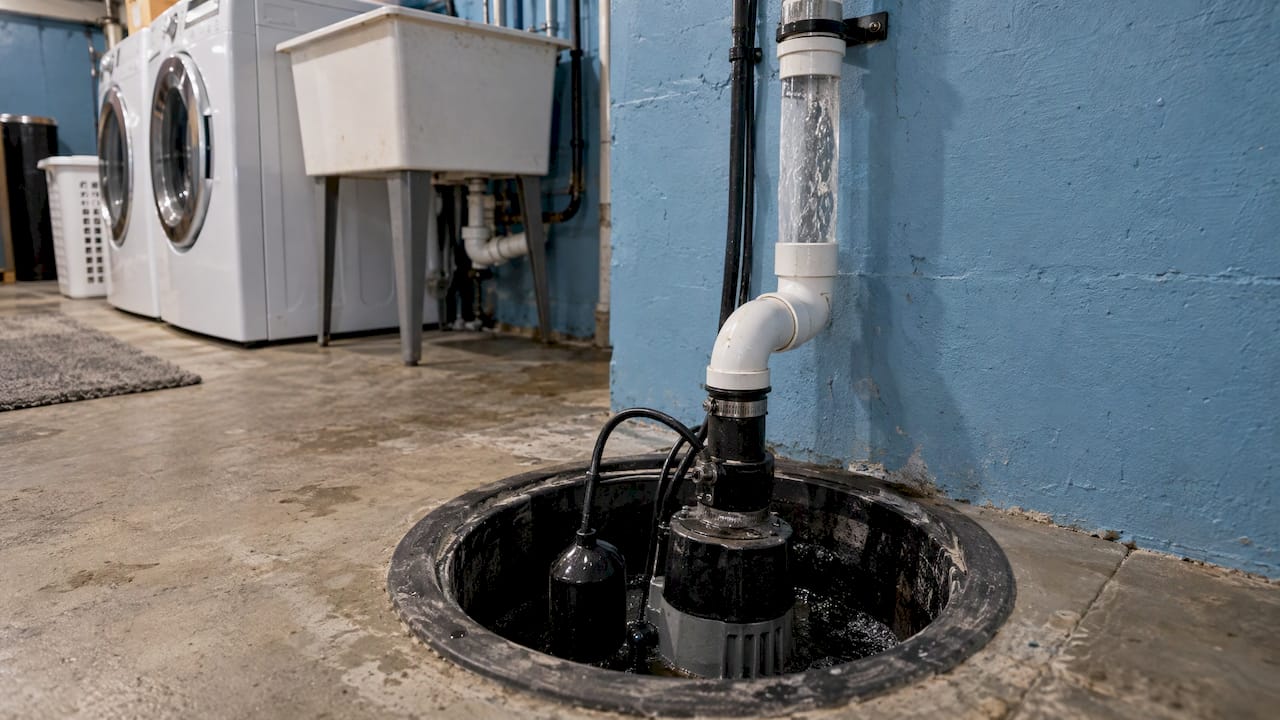
A sump pump that runs constantly is either fighting a lot of incoming water or has a part that is telling it to keep going. The usual suspects are a stuck float switch, a failed check valve, a clogged or frozen discharge line, a pump too small for the job, or groundwater that has risen. Running for a while after a storm is normal. Running for hours in dry weather, or cycling every few seconds, is not. Below we explain how to tell the difference, what is safe to check yourself, and when a licensed plumber should take over.
TL;DR
- Running often during heavy rain or a spring thaw is normal. Running nonstop with a dry pit or in dry weather points to a fault.
- The most common causes are a stuck float switch, a failed check valve, a blocked discharge line, an undersized pump and a high water table.
- Always unplug the pump before you reach into the pit. Never use an extension cord to power it.
- A pump that runs without rest overheats and wears out early, so do not wait on a nonstop pump.
- A basement bathroom uses a different machine, a sewage ejector pump, with its own maintenance needs.
Table of Contents
- What a normal sump pump cycle looks like
- The most common reasons a sump pump won’t shut off
- What to check when it runs nonstop after heavy rain
- Safe steps to fix a pump that keeps running
- How long can a sump pump run before it burns out?
- Basement bathroom pumps: a different machine
- Our perspective
- Plumbing help in Burbank
- Prevent the next runaway pump
- FAQ
- Sources
What a normal sump pump cycle looks like
Before you decide something is broken, know what healthy looks like. A sump pump sits in a pit (the basin) and starts when a float rises with the water level. It pushes water out through a discharge pipe and shuts off when the float drops. If you want the basics of the whole system first, our guide, what a sump pump is and how it works, covers it.
A typical healthy pump runs in short bursts. One published guide puts a normal run at about 10 to 30 seconds at a time, with cycling every two to three minutes during heavy rain or a spring thaw being expected, and many pumps not running at all during a dry week. Treat those numbers as a rule of thumb, since pit size, pump model and soil all change them.
Here is a quick way to sort what you are hearing:
| What you notice | Likely meaning | What to do |
|---|---|---|
| Runs every few minutes during a storm, then settles within hours or days | Normal response to heavy groundwater | Keep watching, make sure the discharge is clear |
| Runs for 10 to 20 seconds, stops, then starts again right away | Water flowing back into the pit, often a check valve | Inspect the check valve |
| Runs nonstop with the pit nearly empty | Float stuck in the ON position or obstructed | Unplug, then free the float |
| Runs nonstop and the pit stays full | Too much inflow, blocked discharge, or an undersized pump | Check the discharge line, then call a plumber |
| Runs on dry days, week after week | Rising water table or recirculating water | Have the site evaluated |
One more point on the numbers. Short cycling is hard on the motor, and the pump industry’s trade association notes that a longer pumping cycle is generally better for pump life. So very frequent starts are a problem even if the pump never runs continuously.
The most common reasons a sump pump won’t shut off
A stuck or obstructed float switch
This is the first thing to look at. A municipal guide on pump failures lists a float or switch stuck in the ON or OFF position as a common reason a pump runs continuously or does not run at all. The float can catch on the pit wall, the discharge pipe, the power cord or debris. It can also get tangled in its own tether.
Manufacturer guidance from Pentair says that continuous running usually means either a lot of water coming in or a float stuck in the ON position. A broken switch that does not return to its original position can keep a pump going even when the basin holds no water.
A simple clue: look into the pit (after unplugging, see the safety steps below). If the pit is nearly empty and the motor is still running, suspect the float or switch.
A failed check valve
A check valve is a one-way valve on the discharge pipe. It lets water leave the pit and stops it from draining back in when the pump turns off. NDSU Extension explains that either type of sump pump should have one, because water flowing back and forth makes the pump start and stop more often than necessary and shortens its life.
When the valve sticks open, fails or is installed backward, the pump pushes the same water out again and again. The classic sign is a short run, a shutoff, then a restart almost immediately. You may also hear a thump or see water drop back into the pit right after the motor stops.
A pump that is too small, or a pit that is too small
The municipal guide mentioned above also points out that an undersized pump can be overworked, run continuously and eventually burn out. A pit that is too small has the opposite problem. The float travels only a short distance between OFF and ON, so the pump cycles constantly with even a small inflow. If your pump starts many times an hour in normal, non-storm weather, ask a plumber whether the pit, the float height or the pump needs to change.
A blocked, frozen or leaking discharge line
If water cannot leave, the pump keeps working and the pit keeps filling. Clogs, kinks, ice in winter and a crushed section of pipe all do this. A clogged drain line can keep the pump running as well. Walk the discharge line outside while the pump runs. Water should come out freely at the end and spread away from the foundation. If it pools at the wall and soaks back in, that water may simply return to the pit.

A high water table
After a wet season the groundwater around your home can stay high for weeks. Bob Vila’s explainer notes that a rise in the water table or increased groundwater can make a pump run when there is no rain, and that a plumber or basement waterproofing specialist can help if the pump runs nonstop for that reason. Some properties need more than one pump or a different drainage approach altogether. If you are weighing options for the yard side of the problem, this comparison of a French drain versus a sump pump explains how the two handle water differently.
Low voltage and wiring problems
Pentair advises that extension cords, or an outlet that shares a breaker with other devices, can cause low voltage. The pump then draws more amps and runs hotter, and heat shortens motor life. A pump trade document recommends a separately protected, properly grounded circuit sized for the pump, and no extension cord. Electrical changes belong with a licensed electrician.
What to check when it runs nonstop after heavy rain
After a big storm, a pump working hard is doing its job. Use this order to decide whether it is just busy or truly stuck.
- Listen and look from outside the pit. Is the discharge water leaving at the outlet, and is it a steady flow? No flow with a running motor suggests a blocked line, a failed impeller or a pump that has lost its prime.
- Check where the water goes. Make sure the outlet is clear and sends water well away from the house. Water that drains back toward the foundation can loop through the pit.
- Look at the pit level. Water rising toward the top means the pump cannot keep up. That is the moment to call, not to wait.
- Watch the trend. A pump that settles down within a day or two after the rain stops is usually fine. One that keeps running well after the ground has dried is not.
- Note the sound. A grinding, humming or hot-smelling motor needs attention at once.
A few other points matter during a storm. A power outage stops a standard pump, so a battery backup or a water-powered unit is worth asking a plumber about. A backup alarm gives early warning before water reaches the floor. If water is already entering the living space, call a plumber right away and keep away from standing water near electrical outlets or appliances.
Safe steps to fix a pump that keeps running
Pentair’s guidance says the basin cover should be removed and power disconnected before servicing. Follow that every time. Never reach into a pit with the pump plugged in, and never stand in water to do it.
- Unplug the pump. Do not rely on the float to keep it from starting. If the outlet is wet, or you cannot reach it dry, shut off the breaker for that circuit only when you can do so without standing in water. If you cannot, call a professional.
- Inspect the pit. Pentair advises looking for anything that stops the float from settling to OFF. Remove the obstruction, or reposition the pump or switch so the float moves freely.
- Clear debris. Gravel, silt and bits of material in the pit can jam the float or the pump inlet. Remove what you can reach.
- Look at the check valve. If it is cracked, clogged or in backward, the arrow should point away from the pump, in the direction of flow. Replacing a check valve involves cutting into the discharge pipe, and a poor connection can leak into your basement, so many homeowners hand this part to a plumber.
- Restore power and test. Plug the pump back in and pour in water until the float lifts. The pump should start, empty the pit and stop on its own. If it does not, stop there.
Some of these steps are not DIY territory. Cutting into pipe, resizing a pit, replacing a pump or changing the circuit are jobs for a licensed plumber or electrician. If you try to fix a stuck float and the pump still will not shut off, call someone the same day.
How long can a sump pump run before it burns out?
There is no single safe number, because it depends on the model, the water temperature, the voltage and whether the motor has thermal protection. One pump retailer’s guide suggests that many residential pumps can handle several hours to a day of continuous running in a heavy storm, and that pumps without thermal protection may fail sooner. We would not plan around that figure. What the municipal failure guide does say is that overwork, including an undersized pump running nonstop, can overheat the motor and lead to burnout.
The practical rule: if a pump has been running without a break for more than a few hours and the weather is not extreme, treat it as a fault. If it runs for days with no storm, call a plumber or a basement waterproofing specialist before it overheats.

Basement bathroom pumps: a different machine
Many readers searching this topic also have a basement bathroom. That fixture is usually served by a sewage ejector pump, which is not the same thing as a sump pump.
- A sump pump moves clean groundwater out of a pit and away from the house.
- A sewage ejector pump collects wastewater from below-grade toilets, sinks and showers in a sealed basin and pushes it up to the main sewer or septic line.
One homeowner guide describes the ejector basin as sealed and vented, with a float that triggers the pump to pass solids. Because the basin is sealed and vented through the roof, you do not open it casually the way you might a sump pit. A guide on sewage pumps adds that a check valve on the discharge stops sewage from flowing back into the basin.
If an ejector pump runs constantly or will not shut off, the likely causes mirror the sump pump: a restricted float, a failed check valve or a clog. A pump trade troubleshooting chart lists both a pump that will not turn off and a system that cycles too often, with restricted float movement among the causes. Because the contents are sewage, do not reach into the basin yourself. Call a licensed plumber.
Keeping a sewage ejector pump healthy
The same trade document says to disconnect power before handling the pump and to follow the manufacturer’s maintenance instructions. Beyond that, a yearly routine is common practice:
- Test the pump by running water into the basin until it starts, and listen for a smooth start and a clean shutoff.
- Have the float checked for tangled debris.
- Have the basin walls cleaned about once a year.
- Confirm the check valve holds so sewage does not return to the basin.
- Replace the alarm battery once a year if there is one.
- Flush only toilet paper and human waste. Wipes, hygiene products and other items can clog the pump and jam the float.
For lifespan, there is no single number we can stand behind, since it depends on the pump, the use and the upkeep. In general, a pump that cycles cleanly and is serviced on schedule lasts longer than one that is jammed with wipes or short cycles all day. Any ejector pump that is old, noisy or slow to clear the basin should be looked at before it fails and sends sewage back into the basement.
A basement that gurgles or backs up can also mean a problem further down the line. Our post on a gurgling toilet when the shower runs explains why the basement can show trouble first, and the signs of sewer line problems help you tell a pump problem from a main line problem.
Our perspective
A pump that runs constantly is a symptom, and the cause is rarely the pump alone. In our experience, homeowners often replace a pump when the float, the check valve or the discharge line was the real culprit, and then the same trouble returns.
We look at the whole path the water takes: where it enters, how it is lifted, where it leaves, and what happens to it after that. Our approach is to find the actual cause, explain it plainly and give a quote that tells you what the work involves before anything starts.
We also think drains, sewer lines and fixtures deserve the same attention as the pump. Water that backs up in a basement can start with the pump, with a drain line or with the sewer. Getting a licensed, insured plumber to check all of it saves repeat visits.
If your pump has been running for hours, do not wait for the next storm to find out why.
Serghei
Plumbing help in Burbank
If the basement problem involves more than the pump, we can help with the plumbing around it. PSV Plumbing is a licensed and insured Burbank team that handles bathroom and fixture plumbing, drain cleaning and sewer line services for homes and commercial properties. We offer free quotes, and we keep our pricing transparent.

To talk through what you are seeing, reach us through psvplumbinginc.com and describe the symptoms. The more detail you give about when the pump runs, what it sounds like and what the pit looks like, the faster we can point you in the right direction.
Prevent the next runaway pump
A few habits cut the odds of a pump that will not stop.
- Test the pump each season. Pour water into the pit and watch for a clean start and stop.
- Keep the pit clean. Remove silt and debris, and keep the lid in place.
- Check the discharge outlet. Clear leaves, ice and blockages, and direct water away from the house.
- Give it a dedicated circuit. Use a grounded outlet and avoid extension cords.
- Add a backup and an alarm. They protect you during outages and give early warning.
- Add it to your plumbing routine. Our complete plumbing maintenance checklist and preventive plumbing measures are good places to start.
Property managers with several buildings can fold pump checks into their regular inspections. Our property manager plumbing guide shows how to organize that across a portfolio.
FAQ
Is it normal for a sump pump to run every 30 minutes?
During a heavy rain or a spring thaw, yes, it can be. A pump may start every few minutes in those conditions and still be healthy. If it does the same in dry weather, or runs more than a handful of times an hour with no storm, have the check valve, float and pit size checked.
Why is my sump pump running every 20 seconds?
Very fast cycling usually means water is returning to the pit after each run, often because the check valve has failed. It can also mean the pit is too small, so the float has little room to travel. Both are fixable by a plumber, and fast cycling shortens pump life if left alone.
How do I fix a sump pump that keeps running?
Unplug it first. Then look in the pit for anything holding the float up, and remove the obstruction or reposition the pump or switch. If the float is free and the pump still runs, check the discharge line and the check valve. Anything that needs cutting into pipe or changing electrical work should go to a licensed professional.
Can a sump pump run all day?
It can during a severe storm, but running all day in ordinary weather is a warning. Continuous running overheats the motor and shortens its life, so a pump that does this needs a diagnosis. The cause might be a stuck float, a blocked discharge or a pump that is too small.
Is a basement bathroom pump the same as a sump pump?
No. A sump pump handles groundwater. A sewage ejector pump moves wastewater from basement toilets and fixtures from a sealed, vented basin. If your ejector pump runs constantly or smells, call a licensed plumber rather than opening the basin yourself.
Sources
- Common Points of Failure (sump pump guide)
- Sump Pump Troubleshooting FAQ, Pentair
- Why Is My Sump Pump Running Without Rain, Bob Vila
- Sump Pump Questions, NDSU Agriculture
- Sewage pump installation and maintenance, SSPMA
- Understanding pumps and common pumping issues, SSPMA
- How Often Should a Sump Pump Run
- Basement Ejector Pump: Complete Guide for Homeowners
- Sewage Sump Pump: How It Works, Sizing and Install
Leave a Reply