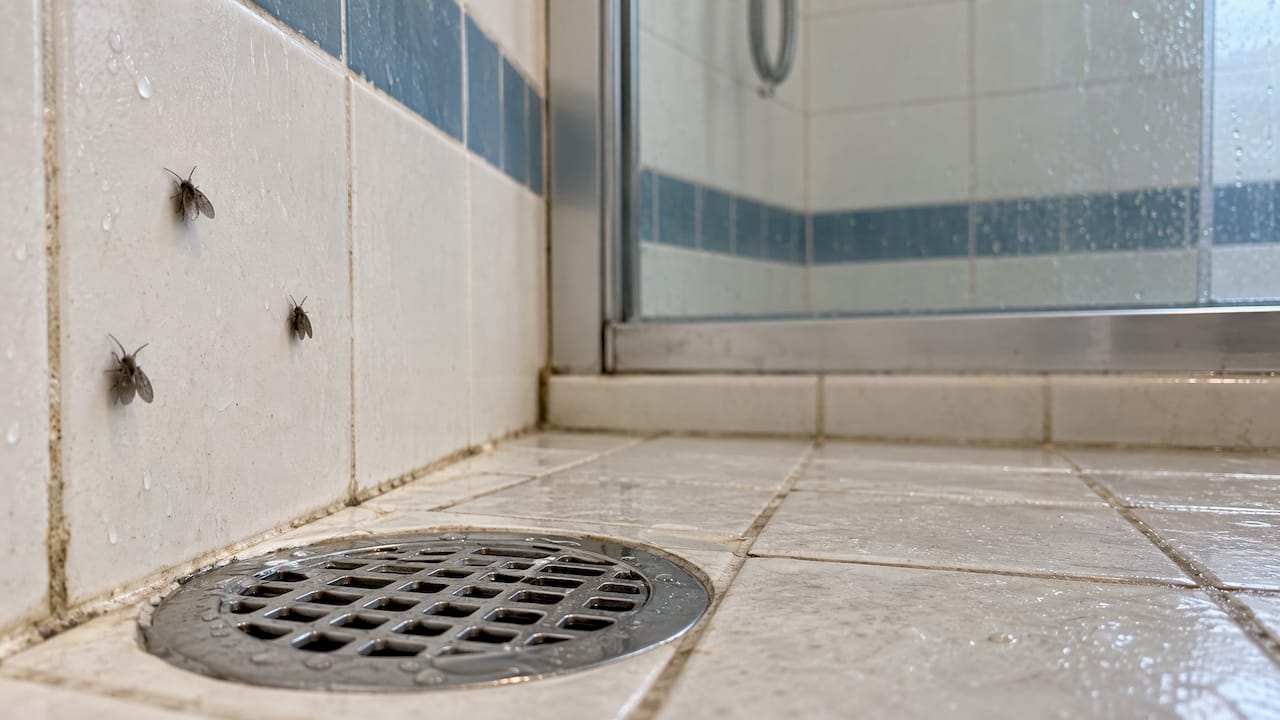
Drain flies in a bathroom come from the slimy film inside a drain or trap, and they only go away when that film is removed. Killing the adults you can see is not enough. Find the drain they breed in, scrub and clean it out, and keep it clean for at least three weeks. If the flies keep coming back after that, the cause is often a plumbing problem, and that is when you need a licensed plumber.
TL;DR
- Drain flies (also called moth flies or drain gnats) breed in the gelatinous slime lining drains and traps, so the fix is removing that slime, not spraying the flies.
- Find the source first. A petroleum-jelly-coated cup placed upside down over a drain overnight shows which drain the flies are using.
- Boiling water and bleach give at best short-term control. A stiff brush and a drain cleaner, followed by regular maintenance, work on the larvae’s habitat.
- Plan on at least 3 weeks of consistent cleaning to break the life cycle.
- Flies that return after careful cleaning, or a sewer smell that won’t quit, can point to a leak or a broken pipe. Call a plumber.
Table of Contents
- Why drain flies show up in a bathroom
- Step 1: Find out which drain they are using
- Step 2: Remove the film that feeds the larvae
- What does not work on its own
- A drain fly problem that is really a laundry room problem
- When drain flies point to a plumbing problem
- Keeping drain flies from coming back
- Our perspective
- Get the drain cleaned properly
- FAQ
- Sources
Why drain flies show up in a bathroom
Drain flies are small, fuzzy, moth-like flies that rest on walls near sinks, tubs and showers. They are weak flyers, so adults are usually found very near the place where they develop. If you see them in the bathroom, the breeding site is almost certainly in or right next to that room.
The larvae live in the film that builds up inside drains and traps. University of Maryland Extension explains that this film is a gelatinous slime, and the larvae feed on the algae, bacteria and fungi in it. Soap residue, hair, skin cells and toothpaste all feed that slime. A drain that is used rarely makes it worse. University of Arkansas Extension notes that a seldom-used guest bathroom shower is a classic spot, because water sits in the trap for long periods.

Bathroom drains are not the only candidates. Alabama Cooperative Extension lists bathtub and shower drains, sink overflow holes, and the base and tank of toilets, especially where there is leakage. The University of Maryland adds sources such as dirty garbage cans, saucers under potted plants and condensate pans under refrigerators and air conditioners.
Are they harmful?
Mostly they are a nuisance. Washington State University says they do not bite people or animals, and most species are merely annoying. The University of Arkansas adds that they are not attracted to human food. What they do tell you is that there is moist organic material sitting in stagnant water near a drain. That is worth fixing for its own sake.
Step 1: Find out which drain they are using
Do not clean every drain in the house at random. Confirm the source first, so you spend your effort in the right place.
- Do a trap test. NC State Extension describes covering a drain with a translucent container coated inside with petroleum jelly, turned upside down over the drain, and leaving it overnight or for a few days. UC IPM suggests leaving a petroleum jelly or oil-coated inverted cup or jar in place for 24 hours. Flies that get stuck show you that drain is a breeding site.
- Check the usual signs. Alabama Extension says slow drainage, bubbling and foul odors from a drain suggest a possible breeding site.
- Look inside. Alabama Extension also describes removing the drain plate or trap parts, scraping the slimy film from inside the pipe with a stiff brush, and checking the slime for live larvae.
- Test every drain in the room. That includes the tub overflow, the floor drain if you have one, and the sink you never use. One neglected drain can supply flies for the whole bathroom.
If the smell is as bothersome as the flies, our guide on testing each fixture first when your bathroom smells like sewer walks through the same fixture-by-fixture logic.
Check the trap, too
Every fixture drain has a curved trap that holds water to block sewer gases. The shape matters when you are cleaning: a standard P-trap is easy to open and brush out, while other designs hide slime in different places. If you want to understand how a bottle trap versus P trap differs in water seal and layout, that comparison helps you spot which part of your drain is holding the film.
Step 2: Remove the film that feeds the larvae
This is the step that decides whether the flies come back. Utah State University says the larvae hide behind the scum, which makes boiling water, pesticides and other chemicals ineffective on their own. Physical removal is the answer.
- Scrub. Use a stiff, hard-bristle brush to scrape the film from the inside of the drain as far down as you can reach. Utah State recommends exactly this to remove the larval habitat.
- Clean the trap. If you can safely remove and clean the trap, do so. NC State says the most effective way to correct or prevent drain fly problems is to clean toilets, drainpipes and traps to remove the rotting organic matter the larvae eat.
- Use a drain cleaner, then flush with hot water. The University of Maryland recommends cleaning drains and traps mechanically or with an over-the-counter drain cleaner, followed by hot water.
- Switch to an enzyme maintenance product. Utah State and UC IPM both recommend an enzymatic drain cleanser to keep drains free of organic film. University of Minnesota Extension also says a biological drain cleaner can remove organic material after you remove the gunk with a stiff brush.
- Keep going. University of Arkansas Extension says control takes thorough cleaning and maintenance for at least 3 weeks or longer to break the life cycle.
For the mechanics of snaking, plunging and safe product use, see our step-by-step drain cleaning guide for homeowners and our overview of drain cleaning methods, safety and tips. If you are choosing a product, our roundup of drain cleaning products compares options.
Safety when you clean
Never mix drain products. NC State warns not to rinse a drain with bleach after using a caustic drain cleaner, because the combination can produce chlorine gas. Read the label, ventilate the room, wear gloves and eye protection, and run one product at a time. Do not pour insecticides down the drain either: the University of Arkansas notes that no insecticide products are registered for use in drains or sewer systems.

What does not work on its own
Most people try the quick fixes first, and most of them fail for the same reason: they hit the flies or the surface, not the film.
| Common fix | What research says |
|---|---|
| Boiling water or bleach | UC IPM says these do not remove the organic film and give at best short-term control. |
| Pesticides poured down the drain | Not registered for drains or sewer systems, according to the University of Arkansas. |
| Sticky paper or UV traps | They capture some adults but will not eliminate an infestation (University of Arkansas). |
| Drowning adults | Adults are hard to drown because they trap air bubbles (University of Arkansas). |
| Scrub plus cleaner plus enzyme upkeep | Targets the larval habitat directly (Utah State, UC IPM). |
Traps for adult flies can still be a useful way to watch your progress. Just treat them as a gauge, not as the cure.
A drain fly problem that is really a laundry room problem
Many people searching for drain flies are also noticing a damp, sewer-like smell from the washing machine drain or laundry room. The two often share a cause: a drain that holds slime or no longer holds water.
Laundry-room sink drains and traps are on Alabama Extension’s list of common indoor breeding sites, especially where slime builds up. So scrub and clean them just like the bathroom ones.
Then look at the trap seal. A trap that sits unused can dry out, and a floor drain can lose its water seal over weeks or months. A dry trap lets sewer gas rise into the room. The CDC’s NIOSH investigated sewer gas in an office building and identified dry drain traps as a cause of sewer odor in restrooms. After maintenance staff installed drain-trap devices, they reported fewer odors. The same report notes that hydrogen sulfide, a component of sewer gas, can be smelled at very low levels, often before exposure limits are reached. Your nose is a good early warning.
A simple routine helps:
- Pour a pitcher of water into any rarely used floor drain, tub, or laundry sink once a month, so the trap stays full.
- Notice when the smell appears: all the time, only when the machine drains, or only after the room sits unused. Timing tells a plumber a lot about where to look.
- Check that the drain hose sits properly in the standpipe, and look for gurgling during the drain cycle.
If the smell is constant, if water keeps disappearing from traps, or if you hear gurgling, treat it as a plumbing issue rather than a cleaning issue. Our article on a gurgling toilet when the shower runs explains how a drain line problem can show itself in more than one fixture.
When drain flies point to a plumbing problem
If you have found the source, cleaned thoroughly, and kept at it for three weeks, the flies should be gone. If they are not, think about what else is feeding them.
The University of Arkansas says an ongoing infestation despite careful sanitation of all drains can indicate a broken pipe or a leak under a slab or in a crawlspace. Utah State says that when flies come from voids, crawl spaces or slabs, the fix includes correcting the moisture problem and sealing. The University of Maryland also lists sewer leaks and backups among the breeding sites.
These are signs to call a licensed plumber:
- Flies keep returning after a full three weeks of cleaning.
- A drain stays slow or bubbles even after you have cleaned it.
- A sewage smell persists, or trap water keeps vanishing.
- Flies appear to come from a wall, a floor or a slab, not from a fixture.
- More than one fixture is draining slowly or backing up.
A plumber can run a camera through the line, find a cracked or sagging section, and clear heavy buildup that a brush cannot reach. For a stubborn film deep in the line, hydro jetting uses pressurized water to scour the pipe walls. If a camera inspection points to a damaged main, our sewer line services cover that work, and our guide to common sewer line issues shows what to look for. A leak above the bathroom can add moisture too; see the cheap tests for a bathroom ceiling leak.
Keeping drain flies from coming back
Prevention is the same job as the cure, done on a schedule.
- Use every drain. Run water in guest baths, spare showers and laundry sinks weekly.
- Scrub on a calendar. Brush the first few inches of each drain and the overflow opening every month or so.
- Use an enzyme cleaner regularly. UC IPM recommends regular use to prevent organic buildup.
- Remove other moisture sources. Empty plant saucers, clean garbage cans, and fix slow leaks under sinks and around toilet bases.
- Act on slow drains early. A slow drain is slime accumulating, and slime is larval food.
For homes with several bathrooms, rentals, or buildings with many units, a maintenance schedule is more reliable than a one-off clean. Property managers can read our plumbing guide for residential portfolios.
Our perspective
We see the same pattern on service calls: people fight the flies they can see and never touch the film they can’t. A flyswatter, a pot of boiling water and a cup of bleach feel like action, but the larvae sit behind the slime in the pipe.
Our approach starts with finding the fixture, then removing what feeds the problem, and then checking whether the plumbing itself is helping it along. A trap that dries out, a slow line, a hidden leak: these are the things that keep a homeowner buying fly traps for months.
We are a locally based, licensed and insured plumbing company in Burbank, and we aim to explain clearly what we find and what it will take to fix it. Free quotes are part of how we work, so you can decide with the facts in hand. A thorough drain cleaning is usually the right place to start, and a camera inspection is the right next step when the flies or the smell keep returning.
Serghei
Get the drain cleaned properly
If you would rather not take traps apart or you have already scrubbed and the flies persist, we can help. PSV Plumbing handles drain cleaning for homes and businesses, along with hydro jetting, sewer line services and bathroom and fixture work. We are licensed and insured, and we offer free quotes.

Tell us which fixtures have flies or odors, and when the smell shows up. That detail helps us come prepared. You can also reach us through our website, and for fixture repairs or upgrades see our bathroom and fixtures page.
FAQ
Why am I getting drain flies in my bathroom?
There is slimy organic film in a drain, trap or overflow where the larvae can feed. Rarely used drains are common culprits because water sits and the film builds. Cleaning the film out removes the reason for the flies being there.
Will pouring bleach down the drain kill drain flies?
Not reliably. UC IPM says boiling water and bleach do not remove the organic film and give at best short-term control. Never combine bleach with a caustic drain cleaner, because it can release chlorine gas. A stiff brush, a suitable cleaner and regular enzyme maintenance work better.
Do drain flies mean I have a plumbing problem?
Sometimes. A single dirty drain is the most common cause, and it is a cleaning issue. But if flies persist after careful cleaning, the University of Arkansas says a broken pipe or a leak under a slab or in a crawlspace can be responsible. That is the time to have a plumber inspect the lines.
How long does it take to get rid of drain flies?
Plan on at least three weeks of thorough cleaning and upkeep, since that is how long it takes to break the life cycle, according to the University of Arkansas. You may see fewer flies within days, but keep cleaning on schedule until none appear.
Why does my laundry room smell like sewage?
A dry trap or floor drain is a frequent cause, because the water seal that blocks sewer gas has evaporated. Pour water into rarely used drains to refill them. If the smell stays or you hear gurgling, have a licensed plumber check the drain line.
Sources
- Drain Flies, University of Maryland Extension
- Drain Flies in the Home: Identification & Management, Alabama Cooperative Extension
- Drain Flies, University of Arkansas Extension
- Moth flies (drain flies), Washington State University Pestsense
- Drain Flies, NC State Extension Publications
- Drain Flies, Utah State University Extension
- Flies, University of Minnesota Extension
- Moth or Drain Flies, UC Statewide IPM Program
- HHE Report HETA-2012-0266-3210, CDC/NIOSH
- Bottle trap vs P trap
Leave a Reply