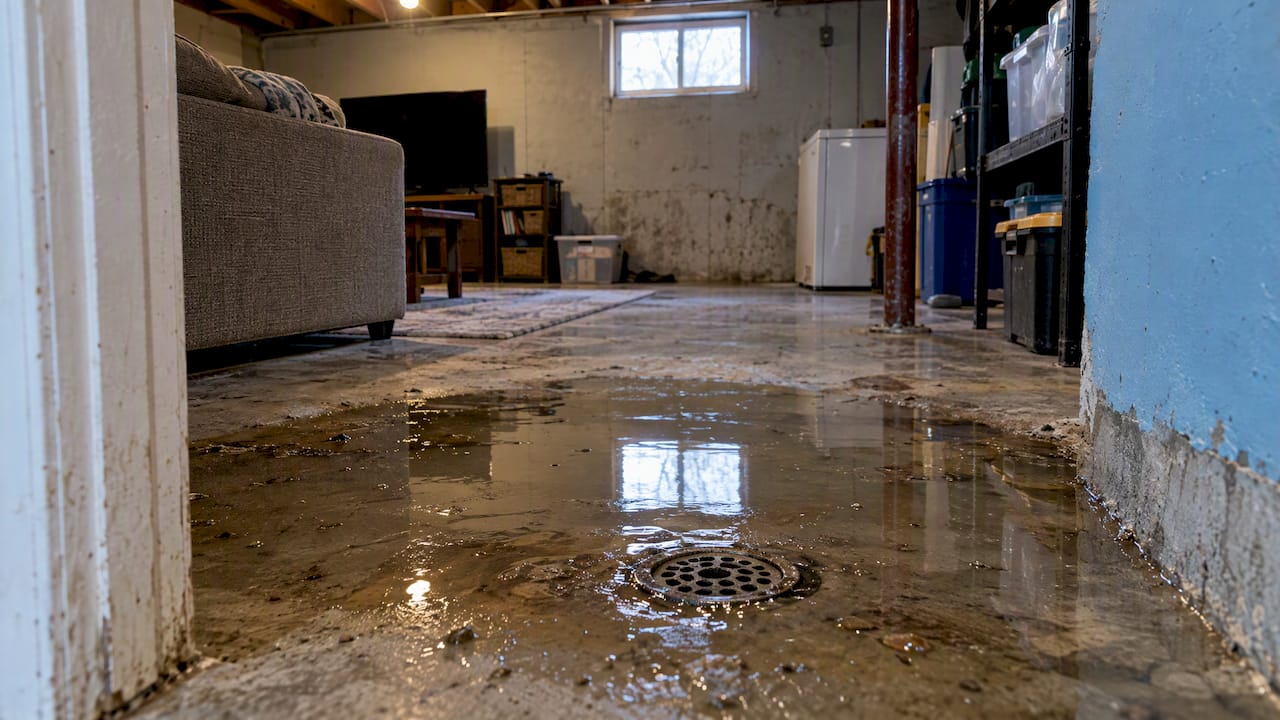
If sewage is coming up through a basement floor drain, shower or toilet, stop using water in the house, keep everyone out of the wet area, and shut off power to the basement only if you can reach the panel without stepping in water. Then find out whether the blockage is in your own sewer line or in the public main. A basement sewer backup rarely fixes itself, and the cause is still in the pipe after the water goes down. Below you will find the order of steps, the safety rules, what to throw away, who is responsible for which pipe, and how we approach the repair.
TL;DR
- Stop using every toilet, sink, shower and appliance that sends water down the drain, so you do not add to the backup.
- Stay out of a basement with standing water until the power is dealt with. Do not use electrical equipment while standing in water.
- You own the private sewer lateral. The city or sewer district handles the public main, so a call to both may be needed.
- Treat sewage as a health hazard: gloves, boots, no mixing of cleaners, and discard anything you cannot clean properly.
- Have the line cleared and inspected, not just the floor mopped. That is what keeps the backup from returning.
Table of Contents
- What to do in the first hour
- Is it sewage, or another kind of basement water?
- Why basements back up first
- Whose pipe is it: your lateral or the city main
- Staying safe around sewage
- Cleaning up: what to dry, what to discard
- Getting the line cleared and fixed
- Preventing the next backup
- Insurance and who pays
- FAQ
- Sources
What to do in the first hour
The order matters. Sewage keeps coming as long as water keeps going down the drains, so the first job is to stop feeding the system.
- Stop all water use. Official guidance is to stop using toilets, showers, washing machines and other fixtures right away so no more wastewater enters the backed-up pipes (City of Tacoma residential flooding guide). Tell everyone in the house. Pause the dishwasher and washer too.
- Do not walk into standing water. Madison’s sewerage district advises that you not enter a basement with standing water until you have contacted your utility company or a licensed electrician (Madison Metropolitan Sewerage District). Water and live circuits are a deadly combination.
- Cut the power to the basement. Seattle Public Utilities lists turning off power as the way to remove the electrical hazard (Seattle Public Utilities). If the panel is in the wet basement, or you would have to step through water to reach it, do not go. Call your electric utility or a licensed electrician.
- Keep children and pets away. Columbus Water and Power recommends keeping both away from the flooded area (City of Columbus). Close the basement door and block the stairs if you can.
- Check whether neighbors are affected. If the whole street has slow drains, the public main is the likely culprit. If only your house is affected, the problem is more often in your own line.
- Call for help. If sewage is backing up when you are not using any water, the Tacoma guidance is to call the city’s sewer maintenance crew immediately. In most places that means your local sewer utility or public works department. For your own line, call a licensed plumber.
Take photos of the water line, damaged items and the drain before you clean anything. You will want them for an insurance claim.
Is it sewage, or another kind of basement water?
Not every wet basement is a sewer backup. The Metropolitan St. Louis-area and Cincinnati-area guidance, like many municipal guides, points out that water in a basement is often mistaken for a sewer backup when it is actually surface water, groundwater or stormwater (Sewer Backups and Other Issues). The difference changes who you call and how you clean.
Clues that point to a sewer backup:
- Water rises out of a floor drain, shower, tub or toilet rather than seeping through walls or the floor slab.
- It smells like sewage and may carry wastewater solids or gray, dark discoloration.
- Fixtures gurgle, or a toilet bubbles when the shower or washer runs. We wrote about why a gurgling toilet can warn of a basement backup.
- It happens on a dry day, not just during heavy rain.
Clues that point to groundwater or surface water: dampness along the wall-floor joint, water entering after storms, and no odor of sewage. Even then, treat the water with caution if it touched anything electrical.
If you cannot tell, act as if it is sewage until a plumber confirms otherwise.
Why basements back up first
A basement drain is usually the lowest opening in the whole plumbing system. When wastewater cannot flow away, it takes the path of least resistance, which is the lowest drain in the house. That is why a floor drain, a basement shower or a laundry standpipe is where the trouble shows up first, even when the actual problem is further out.
The usual causes fall into a few groups:
- A blockage in your own lateral. Grease buildup, wipes and paper products, and debris accumulate and narrow the line until it clogs. Our guide on how to spot common sewer line issues covers the early signs.
- Tree roots. Roots find small joint gaps and grow inside the pipe. See tree roots in your sewer line: signs, removal and cost.
- Damaged or aging pipe. Cracks, offset joints, sags and collapsed sections hold water and debris. Our overview of why sewer lines fail explains the common failure modes.
- A blockage in the public main. When the main is blocked or overwhelmed, wastewater can push back up connected house lines.
- Combined storm and sanitary systems. In some areas, heavy storm flow can overload the sewer and send water back into homes. Mass.gov notes that surface and roof water can add to the problem, and it advises directing gutter downspouts and drains away from the foundation (Mass.gov home care guide).
A quick test: if only the basement fixtures back up and upstairs ones drain fine, the blockage is usually past the point where the basement line joins the main house line. If every fixture is slow, the blockage is likely further down the lateral or in the main.
Whose pipe is it: your lateral or the city main
This question decides who pays and who shows up. Madison’s sewerage district explains the standard split: the property owner is responsible for the private sewer lateral, while the municipality’s emergency maintenance crew checks the public main and removes an obstruction if it is blocked (Madison Metropolitan Sewerage District). Rules differ by city, so check with your local sewer utility for where your responsibility ends.
A practical approach:
- Call your sewer utility and report the backup. They can check the main, often at no charge.
- If the main is clear, the blockage is on your side, and a licensed plumber should clear and inspect the lateral.
- If a rooter service is hired, Seattle’s guidance suggests asking whether the cable is long enough to reach from your side sewer to the city’s main (Seattle Public Utilities). A short cable can clear the fixture but leave the real blockage in place.
If you rent, the picture changes. Read our piece on landlord plumbing responsibilities and notify the owner or property manager in writing right away.
Staying safe around sewage
Sewage carries bacteria and other contaminants, and the basement adds electrical and slipping hazards. Keep these rules in place until the area is cleaned and dry.
- Electricity first. Do not use electrical equipment while standing in water. That includes wet-dry vacuums, extension cords and portable heaters.
- Protect your skin. Wear rubber boots and gloves to minimize contact with sewage (City of Columbus). Wash your hands thoroughly after any contact.
- Never mix cleaning products. The Illinois Department of Public Health warns against combining ammonia and bleach because the vapors are hazardous (Illinois Department of Public Health). Use one product at a time and ventilate.
- Medicines, food and personal products. Columbus guidance says to discard medicines and personal products that touched floodwater, along with food that became wet.
- Children, older adults and anyone with health concerns. Keep them out of the area. If someone develops symptoms after exposure, contact a doctor or your local health department.
Cleaning up: what to dry, what to discard
Cleanup comes after the water stops and the line is clear. Removing sewage before the pipe is fixed only invites a second round.
The Massachusetts guide explains that the health risk depends on the source of the water and how far it penetrated, which in turn depends on how porous the material is, how much water there was, and how long it sat (Mass.gov). In plain terms:
- Hard, non-porous surfaces such as sealed concrete, tile and metal can usually be washed and disinfected.
- Porous materials such as carpet, padding, drywall, insulation, cardboard boxes and upholstered furniture soak up contamination and are often best removed.
- When in doubt, throw it out. Columbus advises that if you doubt an item can be cleaned properly, it is best to discard it.
Drying matters as much as washing. Use fans and a dehumidifier, and keep air moving. Madison’s district cautions against using heat to dry closed interior spaces, since mildew and expanded water damage may result (Madison Metropolitan Sewerage District).
For a large backup, sewage that reached walls, or a finished basement, a professional cleanup and restoration company is worth considering. Ask your plumber to confirm the line is clear before any restoration crew starts, so the work is not repeated.
Our perspective
When a homeowner calls us about a basement backup, the first question is rarely about the mess. It is whether it will happen again. The honest answer depends on what is inside the pipe, and you cannot know that from the floor drain.
That is why we treat a backup as two jobs. The first is clearing the line so water moves again. The second is finding out why it stopped. A camera inspection of the sewer line shows whether you have roots, a belly, a cracked joint or grease buildup, and that tells you whether a cleaning is enough or a repair is the better value.
We also think a quote should be clear before work starts. We offer free quotes, and we explain what we found, what we recommend and why. If a cleaning will solve it, we say so. If the pipe itself needs attention, we show you the evidence.
As a licensed and insured Burbank plumbing company serving homes and commercial properties, we have seen how much a quick, correct diagnosis saves, both in repair cost and in cleanup.
Serghei
Getting the line cleared and fixed
A plumber has several tools, and the right one depends on what is in the line.
- Cabling or snaking breaks through a soft blockage or cuts light roots. It restores flow but may leave residue on the pipe walls.
- Hydro jetting uses high-pressure water to scour grease, scale and silt from the pipe wall. It is often the better choice when the same drain keeps clogging.
- Camera inspection shows the pipe condition and the exact location of a problem, so repairs are targeted.
- Repair or replacement is needed when the pipe is cracked, collapsed or badly out of line. Options vary with the site and the damage, and a plumber should explain them after inspecting.
If you want to understand the cleaning methods first, our guide to drain cleaning methods, safety and tips is a good starting point. Pouring store-bought chemical cleaners into a drain full of sewage is not a fix, and it can expose whoever works on the line next to harsh chemicals.
How we help
We are a local plumbing company in Burbank, licensed and insured, working for homeowners, property managers, commercial property owners and general contractors. For a basement sewer backup, the relevant services are our sewer line services for inspection and repair, drain cleaning to restore flow, and hydro jetting for stubborn buildup. We do not publish fixed prices for these services because the right scope depends on what is in your line. We give free quotes, so you know the cost before the work begins.

If you manage a commercial building or a portfolio, we also handle commercial plumbing, including line maintenance that helps you avoid emergencies. Reach us through psvplumbinginc.com to request a quote.
Preventing the next backup
No plan removes every risk, but these steps reduce it.

Watch what goes down the drain. Grease, wipes, paper towels and other items that do not break down are common blockage starters. Keep them out of toilets and sinks, and use a drain strainer in basement showers and floor drains.
Know the early signs. Slow drains, gurgling, odors near the floor drain and repeat clogs often come before a full backup. Our list of 10 signs of sewer line problems helps you spot them. A washer drain that backs up can also point to a deeper blockage.
Schedule maintenance. Regular inspection and cleaning of the lateral catches roots and buildup before they close the pipe. See our steps for sewer line maintenance that prevents costly repairs.
Manage roof and surface water. Direct downspouts and drains away from the foundation and toward low points away from the house, as the Mass.gov guide recommends.
Ask about a backwater valve. A backflow prevention valve on the sewer line is designed to keep wastewater from flowing back into the house. It must be installed correctly and kept maintained, and local codes and permits may apply, so have a licensed plumber assess your line before deciding.
Do not ignore a repeat. A second backup within months means the first fix did not address the cause. Ask for a camera inspection.
Insurance and who pays
Many homeowners assume a sewage backup is covered. Madison’s sewerage district notes that standard homeowner or renter policies often do not cover damage from sewer backups, so check your own policy (Madison Metropolitan Sewerage District). Some insurers offer an endorsement for water or sewer backup. Call your agent and ask what your policy covers, what the limits are, and what documentation they require.
If the public main caused the backup, contact your city or sewer district as well. Ask whether they have a claims process. Keep photos, receipts, the plumber’s written findings and any utility reports together in one folder.
FAQ
What should I do first if my basement sewer is backing up?
Stop using all water in the house, including toilets, showers and washing machines, so no more wastewater enters the blocked line. Stay out of any standing water until power is dealt with, and keep children and pets away. Then call your sewer utility and a licensed plumber.
What causes sewage to back up in a basement?
The most common causes are a blockage in your own sewer lateral, tree roots, a damaged or collapsed pipe, and a blockage or overload in the public main. The basement drain is the lowest opening, so it is where the wastewater shows up first. A camera inspection identifies which cause applies to your home.
Who pays for a sewer backup repair?
The property owner is generally responsible for the private sewer lateral, while the city or sewer district handles the public main. Insurance often excludes sewer backups unless you have added coverage, so read your policy and call your agent. Rules differ by location, so confirm with your local utility.
How much does it cost to clear a backed-up basement drain?
The cost depends on the cause, the access to the line and the method needed, so a fair figure cannot be given without looking at the pipe. We do not publish fixed prices, and we provide free quotes after we assess the situation. Ask any plumber what the quote includes, such as a camera inspection.
Is it safe to clean up sewage myself?
For a small, contained spill, wear rubber gloves and boots, never mix cleaning products, and discard porous items you cannot clean properly. For large backups, wet drywall or carpet, or anyone with health concerns in the home, bring in professional cleanup help. Never enter standing water until the power is off.
Sources
- City of Tacoma: Residential flooding
- Madison Metropolitan Sewerage District: Handling a Sewer Backup
- Seattle Public Utilities: Troubleshooting Your Sewer Problem
- City of Columbus: What to Do if Your Basement Floods
- Illinois Department of Public Health: Cleaning Up After Flood and Sewer Overflows
- Mass.gov: Flooding and Sewage Back-ups Home Care Guide
- Sewer Backups and Other Issues customer guide
Leave a Reply