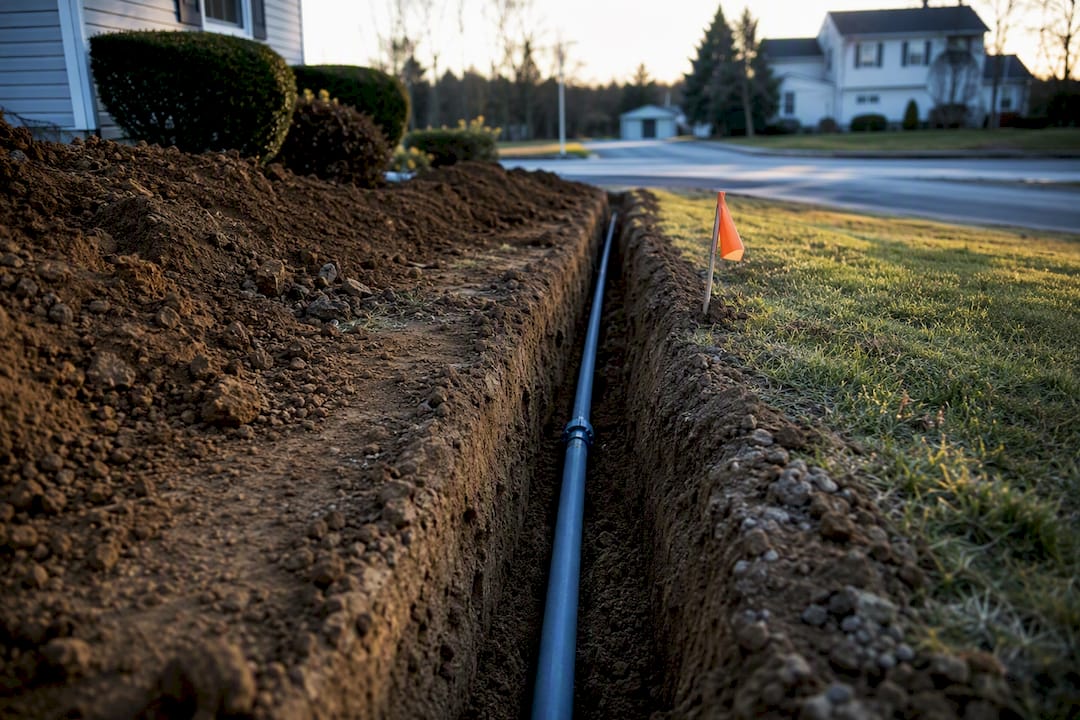
Most homeowners spend between $2,000 and $5,000 on a full water service line replacement, with complex or long runs reaching $12,000 or more, according to Forbes. Per-foot pricing runs roughly $50 to $150 for open trench work, higher for trenchless methods once you factor in equipment. Where your project lands on that range depends mostly on restoration, hardscape crossings, depth, and permitting, not the pipe itself.
TL;DR:
- Water line replacement costs usually range from $2,000 to $5,000 for typical residential jobs, with longer or complex projects exceeding $8,000.
- Trenchless methods often become cost-effective compared to open trenching once crossings or landscaping are involved, despite higher per-foot prices.
- Labor accounts for up to 65% of bid costs, with restoration and permits adding significant expenses that can double the initial estimate.
- Permitting generally adds one to three weeks to the timeline and costs between $50 and $500, depending on local regulations.
- Obtaining multiple written bids and clarifying scope details helps prevent unexpected charges and ensures accurate budgeting.
Table of Contents
- What Does Water Line Installation Cost for a Typical Home?
- How Much Does Trenched vs. Trenchless Water Line Cost per Foot?
- What Drives the Final Price on a Water Line Bid?
- How Long Do Permits and Inspections Add to the Timeline?
- Should You Repair or Replace Your Water Line?
- What Should You Ask Before Signing a Water Line Estimate?
- Why Trust Psvplumbinginc’s Water Line Cost Estimates?
- An Editor’s Take on Budgeting for a Water Line Job
- Get a Free On-Site Water Line Quote
- Sources
- FAQ
What Does Water Line Installation Cost for a Typical Home?
A short 25 to 35 foot run from the street to the meter, with no sidewalk or driveway in the way, usually lands at the low end. You’re often looking at $1,500 to $3,500 total once labor, materials, and basic backfill are included.
Stretch that to a 50 to 60 foot line, which is common for houses set back from the curb, and the math shifts. Add a driveway or sidewalk crossing and you’re paying for either extra excavation and concrete replacement or a trenchless bore, both of which add real money. That’s where a job that looked like $3,000 on paper turns into $6,000 to $8,000.

Longer or more complicated runs, 70 to 100 feet or more, tend to fall into the $8,000 to $12,000+ bracket described by Forbes, especially when the line has to navigate mature trees, retaining walls, or a second hardscape crossing.
Here’s how the scenarios typically stack up:
- 25 to 35 feet, open lawn: $1,500 to $3,500
- 50 to 60 feet, one driveway crossing: $4,000 to $8,000
- 70 to 100+ feet, multiple crossings or deep frost line: $8,000 to $12,000 or more
- Any length with rock excavation or dewatering needed: add $1,000 to $3,000 on top of the base estimate
Restoration and permitting are usually the difference between the low estimate you read online and the actual invoice you get.
How Much Does Trenched vs. Trenchless Water Line Cost per Foot?
Open trench digging typically runs $50 to $150 per linear foot, according to cost data compiled by What It Actually Costs, though metro areas with tight permitting or heavy traffic control needs can push that toward $250 or more. Trenchless methods, pipe bursting and horizontal directional drilling among them, often start higher per foot but skip most of the digging and restoration cost that traditional trenching requires.
That tradeoff flips the math on jobs with hardscape in the way. UseCalcPro’s cost data shows trenchless work often becomes the cheaper overall option once you’re crossing a driveway, sidewalk, or established landscaping, because you’re not tearing up and repouring concrete.
- Open trench, plain lawn: cheapest per foot, cheapest overall
- Open trench under a driveway: cheap per foot, expensive overall once restoration is added
- Trenchless under a driveway: higher per foot, often cheaper overall
- Trenchless in solid rock or extreme depth: cost climbs fast; not always the better choice
Picture a 15-foot driveway crossing. Trenched work might run $1,000 to $1,500 for the digging alone, then another $1,500 to $3,000 to break out and repour the concrete. Trenchless boring under the same driveway often lands at $2,000 to $3,500 total, no demolition required.
Pro Tip: Ask your contractor to quote both methods side by side for any crossing. The per-foot number alone tells you almost nothing about what you’ll actually pay.

What Drives the Final Price on a Water Line Bid?
Labor is the biggest line item on almost every bid, typically eating up 50% to 65% of the total project cost, according to Angi’s cost breakdown. Excavation, pipe pulling, connections, and backfill all take skilled hours, and that time costs more than the pipe itself.
Cost breakdown for a typical $5,000 water line job:
Labor commonly runs $2,500 to $3,250 of that total, roughly half to two thirds, with materials and restoration splitting the rest.
Here’s the rough order of what makes up your bid:
- Labor — excavation, tie-in, testing, and backfill, usually 50% to 65% of the total
- Restoration — sod repair runs about $5 to $20 per square foot, while concrete or paver repair jumps to $15 to $50 per square foot
- Materials — PEX, copper, or HDPE pipe, generally the smallest slice of the budget; see our pipe materials comparison guide for how each holds up over time
- Permits and fees — locates, inspections, and municipal charges
- Hidden add-ons — rock removal, dewatering pumps, and disposal fees that only show up once digging starts
A homeowner who assumes materials drive the price is usually surprised. Copper costs more per foot than PEX, but the labor to install either is nearly identical, which is why swapping pipe material rarely moves the total bid by more than a few hundred dollars.
How Long Do Permits and Inspections Add to the Timeline?
Municipal permit fees typically run $50 to $500 depending on your jurisdiction, according to service line replacement cost data, and most cities require at least one inspection before they’ll sign off on the work. Some require a pressure test, others check backflow prevention, and a few mandate both.
A realistic timeline looks like this:
- Diagnostic visit and locate request: 1 to 3 days
- Permit application and approval: a few days to two weeks, depending on the city
- Actual excavation and installation: 1 to 3 days for most residential jobs
- Final inspection and sign-off: scheduled separately, sometimes adding a few more days
If your municipality requires a code upgrade, like moving from a smaller diameter line to current minimum sizing, that gets tacked on as a fixed cost rather than a per-foot adjustment. Ask about this upfront so it doesn’t surprise you mid-project.
Should You Repair or Replace Your Water Line?
A single leak in an otherwise sound line is usually worth patching. Spot repairs on accessible sections can run as little as $1.50 to $12 per linear foot, while underground spot repairs typically fall in the $100 to $200 per linear foot range, per UseCalcPro’s repair cost data. Full replacement makes more sense once the line itself is the problem, not just one weak spot.
Replacement is usually the smarter call when:
- The line has failed more than once in the past year or two
- You’ve got galvanized steel, lead, or polybutylene pipe, all of which are known failure points in older homes
- Corrosion or discoloration shows up at multiple fixtures, not just one
- A plumber can see the line is failing in more than one spot during inspection
A common rule among plumbers: if repeated repair costs are creeping toward what a full replacement would cost within five years, replace it. You get warranty coverage and stop paying for repeat service calls on the same aging pipe.
What Should You Ask Before Signing a Water Line Estimate?
A written estimate should specify the exact line length, the method being used, the per-foot rate, and whether restoration is included or billed separately. Vague quotes are where surprise charges hide.
Before you sign anything, confirm the contractor covers these points in writing:
- Scope: total footage, pipe material, and installation method (trenched or trenchless)
- Restoration: exactly what gets repaired, sod, concrete, or pavers, and at what cost
- Permits: who pulls them and whether the fee is included in your quote
- Contingencies: what happens if they hit rock, an unmarked utility, or unexpected depth
- Credentials: current license number, proof of insurance, and a written warranty period
If one bid comes in far lower, ask what’s missing. Getting a second opinion on your plumbing estimate before you commit is worth the extra day it takes.
Pro Tip: Get three bids if your project involves any hardscape crossing or unusual access. The spread between trenched and trenchless quotes on those jobs is usually where you’ll find the real savings.
Why Trust Psvplumbinginc’s Water Line Cost Estimates?
Psvplumbinginc provides residential and commercial plumbing services with a focus on transparent pricing and industry-standard workmanship, covering everything from pipe repairs and new installations to sewer inspections and full system upgrades, as outlined on Psvplumbinginc. The company has published detailed cost breakdowns on related projects, including a water softener installation cost guide, reflecting the same line-item approach used throughout this article. Every estimate is built around the actual scope of your site, not a generic per-foot rate pulled from a national average.
An Editor’s Take on Budgeting for a Water Line Job
Get two bids if your yard is simple lawn access. Get three if a driveway, sidewalk, or mature landscaping sits in the path. Insist on a written scope that spells out restoration, not just excavation. And never skip the permit step. It costs little now and protects your resale value later, since an unpermitted water line replacement is a real problem for a home inspector to flag down the road.
— Serghei
Get a Free On-Site Water Line Quote
Skip the guesswork of averaging online ranges against your own yard. Some plumbing companies offer a free on-site visit that includes a utility locate, a recommendation on trenched versus trenchless method for your specific access, and a written fixed-price proposal, not a rough phone estimate. Permit coordination may be handled as part of that visit.

Requesting a quote is simple: reach out through Psvplumbinginc’s pipe repair workflow guide to see exactly how the diagnostic and quoting process works before a technician ever shows up at your door. From there, scheduling the site visit takes a few minutes, and you’ll have a written number in hand before any digging starts.
Sources
- Angi — What does a water main line replacement cost?
- What It Actually Costs — Water service line replacement cost (2026)
- Forbes — Water Line Replacement Cost (2022)
- UseCalcPro — Water line repair and replacement cost calculator
FAQ
How much does a plumber cost to install a water line?
Most licensed plumbers charge $50 to $150 per linear foot for open trench installation, with total project costs commonly falling between $2,000 and $5,000 depending on length, depth, and restoration needs.
How much does it cost to install a 1,000-foot water line?
Open trench work typically costs $50 to $150 per foot; however, jobs this long are rare for single residential connections and usually involve municipal or agricultural service.
How much does it cost to dig up and replace a water line?
Digging up and replacing a standard residential water line typically costs $2,000 to $5,000 total, with underground spot repairs running $100 to $200 per linear foot if only a section needs replacing rather than the full line.
How much does a 1-inch water line cost?
Pipe diameter has a modest effect on material cost but little effect on labor, so a 1-inch line typically falls within the same $50 to $150 per foot trenched range as smaller residential lines, with the total driven more by length and restoration than by pipe size.
Leave a Reply