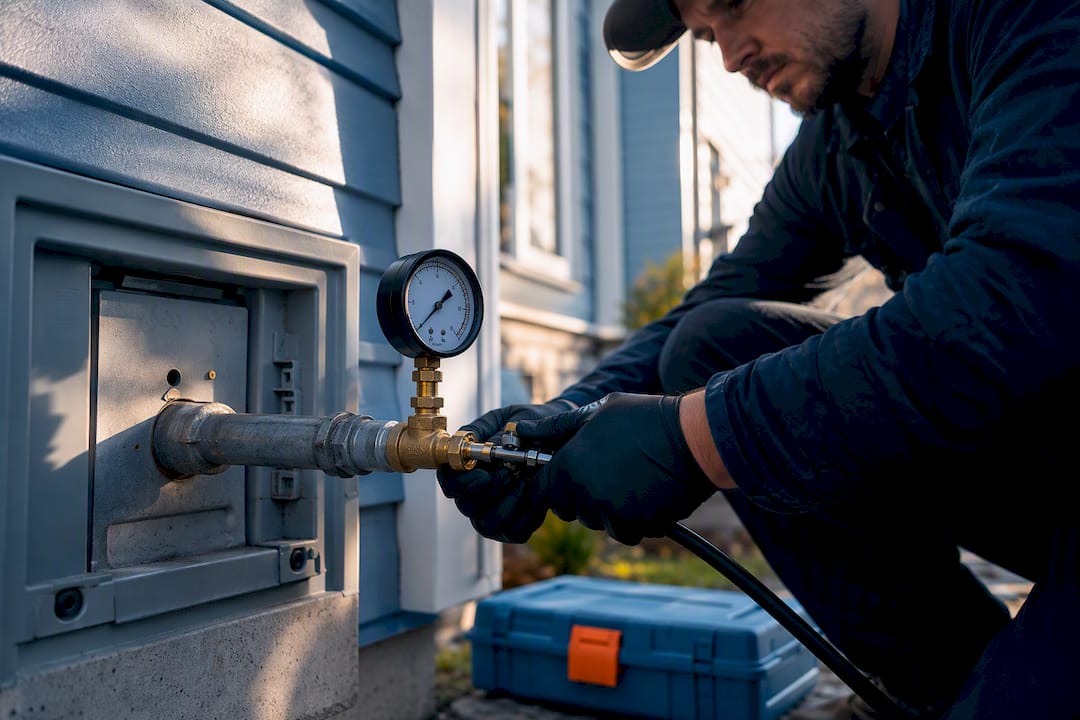
A standard residential gas pressure test typically runs $75 to $150 for the test itself, while a full-system or hydrostatic test can reach $500. That’s the baseline. Permits, inspections, and any repairs found during testing often push the total invoice well beyond that range, sometimes past $750. The scenarios and steps below will help you figure out exactly where your home lands.
TL;DR:
- Homeowners should expect to pay between $75 and $150 for a simple gas pressure test, but additional fees for permits, repairs, and reinspection often increase costs beyond $750.
- Hydrostatic or full-system tests take longer and can cost up to $500, especially when combined with repairs or required inspections.
- Regional differences, access difficulty, and emergency calls influence final prices, with permits adding $100 to $400 or more in specific situations.
- Clarify permit requirements beforehand, as they significantly affect total costs, especially during new service installation or reinspection after a failure.
- A failed test usually costs between $150 and $3,000 or more to repair, depending on the severity, with safety being the top priority during leak repairs.
Table of Contents
- Gas Pressure Test Cost by Job Type
- What Happens During a Gas Pressure Test
- What Drives the Final Price Up or Down
- When Permits and Inspection Fees Apply
- Real-World Cost Scenarios
- How to Get a Quote You Can Actually Trust
- If Your Home Fails the Test
- Why PSV Plumbing Inc’s Numbers Reflect Real U.S. Practice
- The Real Lesson Behind These Numbers
- Get a Straight Answer on Your Gas Line Before You Budget Blind
- Sources
Gas Pressure Test Cost by Job Type
Not every gas pressure test is the same job, and pricing reflects that. A basic pressure hold test, where a plumber pressurizes your gas line and checks for a drop over time, sits at the low end. A hydrostatic or full-system test, which involves filling the line with water or inert gas under higher pressure to verify integrity across the whole system, costs more and takes longer.
Here’s how the ranges typically break down:
- Standard pressure test (test-only): $75 to $150, often closer to $90–$140 for a single-appliance check on many cost guides
- Full-system or hydrostatic test: $150 to $500, with the job taking 12 to 24 hours because the line needs time to hold pressure before the plumber confirms a pass
- Test plus minor repair: commonly $300 to $500, covering a small fitting fix or valve replacement discovered during testing
- Test plus repairs and reinspection: $300 to $750 once permit fees, a utility reinspection, and any parts replacement get added in
A homeowner buying a house with an older gas furnace might only need the $90–$150 basic test to satisfy a lender or inspector. A property owner restoring service after a utility shutoff is looking at the higher end almost every time, because that scenario nearly always drags permits and reinspection into the bill. Gas safety test pricing tables across U.S. markets consistently show this same split: cheap test, expensive paperwork.
The test-only number is the one homeowners search for, but it’s rarely the number they actually pay if anything unusual turns up. Treat it as your floor, not your ceiling.

What Happens During a Gas Pressure Test
A plumber follows a fairly consistent process regardless of which test type your home needs, though the equipment and time commitment change with the method.
- Shut off appliances and isolate the line. The technician closes valves at each appliance and caps open connections so the test measures the piping itself, not a leaking pilot light.
- Connect a pressure gauge or manometer. For a standard hold test, the plumber pumps air into the line to a set pressure, typically around 10 to 25 psi for residential systems.
- Monitor for pressure drop. The gauge sits for 10 to 15 minutes. A steady reading means the line holds. A drop signals a leak somewhere in the system.
- Run a hydrostatic test if required. This swaps air for water or inert gas at higher pressure, useful for verifying larger systems or after major repair work. It takes 12 to 24 hours because the line has to hold overnight.
- Use tracer gas or electronic leak detection for pinpointing. If the hold test fails, the technician uses a sniffer or tracer additive to locate the exact leak point before recommending repairs.
A basic hold test wraps up in under an hour once the plumber arrives. Hydrostatic testing is an overnight commitment, which is one reason it costs more. You’re not just paying for the plumber’s time on-site. You’re paying for the equipment sitting connected to your system for a full day.
For more on how these procedures fit into broader gas line work, our gas line plumbing guide covers safety standards and when a full inspection makes sense.
What Drives the Final Price Up or Down
Two homes on the same street can get very different quotes for what looks like the same job. The line items below explain why.
- Labor rate and travel time: Labor typically runs $80 to $200 depending on your market, and a plumber driving 40 minutes across a rural county bills differently than one working a dense urban route.
- Number of appliances and line complexity: Testing a single water heater line is quick work. Testing a system feeding a furnace, range, dryer, and outdoor fire pit means more junctions, more time, and more potential failure points.
- Access difficulty: Buried lines or crawlspace access add labor hours. Digging to reach a section of pipe is a different job than testing an exposed line in a utility closet.
- Emergency or after-hours calls: Weekend and emergency service commonly carries a premium on top of the base test price.
- Equipment rental: Equipment costs run roughly $30 to $90 depending on whether the job needs specialized hydrostatic gear or just a basic manometer.
Regional differences compound all of this. Coastal and urban markets in the Northeast and West tend to run higher on labor rates and permit costs than the Midwest or South, simply because local licensing and code-enforcement structures differ.
Pro Tip: Ask your plumber upfront whether your home has one gas meter or a split system feeding a detached garage or guest unit. Split systems often need two separate tests, which doubles the labor line even when the total footage of pipe isn’t much longer.
When Permits and Inspection Fees Apply
Not every gas pressure test needs a permit. A routine safety check on an existing system usually doesn’t require one. But certain situations almost always trigger municipal or utility involvement, and that’s where budgets go sideways if you weren’t expecting it.
Permits typically come into play when:
- You’re establishing new gas service to a home or addition
- The utility has issued a Red Tag, cutting off service until the system passes reinspection
- The job involves replacing or relocating a significant section of gas line
- Local code requires inspector witness of the pressure test itself, which is common in several states
Permit and inspection requirements can add $100 to $400 or more to the total invoice, and the range varies a lot by city and county. Scheduling an inspector to witness the test also adds calendar time. Some jurisdictions turn inspections around in a day or two; others book out a week or more, which matters if you’re trying to restore gas service before winter.
Pro Tip: Call your local building department before hiring anyone. Ask directly whether your specific job (new service, Red Tag restoration, line replacement) requires a permit in your area. A five-minute phone call saves you from a quote that looks great until the permit fee shows up separately.
Our gas line inspection guide walks through compliance requirements and what inspectors typically check during a witnessed test.
Real-World Cost Scenarios
Matching your situation to one of these three scenarios gives you a realistic budget target before you even call for a quote.
- Scenario A: Single-appliance quick test. You’re buying a home with one gas water heater and the inspector wants a basic hold test before closing. No permit needed, one appliance, easy access. Expect $90 to $150 total, done in under an hour.
- Scenario B: New-service full-system test with permit. You’re finishing a home addition with a new gas range and needing the whole system tested and permitted before the utility turns on service. This scenario commonly lands at $300 to $600, factoring in the hydrostatic test, permit fee, and the inspector’s witness visit.
- Scenario C: Red-Tag restoration. The utility shut off your gas after finding a leak or code violation. You now need a diagnostic test, likely repairs, a permit, and a reinspection before service gets restored. This is the most expensive path, typically $400 to $900+ once you combine repair costs with permit and reinspection fees.
Outliers push these numbers higher fast. A buried line that needs excavation, a commercial-grade system with a dozen appliances, or a rural property requiring significant travel time can all add several hundred dollars on top of the scenario ranges above. If your home falls outside the typical single-family, one-to-three-appliance profile most cost guides assume, ask your plumber for a site visit before accepting a phone quote.
How to Get a Quote You Can Actually Trust
A quote that doesn’t specify what’s included is a quote you can’t compare against anyone else’s. Before you sign anything, ask these questions directly:
- Does this price include the permit, or is that billed separately?
- Is there a retest fee if the line fails the first time?
- Does the quote include the inspector’s witness fee, if my jurisdiction requires one?
- What’s your hourly rate if the job runs longer than expected?
- Is there a travel surcharge for my address?
Ask for a written estimate that breaks out labor, materials, permit costs, and equipment separately, not a single lump number. Once the work is done, request a post-test certificate. Utilities and insurers often require this documentation to restore service or maintain coverage, so don’t let a plumber leave without providing it.
Licensing and insurance aren’t optional extras here. Gas work is one of the few plumbing jobs where a mistake can genuinely hurt someone, so verify your plumber’s license number and ask to see proof of insurance before work starts.
Pro Tip: Walk away from any quote that’s vague about permit responsibility, refuses to commit to a retest fee upfront, or wants cash-only payment with no paperwork. Those are the three biggest red flags in this trade.
Our residential plumbing checklist has more questions worth asking before any plumbing job, gas-related or otherwise.
If Your Home Fails the Test
A failed pressure test isn’t rare, and it isn’t automatically a disaster. It just means you’re budgeting for repairs on top of the test fee.
- Minor fixes like a loose fitting, worn valve, or small joint leak typically cost between $150 and $800 for repairs and usually don’t require excavation.
- Major repairs, such as a buried line leak or a section that needs replacement, run considerably higher. Buried line repairs commonly cost $1,500 to $3,000 or more, and full line replacement runs $15 to $35 per linear foot.
- Retest and reinspection fees get tacked on after any repair, since the system has to prove it holds pressure before service gets restored.
Safety comes first here. If your test reveals an active leak, don’t treat a hardware-store patch kit as a real fix. Our natural gas leak repair guide explains which situations call for immediate professional attention versus a temporary, monitored fix while you schedule repair work.
Why PSV Plumbing Inc’s Numbers Reflect Real U.S. Practice
Psvplumbinginc is a licensed and insured plumbing provider handling gas line inspections, pressure testing, and repair work for residential and commercial clients across its service area. The estimates in this guide track closely with what our technicians see on real jobs, from quick single-appliance tests to full Red-Tag restorations involving permits and reinspection.
Author Serghei brings a background in researching and writing about home services pricing, drawing on published trade data and firsthand documentation from licensed plumbing work to build cost guides homeowners can actually use. Psvplumbinginc backs its estimates with transparent, itemized pricing rather than vague lump-sum numbers, which is the same standard this guide holds every scenario to. For more on how inspections tie into safety compliance, see our gas line inspection resource.
The Real Lesson Behind These Numbers
The test itself is almost never the expensive part. That’s the piece most cost guides get backwards by leading with a single “average price” instead of separating the test from everything that surrounds it. Homeowners fixate on the $75 to $150 test-only figure, then get blindsided when a permit, an inspector’s schedule, or a repair discovered mid-test triples the bill.
Conventional advice tells you to “get three quotes,” which is fine but incomplete. The better move is asking each quote to itemize permit responsibility and retest fees before you compare a single total number, because two plumbers quoting “$300” can mean completely different scopes of work.
If you take one thing from this guide, prioritize the permit question first, before price. A cheap test quote that ignores a required permit isn’t actually cheaper. It’s a bill you haven’t received yet.
— Serghei
Get a Straight Answer on Your Gas Line Before You Budget Blind
Psvplumbinginc handles the whole sequence in one visit instead of leaving you to coordinate a separate permit runner, inspector, and repair crew. We test, we tell you plainly whether a permit applies to your situation, we handle any repair the test uncovers, and we get you a written certificate at the end.

If your test comes back with a failed section or an aging line that needs work, our pipe repair workflow guide walks through exactly how we handle repair and retest scheduling so you’re not left guessing on timeline or cost. We’re licensed, insured, and every estimate we give breaks out labor, materials, and permit costs separately, so you know what you’re paying for before we start. Request a free quote today and get a real number for your home, not a placeholder range pulled from a national average.
Sources
- How Much Does a Gas Line Repair Cost?
- Gas Line Repair and Replacement Costs 2026 Data
- Gas Safety Test Cost and Pricing How Much It Costs in the United States 2026 – Current Cost
- Gas Line Pressure Test Cost Guide – Current Cost
Leave a Reply