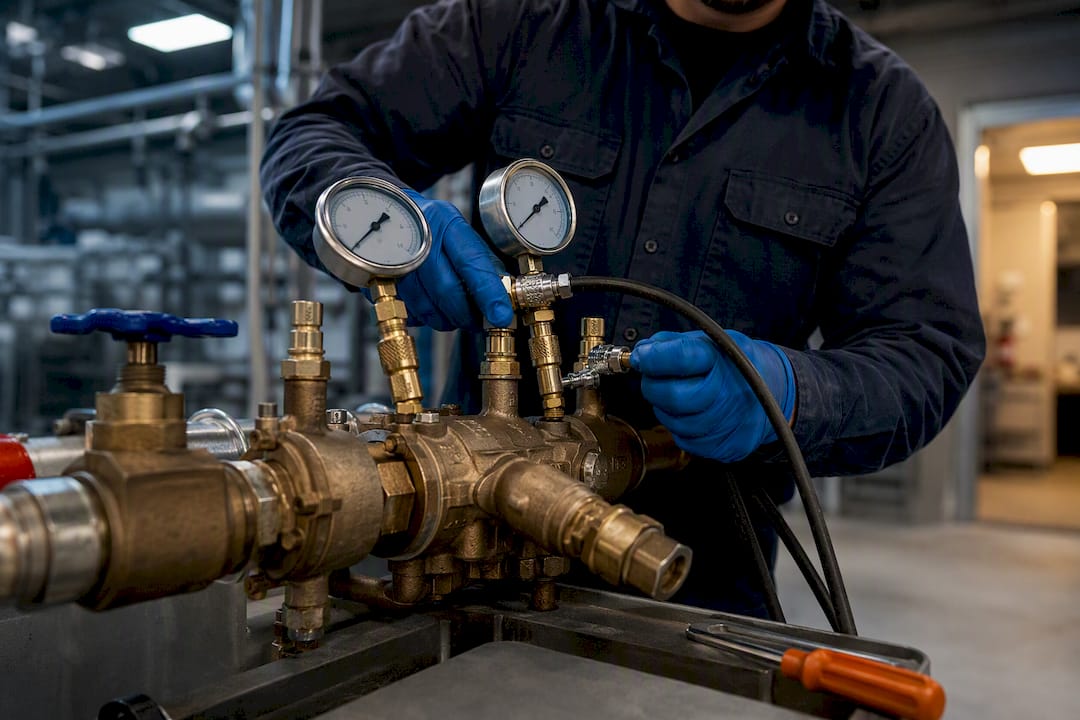
Most property owners in the U.S. pay between $50 and $150 per device for a standard backflow test, with $75 to $180 the most common range once labor and calibration are factored in. That price typically covers the test itself, a basic pass/fail report, and often filing with your water utility. Before you book anything, ask the tester for a per-device price, proof of certification, and whether utility filing is included.
TL;DR:
- The typical cost for a residential backflow test ranges from $75 to $180, with complex commercial assemblies reaching $200 to $300 per device.
- Device type significantly affects pricing, with PVB tests being the most affordable, while RPZ and detector assemblies require more time and cost more.
- Additional charges such as travel, access difficulty, and filing fees can increase the total cost by 20 to 30 percent depending on local regulations.
- Most failed tests are due to minor parts that can usually be repaired for under $275, while full replacement can cost up to $2,000 or more.
- Property owners should verify the tester’s certification and whether the quote includes filing with the water utility to avoid extra fees and compliance issues.
Table of Contents
- What Is the Average Backflow Testing Cost?
- Why Device Type Changes Your Backflow Test Price
- What Drives the Total Price on Your Quote?
- How Long Does a Backflow Test Take?
- Repair or Replace a Failed Backflow Device?
- Who Pays for Backflow Testing and Filing?
- How Do You Vet a Certified Backflow Tester?
- Can You Lower Your Backflow Testing Bill?
- What a Professional Itemized Backflow Quote Looks Like
- What Property Owners Get Wrong About Backflow Pricing
- Get a Straightforward Backflow Testing Quote
- Sources
What Is the Average Backflow Testing Cost?
Nationally, backflow testing runs from about $30 on the low end to $300 on the high end per device, with most standard residential and commercial assemblies landing in the $75 to $180 range. Simple residential setups tend to sit near the bottom of that band. Complex commercial assemblies with multiple test ports push toward the top.
Here’s what those bands typically cover:
- Low ($30 to $75): Basic residential PVB test, single device, easy access, no filing complications.
- Typical ($75 to $180): Standard DCVA or commercial PVB test including report generation and basic paperwork.
- High ($180 to $300): RPZ or detector assembly testing, tight access, or multiple devices requiring separate test procedures.
A single-device home test commonly falls under $150 total, while some sources cite national averages closer to $165 when you factor in service call fees.
A three-device small office, by contrast, often lands between $300 and $500 once travel and paperwork are added. Regional variance matters too. Municipalities with strict cross-connection control programs sometimes add filing fees that shift your total by $20 to $50 per visit, so a quote that looks cheap upfront can still land in the middle of the pack once local fees hit the invoice.
Why Device Type Changes Your Backflow Test Price
Not every backflow prevention assembly costs the same to test, and the differences come down to complexity, not location. Understanding what device is installed on your property helps you sanity check any quote you receive.
- Pressure Vacuum Breaker (PVB): The cheapest and fastest to test, common on residential irrigation systems, usually at the lower end of the pricing band.
- Double Check Valve Assembly (DCVA): Mid-range pricing, frequently found on commercial fire lines and irrigation feeds.
- Reduced Pressure Zone (RPZ) assembly: More expensive because it has more moving parts and stricter test procedures, often exceeding $200 to $300 per device on complex sites.
- Detector assemblies: Used mostly on fire suppression systems, priced near RPZs because they combine backflow prevention with flow metering.
RPZs and detector assemblies cost more because testers need extra time to isolate the system safely and confirm the check valves and relief valve all function under pressure. If you’re unsure what’s installed, our guide on backflow prevention basics breaks down each device type in plain language.
What Drives the Total Price on Your Quote?
Several factors stack on top of the base per-device price, and understanding them helps you spot a fair quote from an inflated one.
- Labor and equipment: Certified testers use calibrated test kits that cost over $1,000 and require annual recalibration, and that overhead shows up in your hourly rate.
- Access difficulty: A device buried in a locked mechanical room or behind landscaping adds time, which adds cost.
- Travel and service call fees: Rural properties or same-day requests often carry a flat trip charge separate from the testing fee.
- Number of devices: Most testers offer a small discount per device once you’re past the second or third assembly on one visit.
- Filing fees: Some municipalities charge a separate fee to log results in their cross-connection database, and this can shift totals by 20 to 30 percent between jurisdictions.
Pro Tip: Ask whether the quoted price is per device or a flat visit fee. A “flat fee” quote on a property with three different assembly types often hides a markup on the harder devices.
How Long Does a Backflow Test Take?
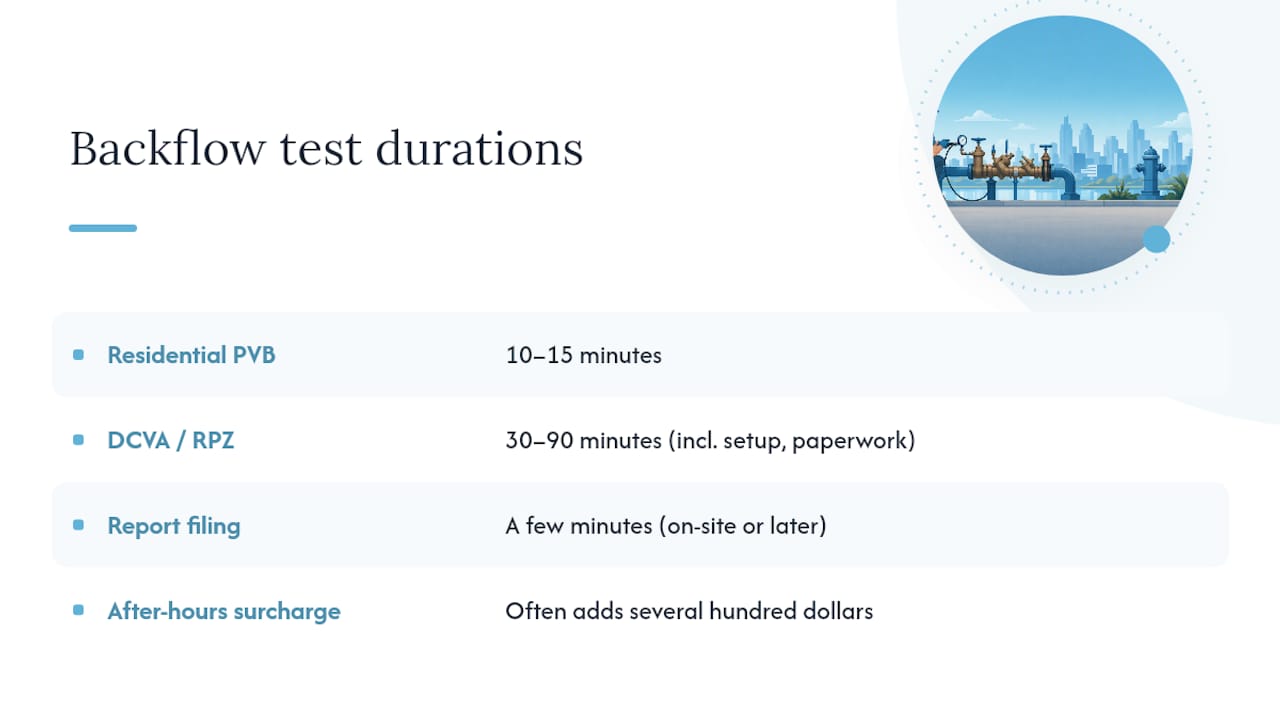
A straightforward residential PVB test usually takes 10 to 15 minutes on site. DCVA and RPZ assemblies run longer, typically 30 to 90 minutes once you include setup, valve isolation, and paperwork. Filing the report with your utility adds a few more minutes, sometimes handled on-site and sometimes submitted later. Scheduling outside normal business hours changes the math fast. Emergency plumber costs run well above standard rates, and that premium applies to after-hours backflow calls too, often adding several hundred dollars to what would otherwise be a routine visit.
Repair or Replace a Failed Backflow Device?
A failed test isn’t automatically bad news. Most failures come down to worn internal parts rather than a device that needs to be torn out entirely.
- Soft-part repairs: O-rings, seats, and rubber components typically run $25 to $275 in parts plus labor, and this fixes the majority of failed tests.
- Full replacement: Runs roughly $300 to $2,000 or more depending on device size and type, with RPZs and detector assemblies at the top of that range.
- The rule of thumb: If repair costs exceed about two thirds of a full replacement, replace the unit instead. You’ll avoid paying twice when a second part fails within a year.
Industry sources note that testing functions as a compliance check-in first, and most failed devices are fixable with minor repairs rather than a full swap. If replacement is on the table, our pipe repair workflow guide walks through what a professional repair job typically involves from quote to completion.
Who Pays for Backflow Testing and Filing?
Property owners, not tenants, are almost always financially responsible for backflow testing, though commercial leases sometimes shift that duty to the tenant in writing. Check your lease before assuming either way. Most municipalities run a cross-connection control program that requires annual testing and charges a filing fee separate from the labor cost. The most important question to ask before you hire anyone: does the tester submit results directly to the water utility, or does that responsibility fall back on you? Skipping this step is one of the most common ways property owners end up out of compliance without realizing it.
How Do You Vet a Certified Backflow Tester?
A cheap quote from an uncertified tester isn’t actually cheap. Utilities won’t accept results from someone who isn’t certified, which means you’d pay for a test that has to be redone.
- Confirm certification. Ask for a state or county backflow tester certificate and proof the test equipment was calibrated within the past year.
- Request an itemized quote. It should list per-device price, filing fee, retest fee if the device fails, and hourly labor rate for repairs.
- Ask about travel fees. Get this in writing before the visit, especially for rural or hard-to-reach properties.
- Watch for red flags. Vague verbal quotes, reluctance to show certification, or “we’ll figure out the price on-site” answers usually signal a noncompliant operation.
Certified technicians are the only ones authorized to sign municipal reports, so a lower bid from an uncertified handyman isn’t actually a bargain if the utility rejects it.
Can You Lower Your Backflow Testing Bill?
You can trim costs without cutting any compliance corners. Bundle every device on your property into one visit, since most testers discount per-device pricing once you’re past the first unit. Ask about multi-year service agreements. Some testers knock a percentage off annual renewals for repeat customers.
- Clear access to test ports and shut off landscaping obstructions before the technician arrives.
- Winterize or drain irrigation lines ahead of scheduled visits to avoid an add-on trip charge.
- Choose experience over the rock-bottom bid when a device is older or has failed before.
Pro Tip: A tester who spends an extra five minutes explaining why a device failed usually saves you money long term by catching small issues before they become $1,000 replacements.
What a Professional Itemized Backflow Quote Looks Like
Psvplumbinginc structures every backflow visit around three things: a certified technician, calibrated gauges, and direct filing with your local water utility once testing wraps up. A trustworthy quote spells out exactly what you’re paying for. It lists the per-device testing price, any travel or service call fee, parts and labor rates if a repair is needed, and clear retest terms if a device fails the first pass.
That transparency matters because backflow compliance isn’t optional, and a vague quote often means a vague understanding of local filing requirements too. For a broader look at how itemized pricing should work across plumbing services generally, our guide on transparent plumbing pricing covers what to expect on any invoice, not just backflow.
What Property Owners Get Wrong About Backflow Pricing
Most guidance on this topic treats backflow testing like a commodity: shop around, take the lowest bid, move on. That advice ignores the one variable that actually protects you, which is whether the tester’s certification is accepted by your water utility. A $60 quote from someone without current certification isn’t a deal. It’s a guaranteed second visit once the utility bounces the report.

The conventional advice also underweights filing. Plenty of property owners assume the test itself is the finish line, then get a compliance notice weeks later because nobody submitted the paperwork. That’s not a pricing problem. It’s a process problem dressed up as one.
If there’s one thing worth prioritizing over price, it’s asking two questions before you book: is this tester certified in my county, and does their quote include filing? Everything else, from repair costs to travel fees, is negotiable. Compliance isn’t. Property managers juggling multiple buildings feel this the most, since one missed filing can cascade into fines across an entire portfolio.
— Serghei
Get a Straightforward Backflow Testing Quote
Psvplumbinginc handles backflow testing the way this guide describes it should work: certified technicians, calibrated equipment, and direct filing with your local water utility so you’re not left tracking down paperwork after the visit.

Every quote from Psvplumbinginc breaks out the per-device price, travel fees, and retest terms up front, so you know exactly what you’re paying for before anyone shows up. If a device fails, the same team can handle the repair or replacement without bringing in a second contractor. Whether you’re managing one property or a small portfolio, request a free quote through our pipe repair workflow page or reach out directly to schedule your next backflow test before your compliance deadline arrives.
Sources
Price bands and device guidance in this article draw on Reliable Fire Protection’s cost analysis, HomeGuide’s pricing data, BackflowRates’ pricing guide, and Snake River Water’s compliance overview. For a direct quote, visit Psvplumbinginc.
- Backflow Test Cost: What U.S. Property Owners Pay in 2026
- Backflow testing cost (HomeGuide)
- Backflow Testing Prices (2025) | Residential & Commercial Cost Guide
- Emergency plumber cost (Forbes)
- The importance of backflow prevention devices
Leave a Reply