TL;DR:
- Many homeowners wrongly assume underground sewer lines are the city’s responsibility, risking costly repairs. The boundary between private and public sewer responsibility is closer to your home than most realize, making early inspection and maintenance essential. Professional camera inspections and timely repairs can prevent extensive damage and save property owners thousands of dollars.
Most homeowners assume that anything underground is the city’s problem. That assumption can cost you thousands of dollars. Sewer line ownership and repair costs often hinge on exactly where private responsibility ends and the city’s begins, and that boundary sits much closer to your house than you might expect. Whether you own a single-family home or manage a commercial property, understanding how your sewer line works, what can go wrong, and who foots the repair bill is one of the smartest things you can do for your property’s long-term health and your wallet.
Table of Contents
- What is a sewer line and how does it work?
- Private vs. public sewer lines: Who is responsible?
- Common sewer line issues and warning signs
- Diagnosing and repairing sewer line problems
- What most property owners miss about sewer lines
- Professional help for sewer line issues and maintenance
- Frequently asked questions
Key Takeaways
| Point | Details |
|---|---|
| Sewer line basics | A sewer line carries wastewater from your property to the city’s main system or a septic tank. |
| Ownership matters | Responsibility for repairs depends on the boundary between private property and municipal lines. |
| Watch for warning signs | Clogs, odors, and soggy yards are early clues your sewer line needs attention. |
| Early diagnosis saves money | Video inspections help find problems before they cause major damage or require expensive digs. |
| Maintenance is key | Routine checks and quick repairs are the best way to avoid big bills and property damage. |
What is a sewer line and how does it work?
A sewer line is not just one pipe. It is an interconnected system of underground pipes that collects wastewater from every drain in your building and moves it away to either a municipal sewer system or a private septic tank. A sewer line is the underground pipe network that carries wastewater from a building to the municipal sewer system or septic. Every time you flush a toilet, run a sink, or drain a bathtub, wastewater travels through this network.
The system works primarily through gravity. Pipes are installed at a slight downward slope so that wastewater flows naturally from the building toward the municipal connection point. There are no pumps involved in most residential systems. The slope, usually about one-quarter inch of drop per foot of pipe, keeps everything moving in the right direction.
Understanding the home plumbing systems within your property helps clarify how the sewer line fits into the bigger picture. Here is a simple breakdown of the main components:
| Component | What it does | Location |
|---|---|---|
| Fixture drain | Collects wastewater from a single appliance (sink, toilet) | Inside the building |
| Branch drain pipe | Connects multiple fixture drains together | Inside the walls/floors |
| Main building drain | Collects all branch drains into one pipe | Inside, at the building’s lowest point |
| Private lateral | Carries wastewater from building to city connection | Underground, on your property |
| Municipal main | The city’s main sewer line | Underground, in the street or easement |
Key facts about how sewer lines operate:
- Wastewater flows by gravity, not pressure
- Vent pipes prevent vacuum lock and allow sewer gases to escape safely through the roof
- Clean-out access points are installed at intervals so plumbers can inspect or clear blockages
- Most residential laterals are four to six inches in diameter
- Sewer lines can be made of cast iron, clay, PVC, or ABS plastic depending on the age of the home
Knowing these basics helps you have more informed conversations with plumbers and understand what you are paying for when repairs come up.
Private vs. public sewer lines: Who is responsible?
This is where many homeowners and property managers make expensive mistakes. The sewer line is divided between privately owned laterals and municipality-owned mains, and those boundaries directly affect who pays for repairs. The distinction sounds simple, but it is not always obvious in practice.
Ownership often hinges on where the private lateral ends and the public sewer main or right-of-way begins. In most jurisdictions, the property owner is responsible for the lateral pipe from the building all the way to the connection point with the city’s main sewer line. That connection is often at the property line, but sometimes it extends into the street.

Here is a comparison of the two types of sewer lines:
| Feature | Private lateral | Public sewer main |
|---|---|---|
| Ownership | Property owner | Municipality or utility |
| Location | On your property (and sometimes beyond) | Street, easement, or public right-of-way |
| Repair cost | Paid by property owner | Paid by the city or utility |
| Maintenance | Owner’s responsibility | City’s responsibility |
| Access for repairs | Property owner arranges | City or utility arranges |
How do you figure out your specific responsibility? Follow these steps:
- Contact your local municipality. Call or visit the public works or water and sewer department. Ask them to confirm where the city’s responsibility starts and where yours ends.
- Review your property records. Some municipalities include sewer easement information in property deeds or survey records.
- Locate your clean-out. The clean-out access point on your property gives you a physical marker for the start of your lateral line.
- Check your homeowner’s insurance. Some policies cover sewer lateral damage; many do not, so verify before you assume coverage.
- Ask about local ordinances. A few cities have shared-repair programs or cost-share agreements for sewer lateral repairs. Knowing about these programs upfront can save significant money.
You can also consult our home plumbing guide to get a clearer picture of how your entire plumbing system connects and where your responsibilities lie as a property owner.
Common sewer line issues and warning signs
Understanding boundaries is just one part. Now, let’s look at what can actually go wrong with your sewer line and how to spot it early.
Sewer line failures rarely announce themselves dramatically. Most problems develop slowly over months or years, making early detection critical for avoiding expensive repairs. Common sewer line issues include clogs and backups, root intrusion, pipe deterioration, and sagging that causes blockages.
Here are the warning signs you should never ignore:
- Slow drains throughout the house. When one drain is slow, it is usually a localized clog. When multiple drains are slow at the same time, it often points to a problem in the main sewer line.
- Recurring drain clogs. If the same drains keep clogging despite clearing them, the issue is likely further down the line.
- Foul odors. Sewer gas smells inside or outside the home signal a crack, gap, or blockage in the sewer system.
- Wet spots or sinkholes in the yard. A leaking sewer line can saturate the soil above it, creating soft, wet patches or even small depressions in the ground.
- Lush, unusually green grass. A patch of grass growing faster and greener than the surrounding area could indicate a sewage leak acting as fertilizer below.
- Backups at floor drains. Water or waste backing up through a floor drain or basement toilet is a strong sign of a blockage or collapse in the main lateral.
The three most common root causes behind these symptoms are:
Aging pipes. Many homes built before the 1980s still have clay or cast-iron sewer pipes. These materials deteriorate over time, crack, and eventually collapse. Clay is especially vulnerable to shifting soil and root intrusion.
Tree root intrusion. Roots seek moisture, and sewer lines are a reliable source. Roots enter through small cracks or joints, then grow inside the pipe, eventually causing severe blockages or pipe collapse. This is one of the most frequently seen problems in older residential neighborhoods.

Pipe bellies or sagging. When soil shifts, sections of a pipe can drop below the slope angle they were installed at. This creates a low spot, called a belly, where waste collects instead of flowing forward, leading to chronic blockages.
Pro Tip: Schedule a sewer line inspection every two to three years if your home is more than 20 years old or if you have mature trees in the yard. This small investment can identify minor issues before they become major repairs. You can learn more about signs of sewer line trouble to stay one step ahead.
“Routine maintenance and early identification of sewer line problems can prevent significant property damage and dramatically reduce repair costs compared to emergency interventions.”
If you also deal with recurring plumbing problem tips around the house, connecting those issues with sewer line symptoms can help you build a more complete picture of your system’s health.
Diagnosing and repairing sewer line problems
If any of these warning signs show up, the next step is diagnosing and addressing the problem efficiently.
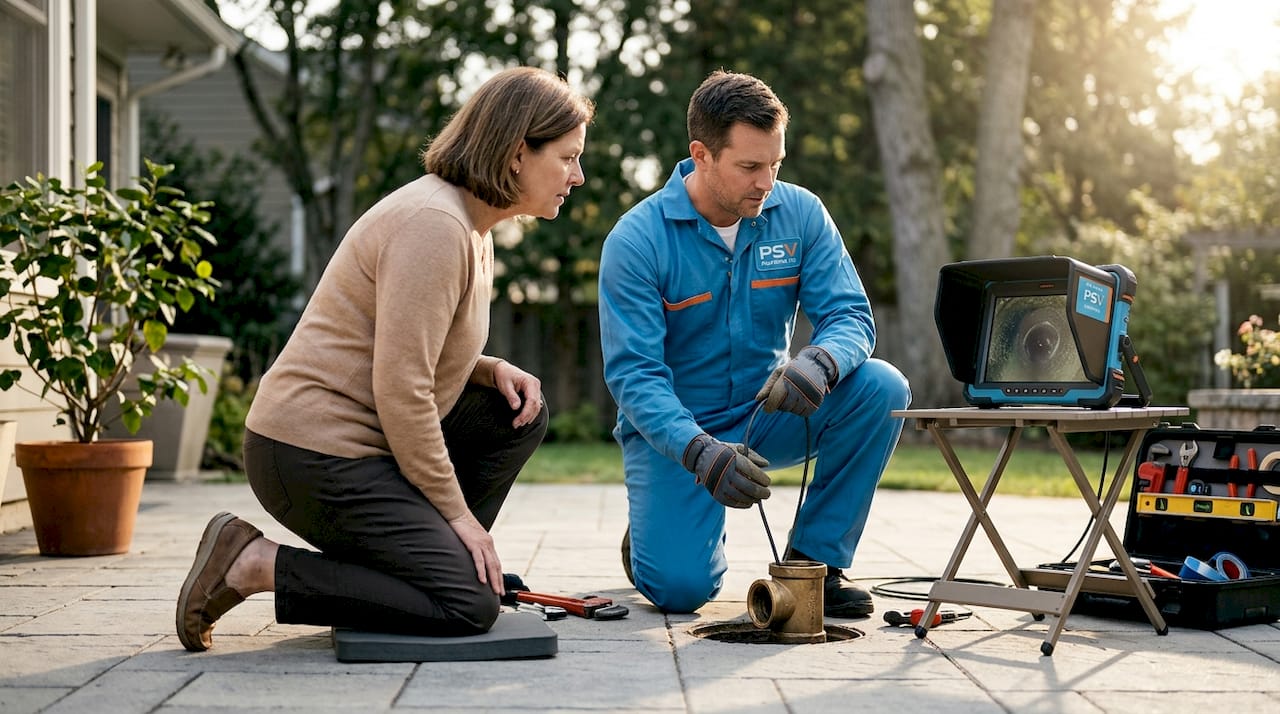
The starting point for any professional sewer line evaluation is a video camera inspection, also called a CCTV inspection. Sewer line repair commonly starts with video inspection to locate the issue precisely, then uses trenchless lining, pipe bursting, or excavation based on the extent and type of damage. Without a camera inspection, a plumber would essentially be guessing at the cause and location of the problem.
Here is a step-by-step overview of how the repair process typically works:
- Initial video inspection. A waterproof camera is fed through the clean-out access into the sewer line. The plumber watches live footage to locate blockages, cracks, root intrusions, or pipe collapse. This footage also serves as documentation for insurance claims or contractor bids.
- Diagnosis and method selection. Based on the inspection findings, the plumber recommends the most appropriate repair method. The choice depends on the type of damage, the pipe’s material, its age, and its location.
- Trenchless pipe lining. For cracks or moderate deterioration, a resin-coated liner is inserted into the existing pipe and inflated. Once cured, it forms a new pipe inside the old one. No digging required. This method is efficient and preserves your landscaping.
- Pipe bursting. When the existing pipe is too damaged for lining, a bursting head is pulled through the old pipe, breaking it apart while simultaneously pulling a new pipe into place. Minimal excavation needed.
- Traditional excavation. For collapsed sections, severely damaged areas, or pipe bellies, the damaged section is dug up and replaced. This method is more disruptive and costly, but sometimes it is the only viable option.
- Post-repair camera verification. A responsible contractor will run the camera again after repairs to confirm the fix is complete and the line flows correctly.
You can explore the full value of professional sewer line inspections to understand what a thorough inspection should include and how to evaluate results.
Pro Tip: Always get at least two quotes for sewer line repairs, and ask each contractor what warranty they provide on both parts and labor. A reputable company will stand behind their work with a clear written warranty. You can also review the benefits of professional pipe repair to know what separates a quality repair from a temporary patch.
When deciding between spot repair and full replacement, consider the pipe’s overall condition. If the camera reveals isolated damage but otherwise sound pipe, a spot repair or lining is a smart, cost-effective choice. If the camera shows widespread deterioration, multiple cracks, or severe sagging throughout the line, replacement is usually more economical in the long run. Reviewing sewer line maintenance steps after any repair can help you establish a routine that extends the life of your new or repaired pipe.
What most property owners miss about sewer lines
We have worked with many homeowners and property managers over the years, and there is a pattern we see repeatedly. People underestimate how much financial risk is tied to not knowing where their sewer responsibility ends. They assume the city handles everything underground, and they find out otherwise only when they receive a bill for thousands of dollars in repairs that the city has no obligation to cover.
The confusion between private and public sewer lines is not just an inconvenience. It is a costly mistake. We have seen property owners delay repairs for weeks, waiting for the city to act, only to discover they were entirely responsible for the damaged section from the start. Checking with your local municipality before any issue arises is not optional, it is essential property management.
Here is another pattern worth addressing. Too many property owners treat sewer maintenance as purely reactive. They do nothing until a clog or backup forces action. But the most expensive repairs we see are the ones that could have been caught much earlier with a simple camera inspection. A homeowner who inspects every two to three years rarely faces the kind of emergency that results in yard excavation or emergency weekend rates.
Real maintenance is not complicated. It means scheduling periodic professional inspections, being thoughtful about what goes down your drains, keeping records of past repairs, and knowing your pipe material so you understand its expected lifespan. A deeper look at your plumbing system overview helps you see how sewer care fits into the larger picture of protecting your property investment. The homeowners who save the most money over time are the ones who treat sewer lines as a system to maintain, not a problem to ignore until it becomes a crisis.
Professional help for sewer line issues and maintenance
With this in mind, taking the next steps for sewer line peace of mind is easier with the right professional support.
At PSV Plumbing Inc, we provide reliable, licensed, and insured sewer line services for both residential and commercial properties. Whether you need to identify sewer line problems before they escalate or want a proven plan to prevent sewer line repairs through regular maintenance, our experienced team is ready to help.

We use camera inspection technology to diagnose issues accurately, and we offer both trenchless and traditional repair methods tailored to your property’s specific needs. Transparent pricing, honest assessments, and quality workmanship are what we bring to every job. Contact our local licensed plumbing experts today for a free quote and let’s keep your sewer line running the way it should.
Frequently asked questions
How do I know if my home has a sewer line problem?
Common signs include slow drains in multiple fixtures, frequent clogs, foul odors inside or outside, or wet patches in the yard. Multiple plumbing symptoms appearing at the same time almost always point to the main sewer line rather than a single fixture.
Where does my responsibility for the sewer line end?
Homeowners are typically responsible for the lateral pipe from their home to the point where it connects to the city’s main line. That boundary varies by municipality, so confirm the exact location with your local public works department.
What is the difference between a drain line and a sewer line?
A drain line carries wastewater from an individual fixture, like a sink or shower, to a larger main pipe. The sewer line then transports all that combined wastewater out of the property and into the municipal system or septic tank.
Can sewer line repairs be done without digging up my yard?
Yes, in many cases. Trenchless methods like pipe lining and pipe bursting can fix damaged sewer lines with minimal or no excavation, provided the pipe’s condition allows for these techniques.
Leave a Reply